













|
||||
 |
 |
|||

WELCOME
|
||||||||||||||||||||||||||||||||||||||||||||||||||||||||||||||||||||||||||||||||||||||||||||||||||||||||||||||||||||||||||||||||||||||||||||||||||||||||||||||||||||||||||||||||||||||||||||||||||||||||||||||||||||||||||||||||||||||||||||||||||||||||||||||||||||||||||||||||||||||||||||||
| " ‘Freudian psychoanalysis’ is the ontogeny,
‘Schicksalanalyse’ the genealogy, and Jung's
‘Analytical psychology’, the archaeology of the deep
mental processes." L. Szondi. |
December 23, 2019 Stockholm
Dear reader of Szondi Forum!
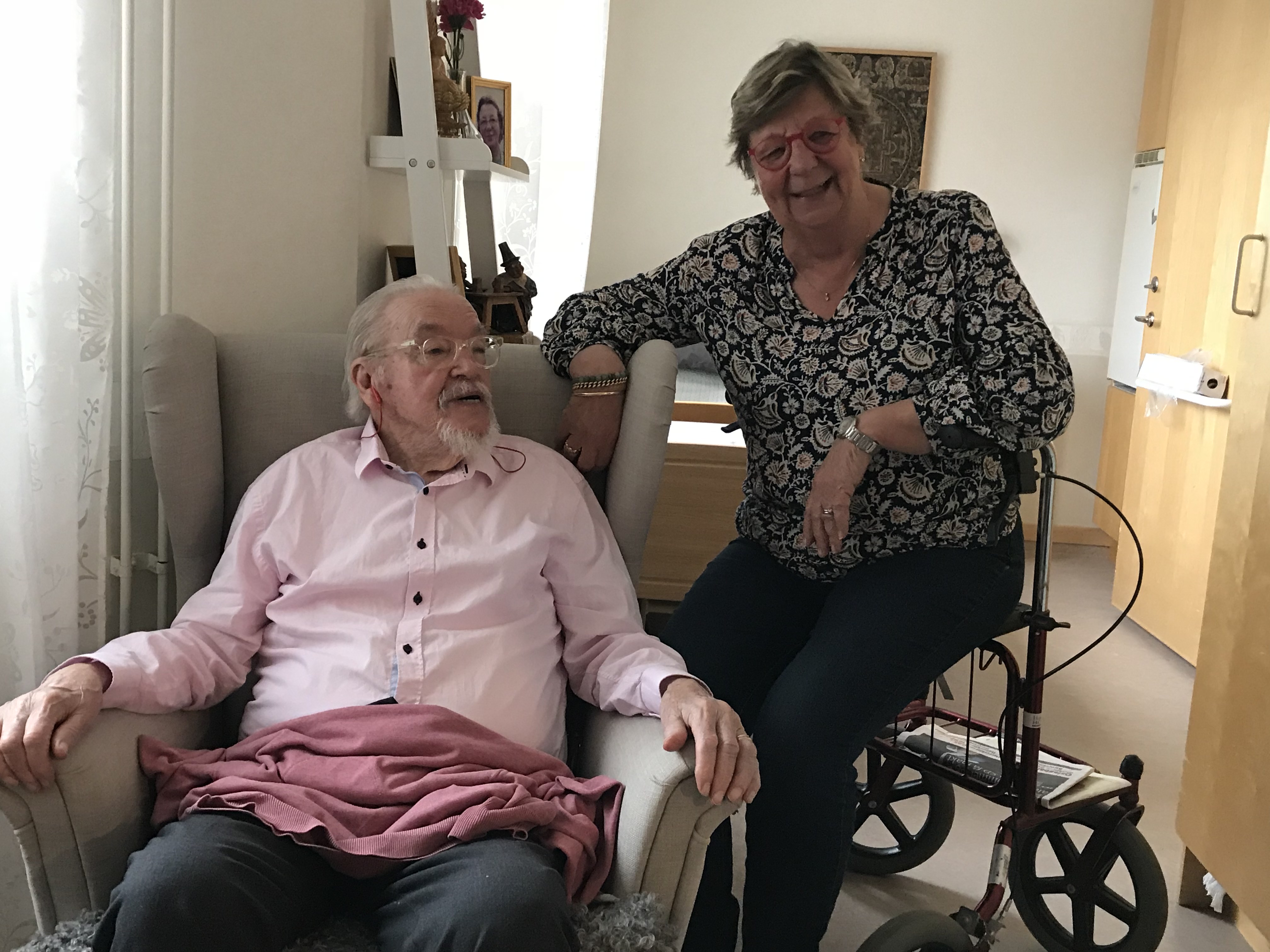
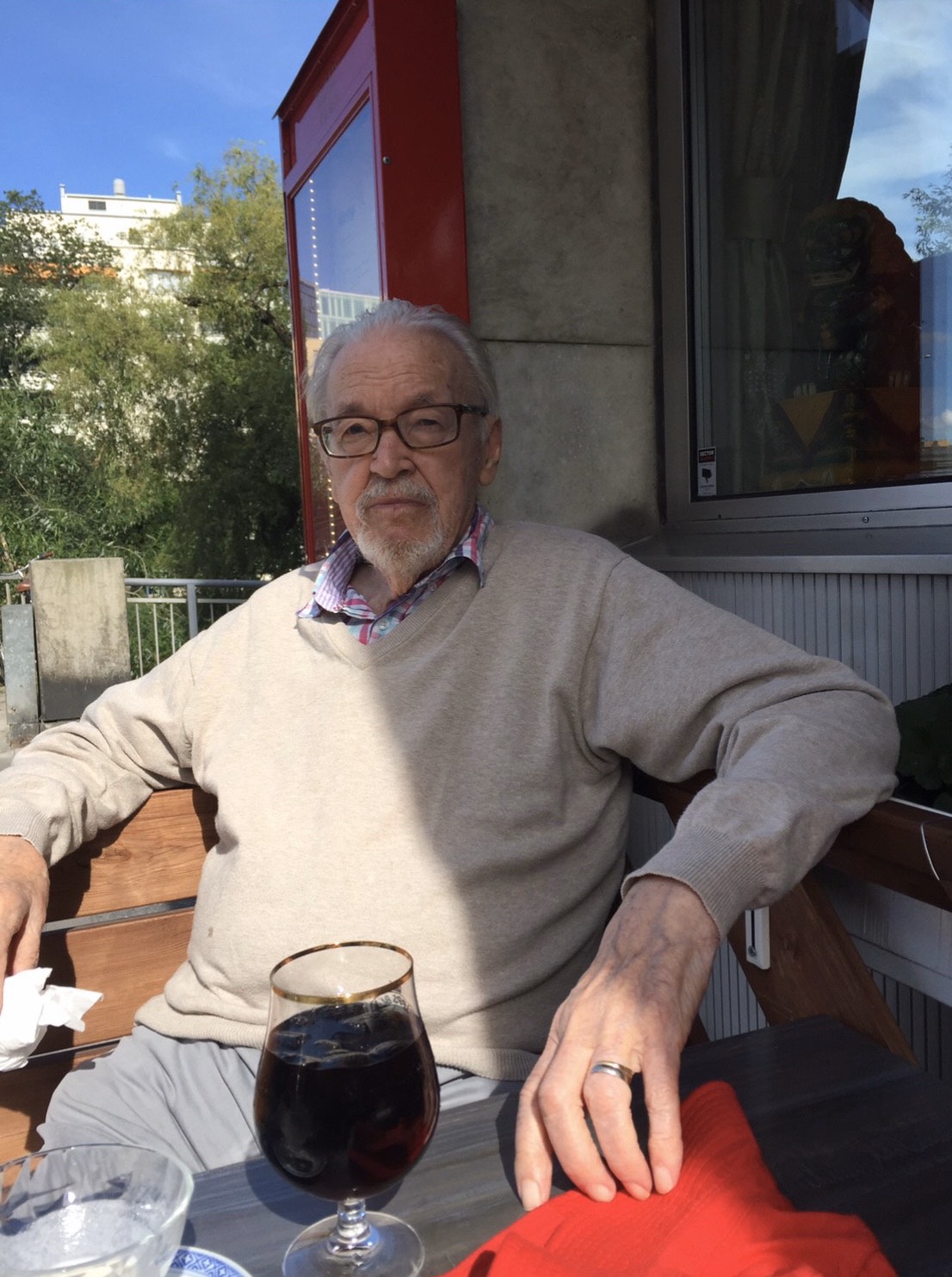
In a couple of days the Founder of Szondi Forum Leo Berlips is 100 year. In more than 70 years Szondi theory and test has been very important to him and has given him great meaning and many good friends all over the the world.
He wish you all the best and a Happy New Year!
December 23, 2013 Stockholm
Dear Szondi friends,
Merry Christmas and a Happy New Year!
Joyeux Noel et Bon Nouvelle Annee!
Felices Navidades y Prospero Ano Nuevo!
Que tengas un buen Natal y un ano lleno de realizaciones!
S Novym Godom i S Rozhdestvom Hristovym!
June 25, 2013 Stockholm / Russian Section of the Szondi Forum
Dear Szondi friends,
In the first place it is really a pleasure for me to inform you about two excellent pieces of good news.
The first one is the celebration of the birthday of the Sponsor of the Szondi Forum, my wife Gunnel Berlips who celebrated her 70th birthday May 26 of this year. Since the opening of our site, more than 15 years ago, she accepted without protest the many hours I worked collecting, writing, publishing, and regulating its content. Still more important for us was the fact that she became our Sponsor, i.c. financially took care for all expenses I had to pay.
The second event has to do with Slavick Sjibajev, our generous web provider. He, together with his wife Oksana, right from the beginning took care of the publication of our Szondi Newsletter and without any salary for the regular running of our website. For me it was therefore quite a pleasure when I learned, some days ago, that he at last got a first class job and became employed by a big American Firm as a data specialist. This means that he will be paid in dollars instead of in Ukrainian valuta, a very great positive improvement for him.
The way I got informed about his new work was quite surprising. My son Jens was in San Francisco on a business trip and learned unexpectedly (by facebook) that at the same time Slavick also was in San Francisco. They met and he heard personally from Slavick about his new employment. Since the beginning of the Szondi Forum, ca 15 years ago, I had continuous contact with Slavick. In this way I was witness to his difficult and continuous struggle to combine his “day by day” work with his higher studies. This meant for him often 15 to 16 hours working and studying every day.
By my own experience I knew what this meant, as well as for will power as for endurance and sacrifices. Therefore I followed his development with great interest and admiration.
I was really very happy to hear from my son that Slavick at last got a job that corresponded to his qualities. Therefore in name of all the readers of the Forum I wish him the best of luck in his new job. Personally I hope he and his wife will visit me some day in Stockholm so that we at last can meet personally!
As for the content of this new Szondi newsletter I am again very happy with the great contributions of Prof. Arthur C. Johnston.
By way of our correspondence I knew that Arthur the last months has concentrated himself in the deeper aspects of Szondi’s philosophy. He made a new English translation of Szondi's "The Ego and the Dream" from Szondi’s book "Ego Analysis." In his "The Ego and the Dream" Szondi continue his exploration of the world beyond reality. He has covered the mad in his previous chapter "The Ego and Delusion," which was presented in the last Szondi Forum.
The new translation of "The Ego and the Dream" gives still more insight into Szondi's thinking behind his whole endeavors to explore the human mind and its relation to the material world. Moreover he reveals in his work how much C. G. Jung's ideas have influenced his thinking in as great a measure as S. Freud's. Szondi also distinguishes how the dream can be interpreted in the Freudian retrospective (looking back for causal-materialist elements) versus the prospective (looking forward using the final-idealistic ideas of Jung, Silberer, and Maeder).
And Szondi stresses his key ideas of participation, integration, and transcendence too. Moreover he presents fully detailed the role of the background ego and other background elements in the dream versus the foreground ego of the awake ego. Equally, Szondi explores the roles of the personal-repressed unconscious, the familial unconscious, and the collective unconscious in dreams.
I am sure that Prof. Johnston’s great new translation will be very valuable for all of you who want to understand better Szondi’s deepest thoughts. [See “Szondi V- The Ego and the Dream,” a PDF, in Attachments.]
Another part of this newsletter is the presentation of Richard Hughes, Professor in Theology, with the title: "The Protest by Fire.” This article presents a fascinating look at the role of fire in the turbulent times of the 1960s. Professor Hughes himself was an active participant in the civil rights movement during the dangerous Mississippi events where there was the danger of being killed. The movie “Mississippi Burning” gave a depiction of this period.
This article will interest those, too, who have an interest in epilepsy and its different manifestations. Professor Hughes also takes a counter view to S. Freud’s interpretation of the symbolic meaning of fire.
Professor Hughes can be counted to belong to those followers of Szondi who strictly keep to Szondi's original approach to depth psychology based on his "gene theory." In this connection you may be interested to learn that a few weeks ago the Swedish Newspaper Dagens Nyheter published a short article with the title: “Blame the Education Level on the Genes.” This article reports how an international collaborative project, in which all Swedish twins’ records were included, has now been able to establish that even their potential educational level is genetic!
Finally, I’m sure you all will appreciate this fine contribution of Professor Hughes to the Szondi Forum. [See “The Protest of Fire,” a PDF, in Attachments.]
On another important topic: As most of you know already the publication of the Szondi Institute’s “Szondiana” has been the past year transferred to the Internet. The ISA and editorial policy will aim at broader scientific recognition (APA) and become digital.
Dr. Robert Maebe describes this in the following way: “Dear reader, cher lecteur,
On behalf of the direction of the ISA we send you our best wishes for 2013. The year 2012 was special for the ISA since -- in agreement with the Szondi Institute -- a greater autonomy for the ISA was decided. Editing the Szondiana has also been transferred to ISA with a modified editorial policy addressing a broader scientific recognition according to APA standards and turning from paper print to digital in order to reduce costs.
The ISA will need more than ever your membership and active participation for the future of Schicksalsanalysis and the related orientations. And you will need a membership to access the latest edition of Szondiana.
2014 will be a special congress year (XXth edition), happening in Brussels. So, follow the news we will release from 2013 on to prepare for the great Szondi event in Brussels.
Dr. Roberts encouraging word which herewith follows are likewise of value for our readers. He writes:
“Since our small community is spread around the world we intend to create a digital Szondi contact news to keep you and us better informed. In that order we ask you to provide us and our community once a year an update of your Szondi related activities (membership of groups, seminars, teaching, publications of the year).
Au nom de la direction de la SIS nous vous présentons nos meilleurs vœux pour 2013.
L'année 2012 a été particulière pour la SIS depuis la décision en accord avec l'Institut Szondi de lui accorder une plus grande autonomie la SIS. La publication de Szondiana a également été transférée à la SIS avec une politique éditoriale modifiée s'adressant à un plus large reconnaissance scientifique selon les normes de l'APA et en passant de l'imprimé au numérique pour réduire les coûts.
L'ISA aura plus que jamais besoin de votre adhésion et de votre participation active pour l'avenir de Schicksalsanalyse et ses orientations connexes. Et vous, vous aurez besoin d'un abonnement pour accéder aux nouvelles éditions de Szondiana.
2014 sera une année spéciale puisque l'année du congrès (XXème édition), qui se fera à Bruxelles. Alors, suivez les nouvelles que nous publierons à partir de 2013 en vue du grand événement Szondi à Bruxelles.
Comme notre petite communauté est dispersée partout dans le monde nous avons l'intention de créer un bulletin de contact szondien numérique pour vous atteindre et vous informer. Dans cette perspective, nous vous demandons de nous fournir et à notre communauté szondienne chaque année une mise à jour de vos activités Szondi (appartenance à des groupes, séminaires, enseignement, publications de l'année).
Robert Maebe, M.D., president ISA / SIS ISA / ISG / SIS- >http://www.szondi.pte.hu/links.html<
Devenir membre / Membership
info@szondi.ch
STIFTUNG SZONDI INSTITUT Krähbuhlstrasse 30
CH-8044 Zürich
100 CHF / year - an IBAN: CH1200206206P03613120 BIC-code: UBSWCHZH80A Bank: UBS AG CH 8098 Zürich
As most of you already know you may find more, and really very extended, interesting and important, information on the Internet on the Site: Szondi Schicksalsanalyse CEP Pathoanalyse -- Scarlet home. scarlet.be/cep/ that mainly presents articles and videos presenting another application of Szondi’s theory with the name of “Pathoanalysis (Anthropopsychiatry.) It is our sister’s Szondi site of which Dr. Robert Maebe is the Editor. However this site publishes mainly articles and videos in French -- An example of this is e.g.:
Dear Szondi friend, I just discovered that the book "Dialectique des pulsions" 3me éd. De Boeck, 1990 can be read on a site by Daniel Vernant! [http://dvsitesz.com/blog/files/c2892e0b8c62d422cd976ebb98742852-9.html]
(Chère szondienne, Je viens de découvrir que le livre est disponible en ligne sur un site dirigé par Daniel Vernant ! Bien à vous.
THE NEXT SZONDI CONGRESS WILL BE NEXT YEAR. WE WILL KEEP YOU INFORMED.
I would like to finish this Introduction with a General Call to friends of KARL LOUVET and let him know that many of our readers would greatly appreciate it if he starts again publishing his excellent and original articles!
CHÈR KARL LOUVET beacoup de nos lecteurs attandent d`avoir le plaisir et l` inspiration de lire votre article. ON VOUS ATTEND!. Votre ami Leo Berlips.
For you who don’t know Karl Louvet it might be interesting to read the information I once wrote about him. EXTRACT: (In the www.szondiforum.org, 1 April 2002)
In contrast with the difficulties which some of you might have to accept Karl's theoretical reasoning he illustrates his conclusions with concrete examples in a very picturesque way. As a former test psychologist, who in the sixties and seventies often had to interpret test results of people living in other parts of Sweden by a blind diagnostic, I myself really enjoyed to read Louvet's subtle interpretations when he applied the Circuit theory to the individual “Factor” and “Vector” positions (I think that his example of "Obsession" ( in the article I referred to) can be used with success in teaching the Szondi Test. (As Karl informed me: the method he used to interpret the instinctual positions is a heritage of Jean Mélon and Daniel Vernant.)
Your Editor Leo Berlips
Attachments:
Protest by Fire.pdf
Szondi V- The Ego and the Dream.pdf
..............................................................................
Leo Berlips, Editor: leo@berlips.com
Prof. A.C. Johnston. Co-Editor: acjohns2@verizon.net
January 2013 / Russian Section of the Szondi Forum
Dear Readers,
We , who make the Szondi Forum: Mrs. B. Berlips, Sponsor; Prof. A. C. Johnston, Co-Editor; Net providers Slavick and Oksana Sjibajev and I your Editor Leo Berlips, hope the NEW YEAR will bring you SUCCESS, HEALTH, and PROSPERITY.
We Hope Your Dreams Come True.
It feels this time extra happy for me to start writing a preview. The reason for this is that this time it contains not less than three important contributions. 1. A detailed analysis of the Ego forms and delusion as presented in the English translation of Prof. Johnston; 2 An introduction of a new book written by Dr. Friedjung Jüttner; 3. An original and new view on the death of the famous painter Vincent van Gogh presented by Richard Hughes.
Part 1.
We are again proud to publish Prof. A. C. Johnston’s latest translation. It concerns one of the most difficult parts in Szondi literature. The best way to illustrate this is Prof. Johnston’s own words when he wrote me about the translation difficulties. He wrote:
Dear Leo,
Fortunately, I just finished up my work on the new Szondi translation "The Ego and Delusion." This was the most difficult translation I've done because of the content and the complexity of the chapter: many repetitions of Szondi Ego forms, charts, illustrations, etc. The part on phenomenology, or existentialism, was especially difficult. I had to round up a batch of books I had on the subject plus a few from Amazon.com to understand the ideas and get the right English words. And I had to look up lots of the specialized words on insanity and delusions.
But I do think this is a very significant chapter for it gives lots of details on the different ego forms. Although the comments are all about the mad, these ideas can also apply to some normal reactions of people who form delusions on certain subjects.
And best of all toward the end of the chapter, Szondi explains clearly his idea that participation is the drive that is the heart of his thinking on human nature and mental illness.
I avoided this chapter as it is focused on mental illness and I am more interested in Szondi's ideas as they apply to normal persons who are not in mental institutions.
Anyway, this is a significant chapter revealing Szondi's ideas in great detail and clarity.
The end of Prof. Johnston’s message speaks for itself, so I can only herewith express again our deep appreciation for this new and difficult translation Prof. Johnston did make for us. Truthfully, if I had not him at my side as a co–editor and regular contributor to the Forum, I am not sure that I would have continued with publishing the Forum. His personal correspondence with me is, moreover, always enriching and stimulating. His extended knowledge, new insights, and original viewpoints remind me often of authors from the Renaissance period.
What many of you probably do not know yet is that he also is a well-known graphologist. He was just honored with the title “The Graphoanalyst of the year” in America by the International Graphoanalyst Society (IGAS).This knowledge gives him a possibility, if necessary, to compare and interpret results of the Szondi test with the results of a graphological examination.
This new translation can be of great use for all of us who are interested to get a deeper theoretical insight in the functions of the Ego forms. [See the PDF attachment “Szondi IV-The Ego and Delusion.”]
Part 2:
In the second place we publish herewith the publishing of a new and excellent German book about Szondi’s “Fate Analysis.” It is written by Dr. Friedjung Jüttner, who is an outstanding representative of the Szondi Institute. The title of his book is: Nimm Dein Schicksal in die eigene Hand [Decide Your Own Fate]. When I started reading it I really became enthusiastic by the content and presentation of this relative short book of 144 pages. Each page is loaded with essential and concentrated information. It contains a short and brilliant description of depth psychology, famous psychiatrists, defense mechanisms, Fate Analysis, etc. (See Contents.) Moreover it contains several short, practical and easy instructions to do personal exercises. In this book Jüttner presented also in a few sentences the ultimate essence of Szondi’s need system. [See “Juettner - Need Names - German” and “Juettner - Need Names - English” and “Juettner Book Announcement” as attachments]
Part 3:
Number 3 of our news concerns a contribution of Prof. Richard Hughes, Prof. in Religion. He belongs to one of the first to be enthusiastic collaborators of our Szondi News. He also was one of the first who wrote a popular book about Fate Analysis Return of the Ancestor -- A big part of which we gave a first place when we presented the Szondi Forum. Just last year he presented the letters between him and Szondi over the years concerning important ideas of Szondi that Hughes put in his many publications. [See May 4 2012 Szondi Forum Newsletter.]
This time he sent me an original article about his conclusions that Vincent van Gogh, the famous but tragic Belgium/Dutch painter, did not commit suicide as a schizophrenic or epileptic but died in an entirely different manner. He illustrates this by summing up the characteristics of his family background and epilepsy as part of his mental illness that traditionally led to his taking his own life.
We are proud that he decided to publish this new, and for many Van Gogh scholars, a surprising and unexpected viewpoint article on our Forum. I expect that many art specialists will be very interested in this article. Therefore I suggest that you take up contact with the nearest Art museum and refer to this rather for them sensational news. I am sure these contacts will be very grateful for your information. [See attachment “Richard Hughes Article on Van Gogh”]
Herewith I have come to the end of this first 2013 Newsletter and hope you find it worthwhile to read. Professor Arthur C. Johnston and I wish you a further successful 2013.
Your Editor Leo Berlips
Attachments:
Juettner - Need Names - German.pdf
Juettner Book Announcement.pdf
Juettner- Need Names - English.pdf
Richard Hughes Van Gogh Article).pdf
Szondi IV-The Ego and Delusion.pdf
..............................................................................
Leo Berlips, Editor: leo@berlips.com
Prof. A.C. Johnston. Co-Editor: acjohns2@verizon.net
October 15, 2012 / Russian Section of the Szondi Forum
Dear Szondi Friends,
The positive news in this newsletter is the fact that we again may present a very valuable contribution by Prof. Arthur Johnston. He succeeded to translate still another part of Szondi’s book Ich-Analyse [Ego Analysis] (1956): “The Ego and Character: The Character Formation Function of the Ego.” (See PDF “Ego and Character by Szondi” as an attachment.) For those of you who cannot read German or French Prof. Johnston makes it possible to get deeper and into more detail about Szondi’s ideas. Also included on this same topic are Gertrude Aull’s chapters on character in her English translation of Szondi’s “Experimental Diagnostics of Drives” (1952). (See PDF “Ego Diagnostics Character.”)
Many professionals consider his Ich-Analyse as Szondi’s most important work. Interesting was also that the great Rorschach specialist Ewald Bohm pointed out to me ( beginning sixties) that in those days the so- called “pure Neuroses” for a great part were replaced by “Ego disturbances.” Up till then the psychoanalytical standard work had been Otto Fenichel’s well-know book: “Psychoanalytic Theory of Neurosis” (1945). However in my opinion Szondi with his Ich-Analyse (1956) opened the best theoretical introduction to these Ego disturbances.
With Prof. Johnston’s new translation from this book and with Aull’s detailed explanations on the relationships of the Drive Categories and the Drive Formulas to one’s character, we are proud that we can give our readers still more extended and important information in this field. Szondi´s ideas presented in this area were further developed by Prof. Jacques Schotte and his collaborators, e. g. Jean Mélon. (See Bob Maebe’s web site: http://home.scarlet.be/cep.) These new insights they called pathoanalysis.
This new Forum news reminds me of the time the Szondi Forum was created in 1995. Neither the two professionals – Bob Maebe and Dr. Friedjung Juettner – who supported my suggestion to start a Szondi Forum, nor I, would expect the enormous extent of interest and information it would, until this time, present: The number of visitors up till now is not less than 313,000.
The last years Prof. Arthur Johnston’s valuable contributions became more and more the largest parts of the content in our Szondi Newsletter. It might be worthwhile to stress that his large contributions and translations were provided all FREE OF CHARGE! So I am sure that I also speak – and this time again – in your name when I herewith thank him for his generous contributions.
To finish this foreword I would like to recommend a very short and easy- to-use personality test. The Myers-Briggs Type Indicator (MBTI) (See web site Wikipedia.) The MBTI is especially useful for those who are employed by profit-making corporations. The MBTI takes less than 15 minutes to apply. It has the great advantage that it, in contrast to projective methods, presents easy to understand and non-problematic information.
To give an answer to the question why I refer to this test I have to return fifty years to the beginning of the sixties. In these days I started working the next 15 years as a “Selection Specialist.” My job was concentrated on finding out if people who were looking for specific jobs were qualified. Our firm worked in different West European countries. In those days I had an extended knowledge of languages and moreover was a specialist in interpretation of Projective tests. So during many years I had to work in other countries. Airfield Schiphol, near Amsterdam, was the main interconnection with Belgium, Germany, France, and Switzerland. (Thanks to this location I could start in the afternoon my flight to Schiphol and in the evening visit my parents). In contrast to this happy fact I generally only got only about one and a half hour (!) to screen each aspirant.
In those days I just had started to study Szondi´s works and had become one of his most enthusiastic advocates. However, to my great disappointment, due to lack of time, I could not use his test in my work. Instead I had to make the best out of the situation. I composed a short test battery with the following short projective tests: The main personality test I used the “Zulliger test,” an abbreviated Rorschach test, which took at most approximately 20 minutes. Moreover I used the Lüscher color test that took even less time. (Unfortunately I learned first more than 50 years later by studying Prof. Borg’s books to apply the Lüscher test in connection with Szondi’s “Hintergrund” [background] principle). These two tests I completed with two drawing tests: “The Tree Test” and “Draw a Picture.” Moreover I used some figure interpretation (aptitude and formal tests). Based on these tests I could make useful and successful interpretations for my employers.
The results of projective tests indicate generally in the first place deviations from the normal. (The theoretical origin of the showing up of just the negative traits I found in Freud’s article: “Die Zersetzung der Persönlichkeit” (1936). In this article Freud published his so-called “Crystal Theory.”) In casu that the main information about the personality are given by a person’s deviations from the normal. This explains why most psychologists generally would have great difficulties to inform and to confront the client with his or her negative traits. In such a situation the MBTI is an excellent instrument to give the testee some generally easy-to-accept information.
In case you have a very complicated test result with many negative conclusions it may be acceptable, useful and, in my opinion, ethical to report only the results of the relative innocent MBTI. In case you find it theoretical acceptable you might give him as much bitter medicine as you find necessary.
Dear Friends. I wonder sometimes, having been born in 1919, how many new introductions to the Szondi Forum I may publish. At present I take gymnastics three times a week. I hope that this will contribute to my writing some more introductions to the Forum.
Kind regards from your Editor and Co-Editor, Prof. Arthur C. Johnston.
Attachments:
Ego and Character by Szondi.pdf
Exp Diagnostics Character.pdf
..............................................................................
Leo Berlips, Editor: leo@berlips.com
Prof. A.C. Johnston. Co-Editor: acjohns2@verizon.net
May 4, 2012 / Russian Section of the Szondi Forum
Dear Szondi friends,
In the first place we, Professor Arthur C. Johnston and I, hope that you and your family had a pleasant Easter and beginning of spring. I expect that this Szondi letter will contain a great surprise for all of you.
In poetical Japanese I would give this Szondi Forum the title: "Spring Presentation of Two Jewels."
1. One of the reasons for such a poetic title is the publication herewith of a splendid introduction to Szondi’s ideas by Prof. Arthur C. Johnston. The title is: SZONDI TEST AND ITS INTEPRETATION: 2012. [See Attachment: The Szondi Test – 2012.]
Without any doubt this book of 100 pages is in my eyes a splendid introduction to the classic ideas of Szondi. It ought to be read by all students in Psychiatry and Psychology.
2. The next interesting and valuable surprise (Jewel 2) has great historic value. It can be published (and is truly a gift to the Szondi movement) thanks to the generosity of Richard Hughes. [See Attachment: Hughes-Szondi letters article.]
Prof. Hughes allows us to publish his correspondence with Szondi over many years. This has great historical value, and I feel proud that one of my last contributions to the Szondi Forum has achieved such a high standard. The copy of this correspondence, together with Prof. Arthur C. Johnston’s description of Szondi's work, make this newsletter in my eyes one of the most important and enlightening events ever published before on the Szondi Forum!
Before I finish I want to thank my friend (Co-editor) Prof. Johnston for his great generosity translating for us and the Szondi Forum so many valuable articles and books. For me this new contribution is a highpoint in the history of the Szondi Form. [Prof. Johnston’s collected works are now also on the Anthropopsychiatry web site http://home.scarlet.be/cep under the title Nouvelles Archives du CEP and then Navigatie Translations by Arthur C. Johnston.]
It makes me very happy to publish herewith two such high quality contributions while gradually coming to the end of my work (expecting to become 93 this year).
I am sure I speak in the name of the Szondi movement (professionals and interested readers) that we hope that Prof. Johnston can continue with his eminent contributions.
At the same time this reminds me of the great work done by our technical staff and the important contributions by my own family. The technicians are our two (Ukraine) computer specialists: Slavic Sjibajev and his wife Oksana: they have since the beginning of my publication of the Szondi Forum in 1995 assisted me by transforming Szondi text into web material for the Szondi Forum. ALL this work was done by them "Free of Charge"! Since the beginning of our collaboration, I have with great respect followed the development of Slavick. He succeeded, after many years working during the day and studying during the evening, to become a highly qualified specialist. Thanks to his studies he works at present as an adviser for a USA firm. I am sure I speak for all of you when I thank them both for their assistance and wish them the best of luck!
As for my family I have in the first place to thank my wife Gunnel Berlips, who had the patience to stand the many hours I spent working with the Forum. Moreover it was she who sponsored the Forum, right from the start, by way of her firm "Motivations Analysis.”
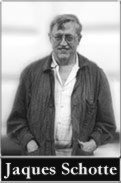
Talking about my family I am proud to mention that my sons, the oldest John Patrick (at present a physician and business man) and Jens-Leo (Technical electrical engineer and business man) set up the Forum as a web site when they were only fourteen and sixteen. It is no surprise that they at present are leaders of a great Internet project to distribute medicine in Sweden. Before finishing this newsletter, I have would like to remind you of the great contributions made by Prof. Jaques Schotte, under many years Sondi's main assistant. Schotte and his fellows started a new development of Szondi’s ideas, originally called "Pathoanalysis." The name is now called “Anthropopsychiatry.” On our Forum you can find already basic information when you press his picture on top of the Forum. Dr. Robert Maebe’s website http://home.scarlet.be/cep presents total information about the work of Schotte and his followers. Referring to Schotte reminds me how by self-study I learned about Szondi around the end of the fifties. My translation and introduction in Swedish of a part of his work at that time allowed me in the beginning of the sixties to be present and accepted by those, to me, Olympian giants in Psychiatry and Philosophy. My main aim in starting this Forum in 1996 was to express my gratitude to them. Somehow meeting them gave me the self-confidence to start with university courses. To finish this 2012 Szondi Forum newsletter, we all four, Prof. Johnston, Slavick and Oksana and I, wish you all a Happy spring 2012 when "Quand tout renaît à l'espérance, Et que l'hiver fuit loin de nous” (When everything is reborn with hope, And winter flees far from us).Attachments:
Hughes-Szondi letters article.pdf
The Szondi Test - 2012.pdf
..............................................................................
Leo Berlips, Editor: leo@berlips.com
Prof. A.C. Johnston. Co-Editor: acjohns2@verizon.net
January 24 2012 / Russian Section of the Szondi Forum
Dear Friends,
In the first place we, Prof. Arthur C. Johnston and I, thank you for your New Year wishes and hope you and your families have a successful and happy continuation of 2012. Moreover I thank you for your kind birthday messages.
I feel happy that my original goal in 1996 to set up a Szondi information site became successful. Since then the Forum has published many articles in several languages, since recently also in Russian.
The quality of our Forum improved immensely when Prof. Arthur C. Johnston became a highly appreciated collaborator as a Co-Editor. The quality of the English text and content improved clearly. He succeeded since then to translate many important Szondi articles, from French and German. Moreover he did publish much of his own work, of which the book Narcissism and D. G. Rossette’s The House of Life was the most important one.
However I feel especially proud to publish this January 2012 a splendid great translation by him. He presents thereby as, in my opinion the Crown Jewel of the Forum, an impressive successful translation of a good portion of Szondi's masterwork Ich-Analyse. Not only that he made a perfect translation, but he succeeded moreover to present important explanations and commentaries to his translation. [See attachment PDFs labeled I. Ego Analysis and II. Szondi Ego Defenses and Sublimination.]
As a complement to Szondi’s masterwork are included excerpts from an English translation by Gertrude Aull of his early edition of Experimental Diagnostics of Drives. [See attachment.]
As it is my intention, due to my age (The end of December I became 92) to reduce my contributions to the Forum, Johnston's impressive translation gives me a chance to make an honorable full retreat. However I still will continue to take the juridical responsibility of the Forums’ Internet publications of the forum. Instead I will take the time to read important Buddhist literature.
As most of you might already know Szondi's main assistant, Prof. Jacques Schotte, developed Fate Analysis in many ways. His followers publish a successful and valuable internet site, represented by their secretary Psychiatrist Robert Maebe: Pathoanalytical site http://home.scarlet.be/cep , However most of the articles there are written in French. For example, here is the latest:
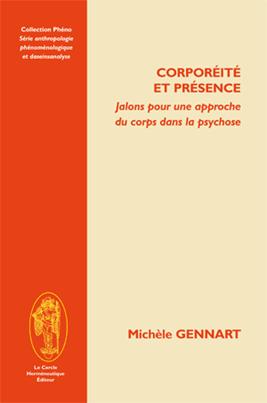
(See the attachment “French Book News” for information on this book and how to obtain it.)
Following are a list of the French titles available at http://home.scarlet.be/cep/CAHIERS/cahier.htm on the pathoanalysis web site:
> Bibliothèque de Pathoanalyse (éd. De Boeck Université)
> Logique de l'inconscient, Lacan ou la raison d'une clinique, Christian Fierens
> Introduction au test de Szondi, Susan K. Deri
> Psychodrame et psychanalyse, jeux et théâtres de l'âme, Bernard Robinson
> Passage à l'acte, éd. Paul Jonckheere
> Freud et la question des origines, Lina Balestriere
> Henrik Ibsen et le problème de l'autoréalisation, Ludwig Binswanger
> Anthropies, prolégomènes à une anthropologie clinique, Regnier Pirard
> Dialectique des pulsions, Lekeuche Philippe, Jean Mélon
> Szondi avec Freud, J. Schotte
> Le contact, éd. Jacques Schotte
>
> Cahiers des Archives Szondi, Louvain-la-Neuve, Cabay,
> KINABLE, J., Abords de la psychopathie
> SCHOTTE, e.a., Le moi en procès
> MELON, e.a., Destins de Stael, Dostoievski, Gericault, Nietzsche, Rimbaud
> MELON, e.a., Recherches théoricocliniques en analyse du destin ; contributions au colloque de Zürich 1984
>
> Andere
> MELON, J., Théorie et pratique du Szondi, Ulg 1995
> DERLEYN, P., Manuel théorique et pratique du Szondi, Hayez, Bruxelles, 2008
On Maebe’s site you also will find a successful Szondi calculation program by which one can save much valuable time when planning to interpret the Szondi test.
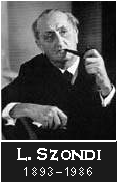
You will also find on the pathoanalysis site a series of valuable lectures in French (auditory and visual) made by Jacques Schotte. In case you want to get a rapid survey of Schotte's ideas -- in English -- just press his picture in the upper right hand corner when you open the Forum, You can do the same in case you want you to get a short survey of Szondi's ideas. (Just press Szondi's picture on the upper left hand corner and the text appears.)
And finally for our Russian friends, Vladimir Djos on the Russian Section of the Szondi Forum has added as PDF attachments the Russian translations of his articles that appeared in English in the last newsletter.
Attachments:
I. Ego Analysis.pdf
II. Szondi Ego Defenses and Sublimination.pdf
Experimental Ego Analysis.pdf
French book news.pdf
..............................................................................
Leo Berlips, Editor: leo@berlips.com
Prof. A.C. Johnston. Co-Editor: acjohns2@verizon.net
October 15 2011
Dear Readers,
There are two themes for this newsletter: (1) Introduction to Vladimir Dzhos (also Djos and Jos in English), a Russian who is the Editor of the new Russian Section of the Szondi Forum, and the English versions of some of his Russian articles and his Szondi-like test on criminality; and (2) the theme of “Destiny and Fate” that includes works by Vladimir Djos, Richard Hughes, and Arthur Johnston.
1. The new Russian Section of the Szondi Forum and its Editor Vladimir Djos. Recently, I came in contact with Vladimir, who is from Moldavia, and learned of his extensive knowledge and work on Szondi. His field is criminology, where he has applied Szondi’s ideas. He is fluent in Russian, Ukranian, and Polish languages and, thus, understands all Slavonic languages. He can communicate in English and translate German into Russian. Like me, he is versed in many languages. He annually visits many followers of Szondi in Russia and has been in close contact with Olga Dyachenko and Andrey V. Tikhomirov, whom I have know for over a decade, and are part of a group of Russian enthusiasts for Szondi’s Schicksalsanalyse and are in Ekaterinburg, Russia. Thus, In Russia, there are select groups that would like to be able to read in Russian the newsletter of the Szondi Forum and to have access to works by Russians like Vladimir Djos on Szondi’s ideas. Fortunate for them, Vladimir has agreed to take on this task as Editor of the Russian Section of the Szondi Forum.
To give you an idea of Vladimir’s dedication to the spread of Szondi’s ideas, I will cite some of his translations of Szondi’s works. Over a period of ten years—and remember that Vladimir has a full time job—he translated the 1972 German edition of Lehrbuch der Experimentellen Triebdiagnostik and presently is doing final editing work on the Russian version of the 1952 English translation of this Szondi work. Vladimir has also done a Russian translation of the huge Szondi work Triebpathologie by an intense effort of full time labor for a year and a half. As a translator myself, I can appreciate the effort and work involved in these endeavors.
Besides the articles on Szondi that we’ll discuss shortly as part of the Destiny and Fate theme, I want to introduce Vladimir Djos’ projective test for his Criminality Index and the Orientation Ratio either towards the past or the future. If you would like to take this test before reading the articles explaining it, select the PDF entitled “III-Slavonic Love Story-2 Test” in the attachments section below. Then, to calculate the results, use “V-Calculation Sheet for Love-Story-2 Test” in the attachments section. This test adds another insight into one’s personality as already given by the “Dur-Moll Index” and the “Sociability Index” of Szondi. For the thinking behind this projective test of Vladimir’s test, read his article “IV-DjosV-Love Story-2 Article” in the attachments section.
2. Our second theme is “Destiny and Fate.” I have chosen this theme because soon after receiving Vladimir’s articles including “POST-DARWIN EVOLUTION OF MAN IN FATE-ANALYSIS,” which explores mankind’s destiny and fate from several perspectives including Darwin, theologians, Szondi, and Vladimir’s own analysis, I received an article from Richard A. Hughes. As you all know, he is the author of many books including his popular Return of the Ancestor and The Radiant Shock of Death and numerous articles. For many years, Richard A. Hughes pondered the questions involved in the concepts of Destiny and Fate. Like Vladimir Djos, Hughes explored the views of others on this topic: Paul Tillich, Sigmund Freud, Rollo May, C. G. Jung, and Szondi. And, of course, Hughes gave his own interpretations of these two terms destiny and fate. It is indeed fortunate that this thoughtful article of Hughes arrived at this time. See below for the attachment “The Concept of Destiny in Depth Psychology and Theology.” Hughes also request that his book The Radiant Shock of Death be put back on the Szondi Forum, so see the attachment for this.
For Vladimir Djos’ article, see attachment “I. Post-Darwin and Fate-Analysis.” Vladimir also has another article on a provocative subject “THE CONCEPT OF ENERGY AND FATE-ANALYSIS,” where Vladimir challenges Szondi’s concept of the origin of energy as a fellow scientist. See attachment “II-Energy and Fate-Analysis.”
On this theme of Destiny and Fate, Arthur C. Johnston’s book Narcissism and D. G. Rossetti’s The House of Life that is on the Szondi Forum also covers the role of fate in an artist’s life. Johnston used some of Szondi’s ideas such as projection, inflation, introjection, and ego formations. Although Szondi’s concept of negation is not precisely designated, the concept of will and discipline are its substitutes.
This book is focused on the Narcissus myth and all its ramifications. The course of the artist’s life as depicted in the sonnet sequence of The House of Life follows that of the ego circuit of functions. The last part of the sonnet sequence is entitled “Youth and Fate.” And Chapter VI of the book shows the artist confronting the issues of fate and death as depicted by Richard A. Hughes in his article.
Although the reader will be thrust into the middle of the issues, it will not be too difficult to see the overall structure of the book and its ideas. So see attachment “Youth and Fate Chapter” for D. G. Rossetti’s interpretation of the life and psychology of an artist who faces grief, artistic works of poetry and painting, fate, and death and makes his choice whether to follow a spiritual path or that of his feminine soul.
Attachments:
I-Post-Darwin and Fate-Analysis.pdf
II-Energy and Fate-Analysis.pdf
III-Slavonic Love Story-2 Test.pdf
IV-DjosV-Love-Story-2 Article.pdf
V-Calculation Sheet for Love-Story-2 Test.pdf
The Concept of Destiny in Depth Psychology and Theology.pdf
Radient Shock book.zip
Youth and Fate Chapter.pdf
..............................................................................
Leo Berlips, Editor: leo@berlips.com
Prof. A.C. Johnston. Co-Editor: acjohns2@verizon.net
June 21 2011
Dear Readers,
The main theme of this Newsletter is "Psychopathology" (Drive and Ego Pathology).
This title suddenly reminded me that, since the time of this Newsletter and the time that I started to collect pictures of "strange people" in my adolescence, nearly eighty (!) years had passed. It proved to me that neither my curiosity nor my need to search for new facts in this field had diminished.This made me feel rather proud of myself in having been an active agent in this development.
However to tell you the truth I soon became modest again when I reminded myself also of Goethe's words: "Ich habe niemals von einem Verbrechen gehört das auch ich nicht hätte ausführen könnte". Or Benjamin Franklin when he saw a drunkard lying in the gutters: "But there, but for the Grace of the Lord, lay I".
Anyhow, dear readers, I do hope you find this newsletter a source of information in this field. The main knowledge originated in Leopold Szondi's and his disciple Prof. Schotte's works.
1. However this time the main reason we selected this theme of psychopathology was my reference, in our Easter 2011 Newsletter, to the contributions of Stanislaw Grof in this field. Most of his discoveries got lost when LSD was forbidden. Again reading the main chapters in his standard work LSD Psychotherapy proved to me again that Grof indeed had contributed valuable insights. It looked to me that Grof had discovered and showed in his book quite a new dimension of the psyche: A layer located in between Freud’s Personal Unconscious and Szondi's Familial Unconscious.
Grof described four stages of development called “Basic Perinatal Matrices” where each corresponded to clinical stages. These were:
BPM 1 (Primal Union With mother).This first perinatal matrix is related to the primal union with the mother. This is the original state of intrauterine existence during which the maternal organism and the child form a symbiotic unity.
BPM 2 (Antagonism Toward Mother).
LSD subjects with this experimental pattern frequently relate to the very onset of the biological delivery and to its first clinical stage.
Many aspects of this complex experiential matrix can be understood from its association with the second clinical stage of biological delivery.
BPM 4 (Separation from Mother) This perinatal matrix seems to be meaningfully related to the third clinical stage of delivery.
To give you a more detailed description of Grof's discoveries we extracted some pages of his book in which he, in more detail, describes his main discoveries. See Attachments.2. Moreover I will describe my own meeting with Grof during the first workshop he held in south Germany around the middle of the eighties. There he introduced his replacement method called “Holotropic” therapy that he used instead of his former and now forbidden LSD therapy.
For me this method was no surprise as I had already used this therapy form (forced breathing) as a part of my work. However I considered this method as a form of Primal Therapy, breaking down most of the defense mechanism of the client. Thanks to my training in Psychodrama, I could “follow up” this more or less forced opening of the patient’s personality. Instead he could, with the assistance of the drama director and the members of his group, build up a healthier way of disposing the patient’s energy.
I describe my own development as a therapist in more detail in the attached “My Professional Autobiography” of this newsletter.3. In connection with this main topic of drive pathology, with our June news 2011, we refer you who can read French to the following interesting article written by Prof. Jaques Schotte, who presents the view of Pathoanalysis:
" Perversions et psychiatrie, sexologie, psychanalyse (notes rédigées par Ph. Lekeuche)" (123 pages). Written in 1984.
4. On this theme of psychopathology, more than fifty years ago, I started studying Szondi's Triebpathologie, Vol. 1: “Der exakten Triebpatologie und Triebpsychiatrie,” published by H.Huber, Bern 1952.
An index (in German and English) of the main chapters in "Syndromatik der Psychopatien" as presented in Szondi's book "Triebpathologie" is included as an attachment.5. You can get a deeper insight into the connection of psychopathology with the Ego disturbances in this field by reading the excellent translation by Prof. Arthur Johnston with the title "Introjection and Incorporation" (pages 68 – 97, Ego Analysis*). You will find these in “Collected Works of A. C. Johnston” in the 15.09.2010 newsletter. [*Szondi’s Ich-Analyse: Die Grundlage zur Vereinigung der Tiefenpsychologie.]
=========================================================================================================
Intermezzo: In this connection I would like to refer to the fact that I already studied, many decennia’s ago (in the sixties) read Szondi´s Ego Analysis. I remember how I was struck by the high quality, clarity and deep knowledge that Szondi contributed to modern psychiatry. By his work he showed how perfectly he had assimilated Freud's psychoanalysis.Therefore I feel proud to have met “the Great Old man” himself and to call myself a Szondian. I am grateful that I can translate this feeling by publishing the Szondiforum.
I feel moreover thankful to Prof. Arthur Johnston for the excellent translations he made of Szondi’s, Jean Mélon’s, and Karl Louvet’s work and others, which we regularly publish on the "szondiforum.org".
=========================================================================================================
6. The latest introduction to Szondi we know of is written in French and called: NOUVEAU MANUEL DU TEST DE SZONDI.Un nouveau manuell d’utilisation du test de Szondi vient de paraître aux éditions Hayez (Bruxelles). Patrick Derleyn est conseiller-psychologue au sein du Service Public Fédéral Justice belge et encadre plusieurs équipes psychosociales d’établissements pénitentiaires. Formé par Jacques Schotte et Jean Mélon, il a interprété plusieurs centaines de protocoles du Szondi à des fins diagnostiques et pronostiques en matière de risque de récidive. Il assure la formation Szondi auprès des psychologues travaillant en milieu carcéral. Il est membre du Comité d’Administration du Centre d’Études Pathoanalytiques (C.E.P.), le centre belge de diffusion de la pensée szondienne dont un des fondateurs était le Dr Jacques Schotte.
CONTENU: Préface du Dr Jean Mélon / Avant propos / Introduction / Manuel / Annexe / index / Table des illustration / Table des matières 450 PAGES - FORMAT A4 PRIX : 40ˆ (+ frais de port) COMMANDES : s’adresser dorénavant à : Bob Maebe, IBW PASTYA, Lindensestraat 1, 3010 Kessel-Lo en indiquant le nom, prénom et adresse du destinataire et le nombre d’exemplaires désirés.
Attachments:
Grof Extracts.pdf
A professional autobiography by Leo Berlips.pdf
Psychopathology Index.htm
..............................................................................
Leo Berlips, Editor: leo@berlips.com
Prof. A.C. Johnston. Co-Editor: acjohns2@verizon.net
Szondi News. Easter Edition 201111
Dear Szondi friends,
Herewith we publish the following articles:
- 1. General Information about the XIXth Congress of the International Szondi Association. Nice, France: 18-21 July 2011
- 2. The “Dur/Moll” relationship.
This article is a summary, made by Prof. Arthur C. Johnston. It describes how the Szondi Test, by way of the “Dur/Moll” relationship, can make a successful differential diagnosis of the existing relationship between masculine and feminine tendencies in the testee. This insight ought to be of great importance for those specialists who must decide the psychic gender of the person who want to change his/her sex.
- 3. Refers to the publication of all "Notes originales des cours de J.Schotte”.
- 4. An article about “Ego Dialectics” by your editor.
- 5. “Latency en Puberteit” presents an article – in Dutch – written by Jean Mélon
=========================================================================================================
1. XIXième Congrès de la Société Internationale Szondi, Nice, France: 18-21 juillet 2011.
Titel:
Voies et moyens de l'hominescence* (le devenir homme) -
Ways and means of hominescence** (becoming man) -
Wege und Mittel zur Menschwerdung.
Phylogenèse, passage, mutation ( transcendence)
Phylogenese, Übergang, Wandlung, Transzendenz
Location:
Université de NICE Sophia, Campus St. Jean d'Angély
Organisateur: prof. Thierry Bisson.
Program:
Monday / Lundi 18/07, Welcome – Accueil
Tuesday / Mardi 19/07, matinée - morning & après-midi - afternoon
Wednesday / Mercredi 20/07, matinée - morning & après-midi - afternoon - Evening / Soir : banquet
Thursday / Jeudi 21/07, sessions / réunion SIS/ ISA meeting
Online informations - Visit(ez)
http://szondicongress.kegtux.org/SzondiCongress/Accueil_international.html
=========================================================================================================
3. This article refers to the fact that the collaborators of the Pathoanalytic movement decided to publish all the "Notes originales des cours de J.Schotte".
These publications are an important contribution to the Szondi movement because they give, in French, a detailed survey of the development of "Pathoanalyse" (antropsychiatrie). The first article in this serial has the title: "Se mouvoir et sentir: Le cycle de la forme de fonctionnement vivant (à propos de V.Von Weiszsaecker").
This article was written by Schotte in the years: 1967-69 and finishes - at present - with the title: "L´homme paroxysmal". (The paroxysmal person and was written in 1992-93 .) More articles are to be published.
Looking at this list I especially noticed Schotte’s article- Nr. 2 -"Perversions et Psychiatrie" (143 pages).
This title reminded me of the great discoveries made in this field, during the 70’s by the Stanislaw Grof. (www.holotropic.com) He described them in his book <“LSD. Psychotherapy, 1980, 347 pages< . There he describes the connection between psychopathology and a new level of unconsciousness, originating in the so called “Perinatal phase” (Birth Agony)”. According to his findings this part of unconsciousness ought to be located somewhere on the level after Jung’s Archetypes and in between Szondi’s “Familial Unconsciousness” and Freud’s “Personal unconsciousness”.
Unfortunately, due to the prohibiton of LSD, this important discovery also was thrown overboard and seemingly forgotten! However, I expect that many Szondi news readers will find it worthwhile to know more about the essentials of Grof’s work at present called “Holotropic therapy”. Therefore we plan, in the next Szondi newsletter, to give a more detailed survey of the essential of his discoveries, as presented in the chapter “Psychodynamic Experiences”.
In this connection I remind you also of an article by Jean Mélon. You find it in Cahier Nr. 8. with the title ”Abus sexuel, sadisme et masochisme”.
4. This article has the title; “Ego Dialectics, as Reflected in Culture, Literature and Psychotherapy: An application of Szondi’s Ego Dynamics”. It was originally written by me during the 70s as an introduction to the guiding principles of my group therapy.
5. We finish this News with an article -- written in Dutch -- by Jean Mélon titled: "Toepassing van de test en de theorien van Szondi op de Latentiefase". The original text was published in 1980 in "Les feuillets psychiatriques de Liège13/2, 140-159.
I finish this newsletter by thanking our Web directors (in Odessa) Slavick and Oksana Sjibajev for their generous “free of charge” work to publish these important articles.
Attachments:
Szondi Dur-Moll Sexual Drive.pdf
Ego Dialectics by Leo.pdf
Melon Article in Dutch.pdf
..............................................................................
Leo Berlips, Editor: leo@berlips.com
Prof. A.C. Johnston. Co-Editor: acjohns2@verizon.net
Last update: 1.2.2011
Dear Friends,
Here follows a New Szondi newsletter, which in the first place expresses our wish that we hope that the New Year started in the best way possible for you and your family.
Moreover, I have the good news for you that each day the Szondiforum is visited by 170 visitors, which also is expressed by the fact that the >www.szondiforum.org< Forum shows as the first reference to the search word Szondi on the Google information site.
This Szondi news letter contains:
1. Details about the new Szondi Congress on July 18-21, 2011 in Nice.
2. A survey of the chapters in the New Szondiana.
3. An article by Prof. Arthur C. Johnston with the title:
"Lüscher Colors and Cube,
Borg’s Interpretation of Szondi Drive Factors,
and Original Positioning of Character Cubes."
4. The visual expression of the interrelationship among main personality items, expressed by another article of Prof. Arthur C. Johnston with the title: "Character Cubes." This article directly relates to the previous article.
5. Updated version of Leo Berlips’ article “Part 1 – Color and the Szondi Test” that appeared in the June 15, 2010 newsletter.
I found Johnston's article Nr. 3, which presents in concentrated form Prof. Borg's interpretations, fascinating reading because the article is an excellent example of how, clearly and in detail, Szondi's theory can be presented in concentrated form.
In my opinion one might use this article even as an intensive short course (an Introduction) to Szondi psychology.
Reading these two articles I am sure that many of you will, like me, be very happy that Prof. Johnston became Co-Editor for the Szondi Forum! His collected works are in an attachment to the September 15, 2010 newsletter.
We hope that you find this information worthwhile.
..............................................................................
Leo Berlips. Editor:
www.szondiforum.org
Prof. A.C. Johnston. Co-Editor
1. Annonce — Ankündigung
de la Société Internationale Szondi ä Nice, juillet 2011
hieu: Université de Nice Sophia, Campus St. Jean d'Angély Dates: Lundi, 18 juillet, jusqu'ä jeudi, 21 juillet 2011 Organisateur sur place: Prof. Thierry Bisson
Languages: English —français
Contributions affärent au thème de 45 minutes et de 30 minutes Le titre:
Voies et moyens de I'hominescence: phylogenèse, passage, mutation, transcendance
Paths and means for hominescence: phylogenesis, passage, mutation, transcendence
Wege und Mittel zur Menschwerdung: Phylogenese, Übergang, Wandel, Transzendenz
Formas e meins de hominescencia:
filogenia, transição, transformação, transcendência
2. Szondiana Contents:
Theodor Itten
Jähzorn — das seelische Feuer des Absoluten ........................................ 5
Almut Schweikert
Glühender Zorn und leidenschaftliche Reue —
Ein turbulentes Wechselbad der Affekte................................................. 31
Josef Hochstrasser
Von der Möglichkeit eines Christenmenschen, zornig sein zu dürfen 48
Renate Daniel
Das Phänomen Zorn aus Sicht der Jung'schen Psychologie ............ 59
Ines Grämiger
Fanatismus und Idealismus
Ein schicksalspsychologischer Unterscheidungsversuch ....... 74
Philippe Lekeuche
L'apport du concept de «paroxysmalité» pour la psychopathologie
et la clinique ....................................................................................................... 80
Jean Kinable
Voies passionnelles de I'affect et drame criminogène de I'affectation
Pan et Mädäe: une lecture szondienne ................................. 95
Jean Mélon
1968-2008. Quarante annees avec Szondi. ...................... 147
E. Kiss, D. Hosszú, M. Káplár, A. Vargha, Z. Demetrovics
Understanding different types of drug addiction
A psychodynamic approach ............................................... 196
Janina Sanches
Contact and Ressentment Are Challenges to Education Enhancement 211
Attachments:
Borg Book Complete.pdf
Complete new char cubes.pdf
Leo Article on Borg Color.pdf
Last update: 15.12.2010
Dear Friends,
We, Leo Berlips. editor, Professor Arthur C. Johnston. Asst. Editor, and Slavick and Oksana Sjibajev, our web providers, wish you all a:
Merry Christmas and Happy New Year
Joyeux Noël et Bonne Année
Frohe Weihnachten und Glückliches Neujahr
Feliz Año NuevoFeliz Natal
Feliz Natal e Feliz Ano Novo
Ñ÷àñòëèâîãî Ðîæäåñòâà è Íîâîãî Ãîäà
Prettig Kerstfeest
Crăciun fericit şi un An Nou Fericit
メリークリスマスと新年あけましておめでとうございます
In connection with my 91 birthday, the Brazilian Szondi group sent me a very charming illustrated song from the Brazilian Szondi group which I include in this newsletter and hope you will enjoy it as much as we did!
As I have not yet received the Szondi Congress, 2011 program I suggest that you take up contact with Dr. R. Maebe, robert.maebe@telenet.be, in order to get the latest information.
Attachments:
Corre.caballito.zip
..............................................................................
Leo Berlips. Editor:
www.szondiforum.org
Prof. A.C. Johnston. Co-Editor
Last update: 15.09.2010 Lund, Sweden (corrected edition 190810)
In the present Szondi News, Prof. Arthur C. Johnston and I have the pleasure to publish an important, exclusive article about today's highest theoretical knowledge of the Szondi test. This article has 81 pages. It presents the brilliant work of Jean Mélon's most gifted student KARL LOUVET, who worked out, developed and presented his advanced theory about the nested positions and hierarchy of Szondi factors, called Matthew 22, 21 method of interpretation.
As Prof. A. C Johnston pointed to me, much of this material was already published in short articles on the >www.szondforum.org<. He described the origin of this new translation in an email to me in the following words:
| "I did the Mélon Szondi Course 98 translation--which I recently found out was written by Louvet from notes he took in the course. Then I did a translation of the Louvet dissertation on creators and the Szondi Test. What I had not done and wanted to do for a long, long time was to rework your translation of Louvet's Circulation
Paths; fortunately, I had made copies of your Szondi Forum translations and all of Louvet's French versions.
Now, it appears that your translations are not on the Szondi Forum even though you refer to them. The arrangement of the Louvet's articles in your translation is excellent. I preserved this and your introductory comments to each of the four parts. This third part--the Circulation Paths-- should complete a powerful introduction to Pathoanalysis Louvet's Matthew 22, 21 method of interpretation. I find this third part--and the last that Louvet did-- extremely clear and full of deep insights into a person's character. Every sentence of Louvet is worth pondering. I worked very hard to make this final version of your original translation as readable and understandable as possible " |
This reference above shows clearly how much work Prof. Johnston has put in this new translation. If you want to read these articles in French take then:
Therefore I will already here, together with all readers of the Szondi forum, express our gratitude for all the translations he, voluntarily and free of charge, has made in the service of the Szondi movement.
I am sure all Szondi workers will feel the same as me, in casu, very grateful for his efforts.
Many of Karl Luvet’s original writings in French you may find on: roma@yucom.be
.........................................................................................................
CIRCUIT INTERPRETATION: Part 1
Circulation
Vital Circulation
The Circuit
The Course of the Legitimacies
Principle of the Significant Regrouping: The Circuits
Positions in the Circuits
The Developments of Legitimacy in the Drive Positions
In PP1 [h+, e-, p-, m+]
In PP2 [s-, hy+, k+, d-]
In PP3 [s+, hy-, k-, d+]
In PP4 [h-, e+, p+, m-]
Drive Refinement
CIRCUIT INTERPRETATION: Part 2
PP Step by Step – 1
PP1
PP2
PP3
PP4
The Difference Between the Imaginary and the Symbolic
Quid? [What?]
CIRCUIT INTERPRETATION: Part 3
PP Step by Step – 2
PP Step by Step – 3
PP Step by Step – 4
CIRCUIT INTERPRETATION: Part 4
Drive Positions k±
The Factor k and the Putting into Sensory Form
What Happens in k±?
The Hooligan
The Police Officer
A Summary
To Consider the Tritendances with the k±
Two Possibilities: k± p+ and k± p-
Two Types of Putting into Form
Eve in Paradise
Common Sense k- and Common Representations p-
Ambivalent Orientation of the k± p- and k± p+
The Profile k-!! p± According to the Matthew 22, 21 Method
The Factor m± According to Matthew 22, 21
The Factor d± According to Matthew 22, 2
The Reaction d+ m+ According to Matthew 22, 21
The Reaction d+ m- According to Matthew 22, 21
The Reaction h± s± According to Matthew 22, 21
The Factor hy± According to Matthew 22, 21
From Lund (Sweden) and (USA) we send you all our best wishes
Attachments:
Collected Works of A. C. Johnston
..............................................................................
Leo Berlips. Editor:
www.szondiforum.org
Prof. A.C. Johnston. Co-Editor
Last update: 15.08.2010 Lund, Sweden
Dear Szondi Readers,
Herewith we present a new Szondi Newsletter which contains the following main items:
1. Information about the Next Szondi Congress.
2. A translation by Prof. Arthur C. Johnston of a chapter from Ulrich Moser’s book Psychologie Der Arbeitswahl und der Arbeitsstörungen [Psychology of Work Choice and Work Disturbances] about the connection between the Szondi test and job selection. Ulrich Moser, a traditional psychoanalyst, wrote his book in 1953. He has some innovative ideas on Szondi's ideas of choice of occupations that have validity for today's world. When reading his work, one must remember that his traditional psychoanalytic views were those of many of his fellow psychoanalysts and that the world has greatly changed since the 1950s. Once you have read his chapter that is focused on Szondi's work choice ideas, you would find the rest of his book--written in German--full of many insights into one's work choice and work disturbances.
.........................................................................................................
Next Szondi Congress:
XIXth Congress of the International Szondi Association, Nice, France: 18-21 July 2011
XIXième Congrès de la Société Internationale Szondi, Nice, France: 18-21 juillet 2011
XIXer Kongress der Internationalen Szondi Gesellschaft: Nizza, Frankreich, 18-21 Juli 2011.
Mission de la Société Internationale Szondi
Mission of the International Szondi Association
Promouvoir la recherche en analyse du destin
To promote research in fate analysis.
Approfondir et développer les méthodes psychiatriques et psychothérapeutiques suivant l'analyse du destin.
To develop and enhance psychiatric and psychotherapeutic methods according to fate analysis.
Promouvoir le centre international de l'analyse du destin des archives et de la bibliothèque de l'Institut Szondi à Zürich.
To promote the international centre, archives and library of Fate Analysis of the Szondi Institut in Zürich.
Organiser régulièrement des colloques internationaux.
To organize regular international meetings
Voies et moyens de l'hominescence* (le devenir homme) phylogenèse, passage, mutation, transcendance.
Ways and means of hominescence** (becoming man) phylogenesis, passage, mutation, transcendence.
Wege und Mittel zur Menschwerdung
Phylogenese, Übergang, Wandlung, Transzendenz.
Lieu - Site:
Université de Nice Sophia, Campus St. Jean d'Angély.
Dates:
Monday / Lundi 18/07, welcome - accueil
Tuesday / Mardi 19/07, matinée - morning & après-midi - afternoon
Wednesday / Mercredi 20/07, matinée - morning & après-midi - afternoon
Evening / Soir : banquet
Thursday / Jeudi 21/07, sessions / réunion SIS/ ISA meeting.
Organisateur sur place: prof. Thierry Bisson
adresse mail address: bisson@unice.fr
Envoyez vos propositions de communication (résumé demi A4) au comité de lecture à cette adresse.
Send your proposals for a communication (abstract half A4) to the organizing board at this address.
Contributions afférent au thème: durée de 45' et de 30'.
Thematic lectures ( 45' ) and communications ( 30' )
Languages – langues : English - français
*Michel Serres, philosophe français http://www.esprit-et-vie.com/article.php3?id_article=192
**Michel Serres, French philosopher http://en.wikipedia.org/wiki/Michel_Serres
Attachments:
Extracts from Moser's Book
Extracts from Moser's Book_files
..............................................................................
Leo Berlips. Editor:
www.szondiforum.org
Prof. A.C. Johnston. Co-Editor
=========================================================================================================
Last update: 15.06.2010
Dear Szondi friends,
Herewith follows a new Szondi Newsletter. It contains first some general information.
1) The protest to give the word “introvert” a psychiatric connotation. By
Gisella Welter.
2) Some information by Ines Grämiger about a Klapper test by which subjects
(patients) might test themselves with the Szondi pictures.
However the main part of this Newsletter is an article written by me about the “Dialectics of the Lüscher Colour test,”/According to the Late Prof. Jacobi Borg.
It is a result of many discussions with Prof. Arthur C. Johnston, without whom I never would have arrived to put so much knowledge about colour psychology in such a relatively short article.
I regard it to be the actual short “summa summarium” of knowledge about Borg’s view about the Lüscher and the Szondi test.
For a more extended presentation about this subject I refer to Jacobi Borg’s two excellent books: Szondi’s Personality Theory in the year 2000 and Drive Emotions and Colour Preferences: Szondi’s Personality Theory in the Year 2004.
We wish you all who live in the North Hemisphere a nice summer and to those who live in the Southern Hemisphere a nice winter.
Attachments:
Part I - Color and the Szondi Test
The Klapper Test
Protest about Introvert Word
..............................................................................
Leo Berlips. Editor:
www.szondiforum.org
Prof. A.C. Johnston. Co-Editor
=========================================================================================================
Last update: 01.05.2010
Dear Szondi friends,
OBS: First I have to mention an unpleasant fact: Somebody misuses my Szondi web address by changing some letters into bigger format and causes by this a deviation to his website.
However I have also very good news. On 15 April the Forum had been visited by more than 250.000 visitors! We thank all of you who made this possible!
As for the coming Szondi Congress I have at this moment no information yet. As soon as we get information we will publish this.
----------------------------------------
Herewith is attached the English translation of an article about Piaget. The original French text we had published two years ago. Already then we considered this article to have great value for the acceptance of the Szondi test as a scientific instrument.
This consideration was based on the fact that the famous American thinker Ken Wilber had came to the conclusion that Piaget was the only one who had presented a real "scientific theory of psychology". Ken Wilber's judgment was based on his exposure of all the other known psychological theories (systems) to a severe scientific norm system.
In the foreword to the French article we underlined, already then, that the positive conclusion of such a great scholar might contribute to make the Szondi test more acceptable in larger circles (Salongfähig). This conclusion might become still stronger if one, at the same time,would mention the very positive results of Prof. Jaakoo Gabriel Borg's validity research of the Szondi test as described in his books [Szondi's Personality Theory in the year 2000 and Drive Emotions and Color Preferences: Szondi's Personality Theory in the year 2004].
We herewith thank Professor Arthur. C. Johnston for his excellent English translation and hope it will spread still more knowledge about the Szondi test's value. (The original French article is also attached to this document).
We wish you all a very pleasant summer!
Attachments:
Une lecture génétique du schéma pulsionnel szondien basée sur la théorie de Jean Piaget. Jean Pierre VAN MEERBEEK.
A Genetic Reading of the Szondi DRIVE DIAGRAM [SCHÈME] Based on the Theory of Jean Piaget. Jean Pierre Van Meerbeek.
..............................................................................
Leo Berlips. Editor:
www.szondiforum.org
Prof. A.C. Johnston. Co-Editor
=========================================================================================================
Last update: 24.02.2010
Dear Szondi friends,
Observe: The picture that shows the awarding of Mélon’s Laudatio is taken from http://home.scarlet.be
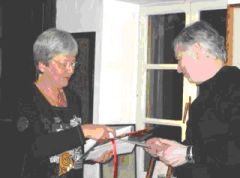
On Saturday 03 11 2008 the Szondi prize 2008 was given to Dr. Jean Mélon by Mrs. Esther Genton-Meyer in the name of the Szondi foundation.
Herewith follows our first Newsletter in 2010. The content mainly refers to the "Laudatio" of Jean Mélon, of which I first became conscious by way of the last Szondiana. We publish therefore herewith in the first place its original in French and its English translation by Arthur C. Johnston and me.
Moreover we will publish the original text in French of his article "Quarante ans avec Szondi." (Forty Years with Szondi). In case some of you might be interested that this article should be translated, just write me some lines (leo@berlips.se).
As it is only possible to write about Jean Mélon’s intellectual development (Werdegang) by mentioning his tutor Prof. Jacques Schotte, I advice you to note the picture of Schotte on the top of the Forum. Click on the picture and then you can read in French and English about the great contributions Schotte made to the Szondi movement.
In case you understand French I moreover highly recommend you to look at Bob Maebe’s excellent website: http://home.scarlet.be. Bob has, moreover, succeeded to add to his site many important video sequences. (For instance 9 videos -- of approximately 10 minutes each -- in which Schotte presents his theory about Pathoanalyse) You will discover there many other videos, e.g. a complete "Rorschach Trainings Program" in French)
We, Dr. Arthur C. Johnston and I hope you will find these articles worthwhile to read and look forward for your commentaries.
Attachments:
1. Qu’est-ce qui fonde le destin d’un homme?
Texte de l’hommage rendu à Jean Mélon à l’occasion de la remise du Prix SZONDI 2008
Martine STASSART
2. What Sets Up the Destiny of a Man?
( Translation by the joint efforts of Prof. Arthur C. Johnston and Leo Berlips )
Text of the homage paid to Jean Mélon at the time of the handing over of the SZONDI 2008 Prize.
Martine STASSART
3. 1968-2008. Quarante années avec Szondi.
Jean Mélon
..............................................................................
Leo Berlips. Editor:
www.szondiforum.org
Arthur C. Johnson Co-Editor
=========================================================================================================
Last update: 15.12.2009
Dear Friends,
151209 Lund Sweden.
Well, I hope you excuse me by simplifying my work by mainly
referring to different Web site addresses, but my increasing age is a good excuse.
Anyhow I hope you find his information useful and we wish you all herewith
l:
A VERY HAPPY CHRISTMAS AND A SUCCESSFUL NEW YEAR.
We again thank Slavick and Oksana Sjibajev our Web site techniciens
for their generous support, likewise my wife Gunnel Berlips for her assistance.
Leo Berlips. Editor:
www.szondiforum.org
Retired Leg.psycholog, leg-psychotherapeut. Certified psychodrama
director, Arthur C. Johnston, retired Literature Professor.
aacjohns2@verizon.net
========================================================================================================
This time the Szondi news is relative short and will contain:
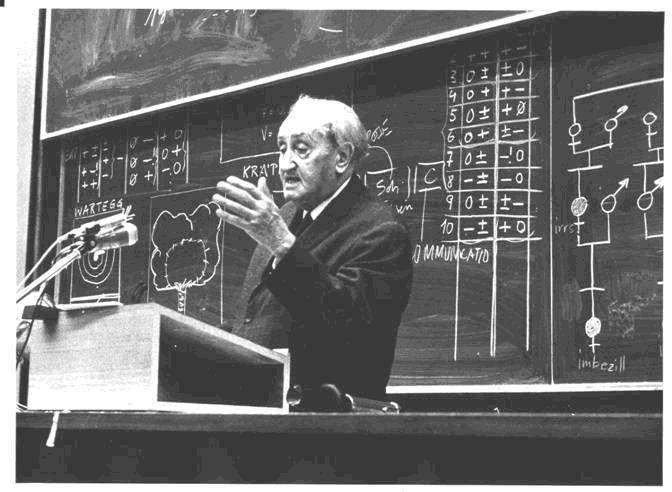
1. My favorite picture of Szondi, showing him lecturing in Leuven (Louvain, Belgium) at the beginning of the sixties.
Note: "Soon it will be fifty years ago I started studying his books but still I have the same enthusiasm for his contributions to "Depth psychology."
2. A powerpoint presentation of Fate Analysis and Pathoanalysis (English text) on Web site address: http://home.scarlet.be/cep/ROMAE/introsz.pdf. This was taken from the Szondi-twin site: http://home.scarlet.be/~tsc32552/.
At this site you will find important information about the second phase of Szondi's theoretical development, called: PATHOANALYSE (which I call in short hand for "the New Testament"). You will find there a biography in English when clicking on the picture of Prof. Jacques Schotte, at the beginning of the Szondiforum. The same is true for the biography of Szondi which you can get by also clicking on the picture of Szondi.
3. A Web site reference to an article -- in German-- by Freud, supporting Szondi?s use of psychiatric patients as his main reference points: http://www.feliz.de/html/freud.htm. (An English version is available: Strachey, James. (1966). Standard edition of the complete psychological works of Sigmund Freud London: Hogarth.).
4. Szondi Institutes December information: info@szondi.ch
5. In Swedish:
En Webbsite addres som visar en förenklat praktisk tillämpning av
Szondis behovs formel på Svenska by Rolf Kenmo finns på:
http://arbetsplatskonflikt.av.gu.se/2akad/kenmo.pdf.
Translation Holiday wishes:
Nous vous souhaitons tous Un TRÉS JOYEUX NOEL ET NOUVEL AN!
Wir wünschen Sie ein FROHES WEIHNACHTSFEST UND EIN GUTES NEUES JAHR!
Te Deseamos una FELIZ NAVIDAD y ¡ FELIZ ANO NUEVO!
Desejamos a todos:
A MUITO FELIZ NATAL E UM SUCESSO COMPLETO NEWYEAR!
Мыжелаем
вам
всем
:
Счастливого
Рождества
и Новогодних
успешным
Kívánunk mindenkinek:
Nagyon boldog karácsonyt és sikeres newyear!
..............................................................................
Leo Berlips. Editor: www.szondiforum.org
Arthur C. Johnston: acjohns2@verizon.net
Extra:
Herewith follows some extra information (in English, French and Dutch)
from the Belgian Website:
Next year we plan:
a) A French seminar on Saturday March 20, 2010 in
Louvain-la-Neuve where Dr. Max Aurières will comment Melon
and Lekeuche´s book “Dialectique
des Pulsions”, seen from
the perspective of the language theories of Gustave Guillaume (a favorite of
Schotte)
b) A whole day on Saturday, May 29, 2010 in
Louvain-la-Neuve . Subject: “Paroxysmality”
(the program is permanently
recorded in March 2010).
c) The preparatory work on the Congress of the ISA in Nice in 2011 is
well advanced.
We await the confirmation of the data (somewhere in july 2011). General
Theme is: “Trieb und
Menschwerdung”
(Drive and Becoming Human)
d) Dr. Jean-Louis Feys has published “L'anthropopsychiatrie de
J. Schotte” published y
Hermann, Parijs. See:
http://www.editions-hermann.fr/ficheproduit.php?lang=fr&menu=&ref=Psychanalyse+L'anthropopsychiatrie+de+Jacques+Schotte&prodid=682
e) The Journal “ Institutions Revue de
Psychothérapie Institutionnelle” has published two journals(43 en 44) as a
tribute to J. Schotte. To be ordered via
secretariatmedical.lb@wanadoo.fr
15 euro + port .
========================================================================================================
L'année prochaine, nous prévoyons:
a) Un séminaire français le samedi 20 Mars 2010 à Louvain-la-Neuve, où le Dr. Max Aurières relira
“Dialectique des Pulsions”, de Mélon et Lekeuche à partir de la théorie linguistique de Gustave Guillaume (un favori de Schotte)
b) Une journée entière le samedi 29 Mai 2010 à Louvain-la-Neuve. Sujet: "Paroxysmality".
(le programme sera établi définitivement en Mars 2010).
c) Les travaux préparatoires sur le congrès de l'ISA
à Nice en 2011 ont bien avancé. Nous
attendons la confirmation des dates (jen uillet 2011).
Thème général est: "Pulsion et Devenir homme"
d) le Dr. Jean-Louis Feys a
publié “L'anthropopsychiatrie de
J. Schotte” Hermann, Paris. choisissez:
http://www.editions-hermann.fr/ficheproduit.php?lang=fr&menu=&ref=Psychanalyse+L'anthropopsychiatrie+de+Jacques+Schotte&prodid=682>update.php
e) Le Journal “Institutions Revue de Psychothérapie
Institutionnelle” a publié deux revues (43 en 44) en hommage
à J. Schotte. Peut être commandé via
secretariatmedical.lb@wanadoo.fr
15 Euro + port.
========================================================================================================
Voor volgend jaar plannen wij nog een Franstalig seminarie op
zaterdagnamiddag 20 maart 2010 in Louvain-la-Neuve
waar Dr. Max Aurières het boek Destin des pulsions,
van Mélon en Lekeuche, zal herlezen vanuit de taaltheorieen van Gustave
Guillaume (een favoriet van Schotte)
en een hele dag op zaterdag 29 mei 2010 in Louvain-la-Neuve rond
de paroxysmaliteit (het programma wordt in maart 2010 definitief vastgelegd).
De voorbereidende werkzaamheden rond het congres van de ISA
te Nice in 2011 schieten goed op.
We wachten op de definitieve
toezegging van de data. Overkoepelend thema: Drift en Menswording
Szondiana onderneemt stappen om een betere plaats op het forum
van de wetenschappelijke publicaties in te nemen.
dr. Jean-Louis Feys heeft L'anthropopsychiatrie de J. Schotte gepubliceerd
bij uitg. Hermann, Parijs
http://www.editions-hermann.fr/ficheproduit.php?lang=fr&menu=&ref=Psychanalyse+L'anthropopsychiatrie+de+Jacques+Schotte&prodid=682
Het tijdschrift Institutions Revue de Psychothérapie Institutionnelle
heeft twee nummers (43 en 44) uitgegeven met hommages aan J. Schotte.
Te bestellen aan 15 euro + port via secretariatmedical.lb@wanadoo.fr
========================================================================================================
Last update: 18 Oct 2009
Dear Szondi Friends,
01009 Lund, Sweden
Due to the fact that I still more or less was compelled to take care for the content of the >www.szondiforum.org>. I will take again take over the function as its OFFICIAL REDACTOR. This will be made easier because Dr. Arthur C. Johnston promised (acjohns2@verizon.net) to assist me. Likewise my wife Gunnel Berlips (gunnel@berlips.org) has promised me to continue to sponsor the Szondi Forum in the future.
This news together with the fact that about the same the Szondi Forum is close to have 250,000 downloads, will be the best present I can get when I become 90 this 27 December.
The greatest News in this Newsletter is that we at last can publish Karl Louvet's dissertation on "Creators and the Szondi Test", translated from French into English by Dr. Arthur C. Johnston. I am sure we all may thank both Karl Louvet as well as Dr. Johnston for their great contributions to the Szondi Forum. At the same time I want to thank also my web technicians Vyacheslav Shybayev (slashi@gmail.com) -- in English: Slavick Sjubajev -- and his wife Oksana for their continuous free-of-charge servicing the Szondi Forum's website, located in Odessa.
Download links:
Original French Version of Louvet's Book
Louvet Book on Creators and the Szondi Test
Szondi Cases Excel Files
Moreover we will publish the following information:
1. From Bob Maebe's website CEP News and
2. Information about Ines Gramiger's compendia (in German).
We hope you find this Szondi news valuable for you and send you all our very best Szondi greetings.
Leo Berlips, editor Szondi news (leo@berlips.com) and Dr. Arthur C. Johnston (acjohns2@verizon.net)
ENGLISH As for
translation of German or any text I have
the pleasure to let you know that the Google translator steadily continues to improve
its translation quality and nearly is on the level of Programs You have to BUY t.ex Systran.
FRENCH Que pour la traduction
de l'allemand ou de tout texte, j'ai le plaisir de vous faire savoir,que le traducteur Google
continue d'ameliorer constamment
la qualite de sa traduction et est presque au niveau de programmes payes, comme t.ex. le
Systran. t.ex
GERMAN Betr.: die Ubersetzung
des deutschen oder einen beliebigen Text arbeitet die Google-Ubersetzer weiterhin stetig, um die Ubersetzung zu verbessern und ist fast annahernd auf dem Niveau der Programme
die fur Ubersetzung bezahlen mussen.
=================================================================
PORTUGUESE Quanto
a traducao do alemao ou qualquer texto
que tenho o prazer de informar que o tradutor do Google continua
a melhorar constantemente a
sua qualidade de traducao e esta quase no nivel de atencao para os
programas de traducao Systran voce tem que pagar.=====================================================================
RUSSIAN. Что касается перевода немецких или любой текст, я имею честь сообщить вам, что переводчик Google постоянно продолжает совершенствовать качество перевода и практически находится на уровне уделяется программам для перевода t.ex Systran.
|
|
|
|
|
|
1 . Ref. tekst seminarie CEP
FRENCH
Chers amis
szondiens et du CEP, Beste
CEP- en Szondi-vrienden, Dear CEP and Szondi
friends,
La traduction francaise (revue et corrigee par Jean Kinable et
Etienne Favraux) du seminaire
de Jens De Vleminck (Cain
et Abel, fils prodigues de
la psychanalyse) est desormais disponible sur le site du CEP
Acces via le lien dernier
seminaire 26/09/09 sur la page d'accueil et ensuite par le lien
16. Jens De Vleminck, Cain et Abel, fils
prodigues de la psychanalyse, 26 septembre 2009
DUTCH.
De Franse vertaling (door J. Kinable en E. Favraux
achteraf nog nagelezen en gecorrigeerde versie) van het seminarie van Jens
De Vleminck (Cain et Abel, verloren zonen van de psychoanalyse)
bevindt zich op op de website van de CEP. Bereikbaar
door te klikken op link van onze frontpagina naar dernier seminaire 26/09/09 en dan klikken
op 16. Jens De Vleminck, Cain et Abel,
fils prodigues de la psychanalyse, 26 septembre 2009
ENGLISH
A french translation
(revised by J. Kinable en E. Favraux ) of Jens De Vleminck's seminar (Cain and Abel, the prodigal sons of
psychoanalysis) is available on the CEP website
Access via link dernier seminaire 26/09/09 on
the frontpage and then via link 16. Jens De
Vleminck, Cain et Abel, fils prodigues de la psychanalyse, 26 septembre 2009
vriendelijke groeten, amities, yours, Dr. Robert Maebe, pour le
Centre d'Etudes
Pathoanalytiques asbl
======================================================================================
Herewith follow the Compendia
of Ines Gramiger, I certainly can recommend these
very clear and concise surveys of the Szondi theory. Leo Berlips.
======================================================================================
2) KOMPENDIEN
DER SCHICKSALSANALYS UND DES SZONDI-TESTES von Ines Gramiger; Uebersicht
uber die Inhalte
Scha.= Schicksalsanalyse.
Kom. =Kompendium
_______________________________________________________________
A)
Wichtigste Kompendien
der SCHICKSALSANALYSE/SCHICKSALSPSYCHOLOGIE:_Komp.der Scha.IV (das
„weiteste“ Kompendium – zum Einstieg und als Uebersicht) (Fr. 50.--/120 Seiten)
Zusammenfassung der gesamten Thesen und
Tabellen zur Schicksals-psychologie in neuen, modernen Schemata und
Kurztexten (neu gestaltet von I.Gramiger)
Die Tabellen sind das wichtigste
Handwerkszeug fur die Anwendung der Be-durfnistheorie in der Praxis – einem
Manual entsprechend.
Die Tabellen sind deshalb auch zweifach
enthalten, damit eine Serie herausgetrennt werden kann fur die „tagliche Begleitung“
in Zeigemapplis.
Inhalte: Schemata der gesunden
Bedurfnisse, samtlicher Berufe und Krankheiten.
Thesen der Entwicklungspsychologie, der
Entwicklung des Ichs, der Gesund-heitslehre/Salutogenese, der
Glaubensfunktionen, der Krankheits- und Neuro-senlehre / Psychopathologie
und Differentialdiagnostik.
Kurzer Ueberblick uber den Szondi-Test
und seine Auswertungsaspekte.______________________________________________
Komp. der Scha.III
(das „intensivste“ Kompendium
- zur Vertiefung in die Bedurfnisse / Faktoren) - als Nachfolge-Lekture auf
Komp. der Scha.IV
(Fr. 38.--/ 100 Seiten)
Vertiefungslekture zum
umfassenden Verstandnis der 8 Bedurfnisse der Schicksalsanalyse
in samtlichen Manifestationsformen des Lebens.
In der Formulierung knapp und stichwortartig
gehalten. Jedes Bedurfnis wird komplex aus verschiedensten Perspektiven
beleuchtet: aus der Sicht des fotographierten Szondi-Test-Portraits, dessen
Neurosenlehre und der Entwick-lungstufe seiner Genese.
Von diesem Verstandnis der kranken
Manifestationsform aus werden die ge-sunden seelischen Normalfunktionen , die
korperlichen Entsprechungen in Or-ganen, Korperteilen und Sinnen
abgeleitet sowie die operotropen
Moglichkeiten (d.h. die Vorlieben fur bestimmte Materialien, Objekte,
Tatigkeiten und Berufe).
Ebenso werden sodann die morbotropen/krankhafen und
kriminellen Mani-festationen abgeleitet.
Am Schluss werden beruhmte
Personlichkeiten, spezifische Kulturen als Manifestanten der Bedurfnisse
aufgefuhrt.
In diesem Komp. sind keine scha.
Grundprinzipien oder ubergreifenden Sche-mata enthalten (dazu wird auf das
Komp. der Scha. IV
verwiesen)._______________________________________________________
Psychopathologie und Neurosenlehre
(Fr. 50.--/126 Seiten)
Klassische sowie
spezifisch schicksalspsychologische Definitionen
aller seelischen Krankheiten und deren Psychodynamik.
Einfuhrung in die spezifisch
schicksalsanalytische Krankheitslehre, welche die genialen Definitionen aber
auch sehr komplexen Texte und Theorien von L.Szondi in moderner und einfacher
Form zusammenfasst und erweitert durch neue Krankheiten und Erkenntnisse.
Das Komp. ist auch fur psychologische
Laien geschrieben (die szondianischen Codes und Kommentare finden sich in
Klammern).
Die Krankheiten werden gemass der
Bedurfnislehre der Scha. unterteilt in :
. Sexualstorungen (Perversionen,
Inversionen etc.)
. Affekt- und Anfallskrankheiten
(Affektepilepsie, Hysterie)
. Icherkrankungen
(Schizophrenien/Psychosen, Perversionen, Zwang, Person-
lichkeits- und narzisstische Ichstorungen)
. Kontakt- und orale Storungen (Psychosen,
Borderline, Depression, Manie,
orale Suchte, Essstorungen, Akzeptations-Neurose).
Aufgrund der von Szondi sehr
dynamisch geschilderten Entstehungsgeschich-te und Abwehrynamik wird eine Krankheit von tief
innen verstehbar und ist auch der therapeutische Weg dadurch vorgezeichnet.
Zum Schluss ist jede Krankheitsgruppe
(zwecks Uebersicht und als Repe-titorium) in einem Mind-Mapping-System auf einer oder mehreren Seiten ubersichtlich
und stichwortartig zusammengefasst.
________________________________________________________________
B) Wichtigste Kompendien zum SZONDI-TEST:
Komp. der Scha.I
(Metapsychologie der
Scha. sowie Einfuhrungslekture zur Szondi-Test- aufnahme. Erste
Szondi-Test-Auswertungen fur Anfanger)
(Fr. 25.-- / 98 Seiten)
Voraus geht eine kurze Einfuhrung in die
Metapsychologie der Scha. und in den Begriff des familiaren Unbewussten.
Dann folgen Anweisungen zur Testaufnahme
und Signierung, zur qualitativen Profildeutung (Rand-Mitte-Methode und Zensuranalyse),
Komplementmethode (Vordergrund-Hintergrunddeutung) und zu den quantitativen Methoden (Triebformel,
Latenzproportion etc.).
Dies ist eine einfache und zweckmassige
Komprimierung der oft sehr komplexen Lehrbucher von L.Szondi, ist aber nur ein
theoretisches Zusatz-Lehrmittel, welches durch Testubungen in Form von Kursen
und Vorlesungen erganzt werden muss.
_______________________________________________________________
Manual
zur Auswertung des
Szondi-Test
(Handbuch
zum Szondi-Test mit samtlichen Checklisten aller Auswertungs-techniken )
(Fr. 20.--/ 68 Seiten)
(Herausgegeben vom Verlag des Szondi-Institutes, aber
auch via die Autorin erhaltlich)
Testologie-Handbuch mit
Checklisten zur komplexen und vollstandigen Auswertung des Szondi-Testes (hochste
Lernstufe )
Dieses Testologie-Handbuch ist eine hochst
knappe und komplexe Deutungs-hilfe, welche alle gangigen
Auswertungsmoglichkeiten auflistet (Syndrome, ty-pische Mitten,
differential-diagnostische Kombinationen, Existenzformen) - aber keine Erklarungen
derselben bietet. Die Erklarungen und Ableitungen sind
in den andern Kompendien zu
finden.
Dies ist der Schlussel, die Checkliste des
beginnenden und des erfahrenen Szondi-Test-Auswerters in der Praxis.
Es enthalt auch Testnormen in
Kurz-Uebersicht sowie einen Gutachtenleit-faden, dh. eine praktische Hilfe zur
Strukturierung einer schriftlichen Test-auswertung und zur Kontrolle samtlicher
Deutungsmethodiken.
______________________________________________________________
C) Der Familienbogen (Anamnese-Bogen zur Erhebung
samtlicher anamnestischer Daten eines Probanden und seiner Familie )(Fr. 25.--)
Der Familienbogen ist
eine wichtige Erganzung zur Szondi-Test-Aufnahme, zum eigenen Stammbaum, zur
allgemeinen Analyse des eigenen und familiaren Schicksals – innerhalb einer
autodidaktischen Selbsterforschung, einer schicksalspsychologischen Beratung
oder Therapie.
Geordnet nach den 8 Bedurfnissen/Faktoren
der Scha. werden charakterliche
Eigenschaften sowie Krankheitssymptome
aufgelistet.
Der Proband unterstreicht fur ihn Zutreffendes mit Rot und tragt je
nach Bedarf daneben alle seine Familienmitglieder, Partner, ev. Freunde in Form von Abkurzungen ein.
(z.B. M fur Mutter, V
fur Vater, P 1 fur den ersten Partner, B1 fur den ersten Bruder etc.).
Dadurch erhalt der Schicksalspsychologe
ein sehr klares Bild uber Charakter und Krankheiten des Probanden uber die
Familie, die Familiendynamik aber auch uber die Liebes- und Partnerwahlen.
Der Proband arbeitet daran selbstandig zuhause, was langwierige, zeitlich
unokonomische und kostenintensive Anamnesegesprache weitgehend ersetzen
kann.
Durch die Auflistung samtlicher moglicher
Symptome wird auch garantiert, dass kein Symptom in der Besprechung vergessen
geht.
_______________________________________________________________
D) Weitere Kompendien der Scha.:
_______________________________________________________
Komp. der Scha. II
(Einfuhrung ins
szondianische Triebsystem )
(Fr. 25.--/ 77 Seiten)
Dieses Komp. umfasst Uebersichten uber das gesamte Triebsystem, insbesondere die Berufe (in
Form der originaren Berufslisten von L.Szondi aus verschiedenen Buchern), sowie
eine ausfuhrliche Ich-Psychologie:
. Ichabwehrformen
als Mittel
fur die Differential-Diagnostik
. Phasen der Ich-Entwicklung in den
Altersstufen
. Gegenuberstellung der Funktionen der
beiden Hirnhalften( k und p )
. weibliches und mannliches Ich
. Verlassenheitsthematik und Ichfunktionen
Anweisungen zur Erstellung eines Stammbaumes/Genogramms
sind darin zu finden ebenso wie :ausfuhrliche Originaltexte von L.Szondi zum Wesen
und zur Neurosenlehre und
Psychopathologie der 8 Grundbedurfnisse des Triebsystems.
Leo Berlips, editor
Szondi news (leo@berlips.com) and Dr. Arthur C.
Johnston (acjohns2@verizon.net).
END NEWSLETTER 011109
Last update: 26 Mar 2009
Szondi Newsletter 010409
Dear Szondi friends,
010409
Herewith I publish with much delay my Szondi Newsletter of the first of
December 2008. The main content of this News contains the second and last part of
information about effective short personality tests. This information will also be the last I send out on the Forum,
because after I having published this:
I will finish my work as the Editor of the Szondiforum.
The main reason for this that I want more time for myself and have not any more the same energy as when I started the Forum, due to the fact that I hope to be 90 y. in December..
The Forum will be changed, according to a suggestion made by my website provider Slavick Sjibajev. He will assist me to transform it by using a program called "User Generated Content" (UGC). This will give all of you, Szondi professionals, a chance to share on the Forum your knowledge, research results, etc. etc. In this way the Forum would therewith get a live of its own. Slavick Sjibajev and his wife Oksana promised me that they will add all required technologies to the Forum software in order that it will accept this UGC content .
In this connection my personal wish would be that Karl Louvet once again will find time to use the UGC to publish his original and stimulating articles.
As I had promised both Prof. Nicolas Durez and Mrs Ines Gramiger to publish their information before I had decided to stop with my work I will add, at the end of my December News,the relevant information they sent me.
It has been nearly fifteen years ago that I started the Forum with the assistance from my, then teenage, sons. The oldest one John Patrick , has in the mean time become a medical doctor with orthopedics as his specialty. My youngest son Jens-Leo Hubertus became, after his degree as a technical engineer, the manager of an IT company. My wife, psychologist Gunnel Berlips has quite from the start, as manager of our firm "Motivation Analysis, been sponsoring all these year the Szondi Forum Webb site. Relative soon Webbsite specialist Slavick Sjibajev took over the the technical responsabilities.
So I want in the first place thank my family, ( also in the name of the 222 250 readers who at least checked in since I started the Szondi Forum) for the patience they had with a father who spent much time (sometimes too much) working at his computer during the last 15 years.
Moreover I thank my Russian friends Slavick and Oksana for all the efforts they invested in keeping the Szondi forum in working conditions.
During these years I had also had the pleasure to have contact with many prominent Szondi professionals , who I also thank for their interest and appreciation.
Especially I am grateful to: Dr. Robert Maebe and Dr. Friedjung Juttner who both encouraged me to start the Szondiforum and to Prof. Takahisa Yamashita, who would become my best friend,( he visited me many times in Sweden and in Thailand)and who I thank for his moral support, right from the start! I would also like to thank Rolf Kenmo , who thanks to his test contributed to spread Szondi's theories.
Last but not least I would like to thank two brilliant contributors to the Szondiforum:
Dr. Jean Mèlon for his generosity, which made it possible to publish many of his valuable articles and contributions of the "Centre d'Etudes Pathoanalytiques" on the Forum (roma@yucom.be) and
Dr. Arthur C. Johnston for the many excellent Szondi translations he magnanimously donated to the Szondi movement .
Wishing you and your families the best of Luck!
Your ex-Editor Leo Berlips
Szondi Newsletter 011208. Only partly corrected in English by Dr. Arthur Johnston
Note 1
Le prix Szondi vient de être attribué à Dr Jean Mélon en 2008.
Note 2
NOUVEAU MANUEL DU TEST DE SZONDI
Note 3
Psychopathology: drives and personality
Note 4 b
MANUAL ZUR AUSWERTUNG DES SZONDI-TESTS
Note 5
SHORT SCREENING TESTS. Part 2
Last update: 17 Oct 2008
Brazilian Szondi Drive test Validity
Comparing TCI Szondi
Jeff revised
Lipot Szondi - Ego Analysis (Translated by Arthur C. Johnston. PhD) - (Internet Explorer format)
Ego Analysis ZIP archive
NEWSLETTER 01/11/08 (English text corrected by Dr. A.C. Johnston )
Dear Szondi readers,
Herewith follows the latest Szondi News. The contents are:
1. Information about a New Szondi Handbook in 1a) French and 1b) English. 1c) in Dutch.
2. Bo Johnson's two articles on the Circle test.
3. Short information about a "Colour test".
The first of December we will present detailed information on an adapted version of Prof. Jaako Gabriel Borg's BEL test (as described in his book:"The Szondi Test in the Year 2004"). Moreover I will present there some historical information about my experiments, which were concentrated on finding out the shortest test giving an ideal coefficient between "Invested Test time versus Produced Information quantity".
4. The History of a great investigation in psycho diagnostics in 1938. Henry Murray´s "Exploration in personalities".
Henry Murray´s :"Exploration in personalities", which might interest many of you.
5. Information about Cahier 10.
6. Personal News. Describes some memory flashes and personal notes.
Have also look at:
http://www.woxikon.com/ a site which: translates immediately in six languages at the same time. (However for Swedes the words, beginning with an ä, ö, å, are absent)
Dear Szondi friends,
151009
Herewith I send you information about two very short personality tests, each one giving you in a few minutes information about some main personality
characteristics. Already as a student, before I started to work as a specialist in psychological diagnostics at the end of the fifties, I was interested
in this question
The first one is called the Circle test, created by a friend of mine, Dr. Bo Johnson, a psychiatrist. The other one is an adaptation of the Luscher Colour
test revised in 2004 by Prof. Borg. Both the Circle and Borg's adaptation, the BBL colour test, give essential information in a few minutes.
Dr. Johnson started already experimenting with his graphic Circle test in the fifties. He succeeded in a few minutes to distinguish indications of
psychic disturbances. (See attached files.) For those of you who might be interested in Graphology I attach also Dr. Arthur Johnston's reference
to graphological items.
Moreover I learned in the same period (the end of the fifties) aleady about the existence of several other colour tests. Of these I found the Luscher and
Friedling test the most promising. Experiments showed me that the Luscher test took the least time to apply. Two registrations could easily be made, in
less than 10 minutes. This test was furthermore very easy to interpret. Luscher presented 56 basic standard interpretations which made the interpretation
rather mechanical and simple. This was probably one of the reasons why many people underestimated the possibilities of this test.
Two years ago I read Prof. Borgs book "Szondi in the year 2004" in which he showed the correlation between the eight Szondi factors and Luscher's
eight colours. This proved to be a very promising method about which I will give you more details in my next transfer. I hope this information proves
to be valuable for some of you.
With Szondi greetings to you all.
Your editor: Leo Berlips, www.szondiforum.org.
NEWS
Dear Friends, 06 07 08
(Due to the fact that, at the very last moment, some more information was added, this might for some of you be the second text of this Newsletter. If this is the case please excuse me)
Herewith I intend gradually to send you new information referring to different topics. All these will be SEND in BLOCKS as well to the Szondi Forum as to Individual email addresses.
Block 1.
· A study by Dr. phil. Enikő Gyöngyösiné Kiss This was first published in the Szondiana, Zeitschrift für Tiefenpsychologie und Beiträge zur Schicksalsanalyse, Zürich, 2005.
· A similar study of the Brazilian group, presented at the Lisbon Congress in 2008.
· The French original and English's translation of "Jef."
· Dr. phil. Kiss article treats the following:
· Summary:
The presentation mentions personality theories of the 20th and 21st centuries, which connect their concepts of personality with a biological background. The main directs of these theories are: physique and personality, depth psychology, trait theories, neuroscience and personality, behavioural genetics, evolutionary psychology and the temperament and character theories.
We can see in the development of recent personality psychology that some of these concepts come to nearer to each other: for example the trait models (Five Factor Model), the temperament and character theories and the direct of neuroscience and personality. One of the integrative models is Cloninger's unified biosocial theory in which hypothesized four temperament and three character dimensions. In this model the temperament dimensions are thought to be genetically independent and have predictive validity for patterns of response to specific environmental stimuli.
In the second part of the presentation an empirical research is presented. We compared Cloninger's biopsychological theory and inventory with Szondi's drive system and his projective test. The subjects were 101 healthy men and women, between 20 and 40 years of age. The subjects filled out the Temperament and Character Inventory, and the ten profiles Szondi Projective Test was also taken with them. The results show, that in the cases of Harm Avoidance, Novelty Seeking, Reward Dependence and Cooperativeness factors in the TCI we obtained positive correlations with the suitable Szondi Test signs.
For those of you who are interested in the Brazilian group article follows here an:
ABSTRACT: This study's intention is to prove the validity of the Szondi Drive Test, SDT, comparing the Szondi Test with the Factorial Inventory Personality (IFP) test. The sample was collected from 301 subjects and the index was calculated among data with SSPS 10.0 with the Factorial Matrix Correlation (r of Pearson). The reliability research with itself, in this case, its Brazilian software, whose sample was based on the result of 122 people showed high reliability. The index was calculated with data based on the Factorial Matrix Correlation (r of Pearson), too. The result of this study has shown that there was a Szondi Test high reliability, but its validity with IFP showed that there were some factors that measured the same psychological characteristics in the Szondi Test and in the IFP.
BLOCK 2.
· Jean Mélon's case histories of COUPLES in French, In the future when I have more time I will translate them into English.
BLOCK 3. a and b.
· Jean Mélon's INDIVIDUAL case histories in French. Likewise I hope in the future gradually to translate them into English
Unfortunately I have not any copy of Fate Analytic protocols. In case you have such protocol(s) with a case history, please let me know.
Moreover I hope that Mrs Ines Grämiger, when she comes back from her holiday can help me. She is well known to make complete and highly differentiated Test evaluations.
In case you don't want my information let me know and your email address will immediately be eradicated from my list.
To finish this information I wish you all who have a summer holiday on the Northern half of our planet a nice holiday with excellent weather and to those living on the Southern part patience till your holiday period starts again.
With SZONDI GREETINGS TO YOU ALL from Leo Berlips. Ed: www.szondiforum.org
NEWSLETTER 04 07 08
Szondi News:
In the first place we wish the participants at the 18th Congress
· A SUCCESFUL AND AGREEABLE PARTICIPATION
· UNE PARTICIPATION RÉUSSIE ET AGRÉABLE
· EINE ERFOLGREICHE TEILNAHME
· UMA PARTICIPAÇÃO TIDA ÊXITO E AGRADÁVEL
· UNA PARTICIPACIÓN CONSEGUIDA Y
AGRADABLE
· EEN GESLAAGDE EN AANGENAME DEELNAME
· EN FRAMGÅNGSRIK OCH ANGENÄM DELTAGNING
Leo Berlips and Dr. Arthur C. Johnston.
==============================
CONTENTS of NEWSLETTER:
1 .Program of the 18th Congress of the International Szondi Association.
2. Info from the Swiss Szondi Group and Szondi Trainings centre
3.As requested: Homepage address of Giselle Welter
4. Translation of the Journaux 1 -10, of the” Centre of Pathoanalytical Studies. (Cahiers du ”Centre d’ Études Pathoanalystiques)
5. General Information a) In English. B). En Francais
======================================
Ad 1.
18th Congress of the International Szondi Association Lisbon, Portugal: 10-12 July 2008
18ème
Congrès de la Société Internationale
SzondiLisbonne, Portugal : 10-12 Juillet 2008
|
Reception |
||
|
|
||
|
Thursday/Jeudi 10, 10h00-12h30 |
||
|
10h00-10h30 |
|
Opening session/Séance d’ouverture |
|
10h30-11h30 |
Leo Ruelens |
La theórie de la pulsion à l’horizon de la Schicksalsanalyse |
|
11h30-12h30 |
Andrés García Siso |
Fiabilité et validité du test de Szondi. |
|
|
||
|
14h00-15h00 |
Christophe Adam |
Contrat pervers et contrat névrotique : du pacte vers l’alliance |
|
15h00-15h30 |
Thierry Bisson |
Psychopathologie de l’attachement et modalités d’investissement de l’enfant au cours de la grossesse : étude longitudinale à partir du test de Szondi. |
|
15h30-16h00 |
Coffee break/Pause café |
|
|
16h00-17h00 |
Monique Henry-Birouste |
Les tendances absentes: anachronisme dans l’histoire du sujet |
|
17h00-17h30 |
Dumitru Ivana |
Les circuits pulsionnels et les profils vectoriels |
|
17h30-18h00 |
Virginia Rotarescu |
Le cerveau – l’organe du psychique. Est-ce que la pathologie neurochirurgicale est une maladie pulsionnelle ? |
|
|
||
|
14h00-14h30 |
Ida Maria Mello Schivitz, Karen Mello Schivitz, Clara Juareza Pereira da Silva |
Szondi Trieb Test Validity. (STT) A correlational study between Szondi Test and IFP |
|
14h30-15h00 |
Ida Maria Mello Schivitz |
Brazilian software for the Szondi Trieb test (STTB) |
|
15h00-15h30 |
Eliza Del Rosário Ugarte Verduguez, Marlene Inácio, Elaine Maria Frade Costa, Juareza Pereira da Silva, Sílvia Corral de Area Leão Souza, Berenice Bilharinho Mendonça |
Aspects of the psychosexuality and the personality of transsexual men and women evaluated by the Szondi projective test |
|
15h30-16h00 |
Coffee break/Pause café |
|
|
16h00-16h30 |
Rolf Kenmo |
The HumanGuide concepts applied on measuring organisation culture |
|
16h30-17h00 |
Giselle Welter |
HumanGuide: Validity evidence of the Brazilian version |
|
|
||
|
9h30-10h30 |
Dominique Reniers |
Des circuits pulsionnels à la boucle du désir: Au-delà du principe du pathologique dans le système pulsionnel szondien |
|
11h30-11h30 |
Michel Galasse |
Du néo-sujet au néo-analyste; quelles transitions? |
|
11h30-12h30 |
Maurizio Badanaï |
Nouveaux éclairages sur les seize profils du moi |
|
|
||
|
9h30-10h00 |
Rita Hargitai |
From drive to representation |
|
10h00-10h30 |
Enikő Gyöngyösiné Kiss, Heléna Sajabo, Mátyás Káplár |
The genotropistic theory of the choice in love |
|
10h30-11h00 |
László Nagy, Réka Tóth- Marianna Szűcs |
Analysis of Szondi tests of alcoholic patients |
|
11h00-11h30 |
György Révész, László Séra |
„Reading from vs. reading into” – an investigation of Szondi’s pictures |
|
11h30-12h00 |
Rita Meneses |
Szondi contributions to the study of adult attachment (and vice-versa) |
|
12h00-12h30 |
Bruno Gonçalves, Enikő Gyöngyösiné Kiss |
Comparing test results from Hungarian and Portuguese community samples |
|
|
||
|
14h00-15h00 |
Jean Kinable |
Vecteur szondien du moi et décomposition freudienne de la personnalité psychique |
|
15h00-15h30 |
Robert Maebe |
Compte tenu, compte rendu |
|
15h30-16h00 |
Coffee break/Pause café |
|
|
16h00-17h00 |
Marc Ledoux |
La notion du sujet chez Von Weizsäcker révèle la notion de personne comme "ouverte" à chaque vecteur de Szondi |
|
17h00-18h00 |
Claude Van Reeth |
L’incidence de la phylogénèse dans la pensée szondienne |
|
|
||
|
14h00-15h00 |
Almut Schweikert |
Towards a theory of aggression: The Szondi test as a framework for the assessment of emotional dynamics in homicide convicts |
|
15h00-15h30 |
Coffee break/Pause café |
|
|
15h30-16h00 |
Jens De Vleminck |
The legacy of Cain: On human aggression |
|
16h00-16h30 |
Danuta Saletnik |
Fate-analysis and building a collaboration bridge between psychology and priesthood |
|
|
||
|
10h00-10h30 |
Bernard Robinson |
Pathoanalyse, lien social et personnalité |
|
10h30-11h30 |
Annie Berner-Hürbin |
Système pulsionnel, tempérament et salutogénèse. |
|
11h30-12h15 |
Réunion de la SIS/ ISA meeting |
|
Ad. 2 iAd 2. Info Swiss Szondi Group
L’'enseigne
Szondi
de Genève est une adresse de formation au Szondi-test
("diagnostic expérimental des pulsions") et à
l'anthropologie philosophique.
Direction
: Maurizio Badanaï
Docteur en philosophie
Maître-Praticien
en PNL
Membre de la Société Internationale
Szondi
Siège
:
34, Rue de Carouge 1205 Genève
Tél. : 022 / 344 77 90 Email : maurizio@szondi-geneve.com
Message from Swiss Szondi group:
Hello Szondi friends ,
02 07 08
Herewith a short message to announce you that on Saturday, October 25 will take place in Geneva one day a general review of the practice of the Szondi-test. For more information, see " http://szondi-geneve.com site
-----------------------------------------------------------
Bonjour amis szondiens,
Voici un court message pour vous annoncer que le samedi 25 octobre aura lieu à Genève une journée conviviale d'échange sur la pratique du Szondi-test. Pour plus d'info, voir la rubrique "Rendez-vous" du site http://szondi-geneve.com
-------------------------------------------------------------------
Ad: 3 Giselle Welter.
---------------------------------------------------------------------
Ad: 4 Index of The Journals of the “Centre d'Etudes Pathoanalytiques” ( CEP) Revieuw of clinical anthropology, psychoanalyse and phenomenology.
In case you are interested to have one of these of these articles translated into English you may can contact me and I put you on my waiting list. Ed. leo@berlips.com.
You find these articles on the Forum and also on Webbsite:
http://home.scarlet.be/cep/ (top left side)
Editorial content (Journal 1 April 93) Research done by the Liège group. Dubois Dominique: Suicide as destiny 3./ Siegelbaum Frederic: Failing at the end of higher studies 17/ Goffart Sabine: The uprooted old man 33/ Gregoire Pascal: Personality of the clairvoyants. 47/ Poelmans Christian and Stassart Martine: The adolescent attitude towards more qualified studies. 61 /Colette Claude: From Hemophilia to hypochondria 71- 82. Price: 8 Euros.
…………………………………………………………………..
Editorial content in Dutch (Journal 2, September, 93). Pathoanalyse, deel van Lot’s analyse. Herziening van de driften leer van L. Szondi 3/ Schotte Jacques: Pathoanalyse in psychopathology 15 / Lekeuche Philippe: Afgrensning van essentieel drug misbruik 51/ Ledoux Marc: Pathoanalyse in de institutionele psychotherapy 71- 82. Price: 8 Euros.
……………………………………………………………….
Editorial content (Journal 3. December 93).” Conference In Budapest, 14 April 17th, 1993”. ref. to the Centenary of the birth of Léopold Szondi. Schotte Jacques: About Fateanalysis in Pathoanalyse 3/ Van Meerbeek Jean Pierre: A genetic reading of the instinctual Szondi diagram based on the theory of Jean Piaget 25/ Kinable Jean: Psychopathy and perversion 45/ Lekeuche Philippe: Delimitation of crucial drug abuse 73 /Brackelaire Jean Luc: Forbidden to project yourself ?! The test of Szondi seen by Tarahumaras 89 / De Groef Johan and Pattyn Marc: Mental impairment seen in the perspective of Pathoanalyse 101/ Gonçalvez Bruno: Responses of adolescents and young deaf adults with the test of Szondi 104 / Ledoux Marc: Béla Bartok, only with its music 115.121. Price: 10 Euros.
………………………………………………………………….
Editorial content ( Journal 4, November 4th, 94). Paroxysmality. Blumer Dietrich: Epilepsy of Vincent van Gogh 3/ Lekeuche Philippe: Karamazov and the Schotte’s P vector.11/ Maldiney Henri: Paroxysmality in art 39/ Jean Melon: Paroxysm, rebellion and surprise 73/ Nidecka Bator Iwona: The paroxysmal man in Dostoievski’s litterature 79/ Pluygers Claire: Paroxysmal splitting of the personality as seen in the 0separation of the world in “the Idiot” of Dostoievski 83/ Pluygers Claire: The beyond of the ethic in Dostoievski and Nietzsche 89 / Stassart Martine: Essential Epilepsy in Szondi and Rorschach 95/ Vergote Antoine: The paranoid violence of Caïn and its humanization 116.124. Price: 10 Euros.
……………………………………………………………………….
Editorial content (Journal 5 September, 95. Transformations of the sexual . Gerard Bonnet: Narcissism and sexuality 1/ Jean Kinable: The szondian partition of the sexual: change and exchange (swap) 14/ Jacques Roisin: Rene Magritte. A specific destiny of the scopic urge 32 /Jacques Schotte: The “Sexual Theory in anthropopsychiatrie 61/ Martine Stassart: Metapsychology of the adolescence 71/ Jean Melon and Henri M.: Intropathies 105/ Jean Kinable: Remarks about transsexualism 143/ Alberto Peralta: Introduction to Perceptanalyse 155/ Jean Paul Abribat: "Psychopathia sexualis" de Krafft Ebing et Moll 164 174. Prix : 13 Euros
……………………………………………………………………
(Journal 6 In Dutch. Septembre 95.) Pathoanalyse en Depressie . Bob Maebe: Inleiding 3 / A. Vergote : Psychoanalyse van de depressie 8 / J. Mélon : De weerbarstige depressie 27/ M. Ledoux : Poëtische bezinning rond de musikale taal van Robert Schumann 41 / J. Mélon : De depressive positie bij Szondi 48 / J. Mélon : De depressie in de Szonditest 59 / J. Schotte : From redefining depression to reassessing nosology 63 82 . Prix: 8 Euros.
………………………………………………………………………
Editorial content (Journal 7 April 96. Ethno psychology. Jean Melon: Oedipus and Moïse 1 /Martine Stassart: TheAnthropology of adolescence 13/ Rene Devisch: The “Mbwoolu” cure at Yaka of Zaire 41/Jean Melon: In connection with the European identity 60/ J.Mélon, M.Stassart and B.Herman: Szondi of Tarahumaras 68/ J.Mélon and Mr. Stassart: The contribution of Szondi in Ethnopsychologie 76/ Brigitte Hermann: A Burundian population 87/ Anne Pochet: The Rural and urban population in north Italy.100/ Ilias Kourkoutas: Transitional identifications in adolescence 116.122. /Price: 10 Euros.
…………………………………………………………………….
Editorial content (Journal 8. Novembre 2001) Constellations 1. Jean Melon. Abus sexuel, sadisme et masochisme/ Caroline De Togni: Female prostitution and traumatic repetition 101/Florence Robin: The anorexia nervosa in the Rorschach and Szondi test 125/ Sandrine Neuville: New research on twins 136/ Mathilde and Alexandre: the meteorites 159/ Jean Melon: Sexual abuse, sadism and masochism 165/ Helene Wolf: Bar Mitsvah, initiatory rite and formation of the judish personality 179/ Stéphanie Haxhe. Impact of the gap of age when becoming an individual members of a phraternity (fratie) 188/ Bruno Gonçalvès: The Szondi registration of the alcoholics: alcoholism and drug abuse 203-212. Price: 15 Euros.
…………………………………………………………..
Editorial content (Journal 9, September 2002). Constellations 2.
Bob MAEBE. Constellations. Openings speech at the Conference of Vaalbeek 2001.3/ Jean KINABLE. Szondi-Rorschach: Interanalyse. In connection with trauma from the point of view of the affect. 5/ Philippe LEKEUCHE. A szondian enlightment of schizophrenia. 31/ Alain LAROME and Maxime/ LECAMP. The “Ego” with its paroxysm. 51/ Monic HENRY-BIROUSTE. The excluded Tendencies in a protocol. Questions and hypothèses.55/ Françoise DUFAY-VUILLEMIN. The duty of senority. A female patient forwarding an auto-immune disease. 68/ Alexis DIELS. Szondi enlightment of the alcoholic speech. 77/ Tanguy de FOY. Participation, thoughts about meeting the adolescent. 82/ Esther GENTON-MEIER and Barbara TRIPET. The test of Szondi in marriage counseling. 87/ Marc LEDOUX. Instinctual constellations and social constellations. 98/ Virginia DAVIDTS. Exhibitionism in the light of the pathoanalyse. 101/ Veronique BERGMANS and Sophie DARMOISE. The Szondi test: another glance at social defense. 109 / Maurizio BADANAI. To put “values” in the instinctual Szondi system 115/ Luigi SCANDELLA. The destiny of Pasolini. 137/ Helene DRACOULIS. Bankrupty of the imagination? Study of the quality of the fantasies among women waiting dermatite atopique.153 / Clotilde HENRY of FRAHAN. The anorexia nervosa in the light of pathoanalyse. 161-162/ Patrick DERLEYN. Dialectic of the fore- and of the background. 163-175. Price: 15 Euros.
Index Journal 10 will soon be published.
Forwarding costs: between 5 Euros (for an issue) and 7 Euros (for three issues). Price doubled except ECC.
Contact: Dr. Jean Melon, 20 rue Petit Bioleux, B-4122 Plainevaux. E-mail melonjan@skynet.be
==================================================
|
|
Actes du Collogue de Gand, Tousssaint 2004 Journal 10: Conference "To be or not to be.. Szondians tomorrow” Editorial content SUMMARY |
|
|||||
|
Barbara Tripet. The familial Transmission. |
3-12 |
|
|||||
|
Dominique Reniers. The Szondi Drive System and the Logic of the need. (Logique du desir). |
13-23 |
|
|||||
|
Jean Kinable. The Affect’s Paroxysmality . |
25-44 |
|
|||||
|
Philip Lekeuche. Drives and Creation. |
45-52 |
|
|||||
|
Jean Francois Pascual . Comprehension of Drug Adictions. |
53-72 |
|
|||||
|
L. Scandella. Long Cycles and Works of Thinking. |
73 -97 |
|
|||||
|
Tomas Geyskens. Freud’s Szondian touch in the Finished and Unfinished Analysis. |
99- 108 |
|
|||||
|
Marc Ledoux. Szondi and the Meaning of its transmission by Teaching. |
109-112 |
|
|||||
|
Christophe Adam. Szondi and Laclos. |
113-140 |
||||||
|
Benjamin Thiry .The Swindler in the City. |
141-148 |
||||||
|
Tanguy De Foy. Passages. |
149-156 |
||||||
|
Gregory Vastrat et Christophe Adam. Inter-analyzes Szondi-Rorschach . |
157-164 |
||||||
|
Vincent Estellon. Precarious Sexuality and Sexual Precariousness. |
165-176 |
||||||
|
Francoise Dufay-Vuillemin. My Body Disconcerts Me. |
177-191 |
||||||
|
Bruno Goncalves. Presentation of a Database of International Szondi Files. |
192 |
||||||
|
Jean Melon. The Declining of the Paternal Figure: From the Antiquated Model to the Postmodern Model. |
193-218 |
|
|||||
|
Jean Jacques Metge. My Meeting with Szondi. |
211-218 |
||||||
|
Max Aurieres. Pathoanalyse, DSM and Psychiatry |
219-233 |
||||||
==================================================
Ad. 5 General Information:
Dear Szondi Friends,
At last I have again the possibility, thanks to my friends IT specialists Slavick and Oksana Sjibajev, to update the Forum with the latest Szondi News.
Especially promising for the Szondi movement is the fact that we, during the last four months, got 10.000 logg in’s on the Forum. It shows that the interest in Szondi is rising. In my opinion we have for a great part to thank Dr. Arthur C. Johnston for this progress. He has in an astonishing short time made large translations of important classical Szondi and Mélon texts. (e.g The Szondi Course de Jean Mélon.and the translation of Szondi’s chapter “Ego Analysis” from German. Moreover he at present corrects all my English texts-. .
As
for the general policy of the Forum we have somewhat changed our
objectives. Although there exists still many interesting articles to
translate from French into English, (e.g. the .articles of the
Cahiers) at present we plan to concentrate our contributions mainly
on the “Praxis” of the Szondi test
interpretation . Luckily enough for us has Dr. Jean Mélon
during the last years published many interesting case histories,
presented by his students at his seminars. With his usual generosity
he
General Newsletter, 07 04 05 Falkenberg, Westcoast of Sweden, Dear Szondi friends, In the first place I want to inform you
about the 17th International Szondi Congress that is held in Pécs,Hungary the 22 – 25 of June 2005. (More info. at the end) We also remind you again of Jaakko Gabriel Borg’s Book: (jaakko.borg@pp.inet.fi) SZONDI'S PERSONALITY THEORY IN THE YEAR
2004. ----------------------------------------------------------------- As you might already have seen we have
updated the Szondi Forum with many articles about the CIRCUIT
DRIVE THEORY. This theory has contributed with an extra
differential diagnostic step forwards in interpreting the Szondi test. We
publish therefore a re-translated extract from Jean MÉLON´s “Szondi Course”
that presents his “Pathoanalytical Circuit Theory” in English and in French.
Our summary contains the articles: 6.1.3. The
ontogenetic point of view and the drive circuit theory. 6.1.4. The
interpretation based on the periodical perspective of the drive circuits. 6.1. 5.
Positions and the fate of the drive. We also publish four articles about the
same subject by Karl LOUVET (who was a pupil of Jean Mélon and not of Schotte,
something I incorrectly mentioned earlier) Part 1. The
first steps to the Circuit. Part 2. Circuit interpretation. Part 4. Drive
Positions. (Positions
pulsionnelles) Some of you will probably be rather
critically when reading Louvet´s outspoken philosophic idealistic
approach in his presentation of the Drive Circuits. But even to them I
recommend to read Part 3 of his presentation. It is certainly worthwhile
because it describes in a very earthy and practical way an easy method how to
calculate – by hand - the Circuit level of a Szondi-protocol. However one can
use a Computer Calculation program and save a lot of time. There are two
versions that are free and downloadable in the section "Liens"
(heading "Matériel") from Karl Louvet´s site: >http://szondi.apinc.org/links.php?lng=fr< In contrast with the difficulties which
some of you might have to accept Karl’s theoretical reasoning he illustrates his conclusions with concrete examples in a
very picturesque way. As a former test psychologist, who in the sixties and
seventies often had to interpret test results of people living in other parts
of Sweden (blind diagnostic), I really enjoyed myself to read Louvet’s subtle
interpretations when he applied the Circuit theory to the individual
Factor and Vector positions (see article Nr 4). I
think that his example of “Obsession” in this article can be used with success
in teaching the Szonditest. (As Karl informed me: the method he used to
interpret the instinctual positions is a heritage of Jean Mélon and
Daniel Vernant). I made these translations in Karon, Thailand, during the aftermath of the Tsunami. They helped me to get a kind of mental
private space in a world in turbulence. Moreover I can even say that I was
saved from a very serious auto accident by keeping to my daily work schedule.
One month after the catastrophe I was invited one morning to accompany by car
some of my Thailand friends to Phuket town. Fortunately for me I kept to my
schedule and did not follow with them. On their way they got a very serious car
accident. If I had followed with them I probably would not have survived. Their
car was totally destroyed and they narrowly escaped. So one might say that my
translation work saved me. The first months after the catastrophe I
participated several times in relief actions together with some European
expatriates and their Thai girl friends. Only a few days already after we
transported food, water, milk for babies etc. to the victims in the Kao Lac
district. Thanks to my daughter, who collected not less than 3400 Euros !
(contributed by German and Swiss Yoga groups) we could even contribute to
GeneMc Cains “Education Sponsorship fund”. In case You want to contribute money
to the child victims of the Tsunami. Please read: >www.tsunamirelieffundthai.org/< In this connection I want to express my
appreciation and gratitude for the warm interest and kind emails I got in
connection with my stay in Thailand and Eastern holidays. Especially some of
the messages I got from South America touched my heart. Un
Gran Abrazo a todas mis amigas y amigos! In the midst of March and after a short
visit to Hong Kong I returned to Sweden again. Notwithstanding the cold winter conditions
I felt this time really happy to return to Sweden. However at home I had to
pass through some difficult weeks due to physical reactions on the stress I
went through before. Fortunately I feel gradually better and I hope to be soon
in form again. I send you all my best Szondi wishes and
look forward to meet many of my Szondi-friends at the 17th
International Congress in Hungary. Leo Berlips, ed.>www.szondiforum.com< Short
Foreword to the 3th Article of Karl Louvet Part 3 of Karl Louvet´s “Basic Circuit
Calculation”. It is one of the first concrete examples of how to make a
calculation of the Circuit levels. As such it is a very important contribution
of Karl, for even when one does not have a computer program one can learn how
to calculate the different levels. Thanks to the fact that this time his text
was very concrete I had no great problems with my (liberal) translation. Leo Berlips, editor
>www.szondiforum.com< ============================================================ Information about the Congress of the International Szondi
Association, 22-25 June, 2005 in
Full registration paid after April 01, 2005: ¤100 Banquet: ¤20 · submitted before May 20, 2005 - 100% refund · submitted between May 21, and June 01, 2005 - 50% refund · no refund on cancellation sent after June 01, 2005. Methods
of payment:
Bank transfer to HU86-10024003-00282716-00000000 Bank address: 7621 Pécs, Apáca utca 6. Recipient name: Pécsi Tudományegyetem Comment: 66036-08-25 SZONDI
CONFERENCE registration fee - [Your
name]----------------------------------------------------------------- Travel information: By plane: Arrival to Ferihegy Airport (Budapest). There are two railway stations in Budapest from where InterCity
train services are available to Pécs: the first is Déli Railway Station
(Southern Railway Station) and the second is Keleti Railway Station (Eastern
Railway Station) (see the table of schedule). From Ferihegy Airport to Déli or Keleti Railway Station you can take an Airport Minibus Transfer. See details
at http://www.bud.hu/english/services if you have any problem or question, do not hesitate to contact us
at sis.meeting@freemail.hu. 01 01 05 Dear Friends, As most of you already know I live this winter again in Thailand. In connection with the
Sumani wave we had a narrow escape. See my (this time gramatically corrected) report. In this report I forgot to thank all of you who gratulated me to my birthday. I look forward to the year 2005, especially because I got interested in a very original introduction to the Pathoanalogical way of interpreting the Szondi test with the "Circuit analysis method by Karl Louvet, a student of Prof. Jacques Schotte. For you who can read French I suggest you have already a look at his French Site. 29 12 04, Wedness day, Phuket Island We are very happy to be able to let you know that we are Safe! Still both my son and me had as narrow escape as we only one hour before the Sumani arrived at the Karon Beach we were making a short walk there. Lycky enough for us when the wave stroke the beach we were sitting in the front entrance of our Guesthouse, about one kilometer away from the sea, when the whole picture of street life started to change into a kind of Fellini movie. Suddenly all people were shouting warnings and running or driving into the direction of Inland. We to had to leave immediately our Guesthouse and forced to get onto a higher level, as soon as possible. The reason for this was that there had been warnings that a new high wave would strike the coast and nobody knew anything about its height. After a long time walking upwards in the hot sun we arrived at last at the top of a small hill, about 50 -60 meters high were we had to wait many hours till the late afternoon before we could go down again. Up till this time the police had stopped the traffic. Happily enough for the Karon Hotel and shopowners Karon had probably the least damaged beach of the whole aerea, although even here many persons lost their lifes.
As I suppose you will have read already read or seen more extended news I keep this report short. Newsletter 6.12.2004 Dear Szondi Friends, Herewith we inform you that we plan to
update the Szondi Forum with the following articles and information: "Szondi´s
Personality Theory in the Year 2004: Validity and reliability for the Szondi
test in the year 2004" During the next four months I will be in Thailand where you can contact me by email.
Part 3. Basic Circuit
Calculation.
or directly from the site of Bob Maebe for the last version of the CEP :
>http://home.tiscali.be/yuc-roma/ROMAE/logiciels/logiciels.htm<
Pécs, Hungary. (Info: < <)
Registration fee:
Full registration via cash on the spot: ¤120
Cancellation policy:
Bank
name: Magyar Államkincstár
SWIFT:
MANEHUHB
Tickets can be purchased in the arrival hall. The InterCity trains
are the fastest and most comfortable trains services between the cities.
Duration of the journey (Budapest-Pécs) is about 2 hours and 40 minutes. For IC
schedule please see the next: (http://www.elvira.hu)
Herewith we update the Forum with two coloured visual representations made by Dr. Angel S. GUGLIOTTI which he uses when he teaches in his " CIRCULO DE ESTUDIOS SZONDIANOS DE BUENOS AIRES " Part 1 and Part 2.
So dear Friends, you really made me Happy to receive
and read your birtday wishes. Thank you so much!!
Although we had a narrow escape. Because originally we had planned to make a trip to the famous Pipi Island the very day of the castrophy. It was the island where many tourists were drowned on the beaches. However just the day before the Sumaniwave we changed our plan and stayed in Karon. (Phuket)
We wish you all a MERRY CHRISTMAS and HAPPY NEW YEAR!
Leo Berlips, editor Szondi Forum >leo@berlips.com<
AFFECT VECTOR
Previous news you can find here:
Archive 1
Archive 2
Archive 3
 |
 |
© 1996-2002 Leo Berlips, JP Berlips & Jens Berlips, Slavick Shibayev