CHAPTER FOUR: DREAMS AND VISIONS OF DEATH
PARTICIPATORY DREAM WORK
In this and the following two charters the relation
between death and participatory selfhood is explored in terms of dreams and
visions. Since terminal illness and bereavement usually come under medical
management, dreams and visions are often dismissed by health-care givers as
hallucinations or delusions. Such interpretations are philosophical
judgments that exceed the boundaries of medicine and need to be challenged.
To clarify these issues the respective terms should be
defined. Hallucinations are a discharge of sensory material
from within the central nervous system that does not cohere with the
objective socio-physical environment. One who hallucinates seems confused
and incoherent. Hallucinations may be caused by bodily traumas, high fever,
poison, or medications. The basic characteristic of hallucinations is that
they do not change the person's life or attitude. One remains the same
before and after hallucinating, namely, with impaired reality testing.
Delusion is similar to
hallucination, except that it falsifies reality, and is driven by internaI
disturbances and defective relatedness. Whereas hallucination is a
distortion of perception, delusion is an erroneous view of the world that
substitutes for genuine participation (Szondi 1956, 413, 451). One who is
deluded desires to relate socially and metaphysically but cannot. Instead
one surrenders to substitute forms of satisfaction determined by a specific
ego phase, such as projection or inflation. Whatever the mode, one needs
delusion to cope with a basic insecurity, fear of aloneness, and anxiety of
death.
Page 90
A vision is an experience in which symbolic
content enters the mind from a side source, whether unconscious or
transcendent. The most distinctive traits are a mandate, such as a summons
or a calling, and consequently, profound changes in the personality
(Benz 1968, 10-11):
The mandate is self-evident and self-authenticating. To a
certain extent, a vision resembles a dream; however, the dream presents
indirect or symbolic forms that require interpretation.
Generally, in the history of religions little dreams are
distinguished from big dreams. The former express content entirely within
the dreamer's personal experience, but the latter are exclusively symbolic,
containing ancestral models and/or archetypes from within traditional
religions and mythologies. Big dreams are like visions, and, in the history
of religions, they are paired with each other. However, dreams come during
sleep while visions could appear in sleep, in waking consciousness, or upon
awakening. Furthermore, a vision could bring a separation from the body,
otherworld journey, and ecstasy. Thus, the vision would exemplify an
expansive, participatory mode of thought in opposition to the body, as
Szondi would say.
The visionary is grasped by ultimate reality, which makes
the mandate compelling. Visionary material may be imaginal, visual, or
auditory. Historically, mystics have tried to go beyond sensory visions to
image-less states of pure being or nothingness. Since some visions impart
pure experience, it is difficult to define them exclusively as projections
of the unconscious. When symbolism is present, surely the unconscious plays
the same role in the vision; and the law of participation, formulated by
Szondi, provides a comprehensive framework. When the visionary is grasped by
ultimate reality, he or she is simultaneously
driven toward participation in fundamental reality.
Sensory modes, even conscious and unconscious, may be regarded as phases
along the way to pontifical selfhood and its functional characteristics of
participation, integration, and transcendence.
Closely related to the vision is the apparition,
defined as a spontaneous breakthrough from a transpersonal source into a the
natural world, while the latter remains unchanged and correlated with
personal consciousness (Dinzelbacher 1978, 117). When beholding an
apparition, one does not separate from the body. An apparition resembles a
vision in the sense that it may come to waking consciousness and deliver a
mandate. However, unlike the vision, an apparition may be seen by more than
one person and have an objective quality, spatial form, or
Page 91
mass without matter. An apparition may move, vibrate, or radiate energy
in morphic fields. Like the dream and vision, an apparition conforms to the
law of participation and presents a narrative framework as complementary to
organic and interpersonal dimensions. Apparition, dream, and vision all bear
co-acting transpersonal and unconscious functions as well.
Furthermore, apparition, dream, and vision may involve a
synchronicity, a phenomenon emphasized by Jungian psychology. Jung defines
synchronicity as a meaningful coincidence of two or more psychic or physical
events, which are separated in space and cannot be explained by causal
interaction (1960, 441). The simultaneous and meaningful coming together of
distant events is governed by an archetype. Under the impact of
synchronicity, the psyche is relativized. The three dimensional,
spatio-temporal, causal world is temporarily, suspended, as the connective
unconscious realizes a purposive unity. Since the Jungian definition of the
psyche is deficient, with respect to the family, it is necessary to
add that the ancestry may also inform a synchronicity. Both ancestral and
archetypal forms share translocal and transcausal exchanges within the
unconscious.
All of the foregoing phenomena may be viewed in terms of
Szondi's participatory theory of dreams. Szondi defines the dream as a
nocturnal search for a oneness, likeness, and relatedness between waking
consciousness or foreground and the hidden, unconscious background
(1956,466). Achieving such a unity obtains an
"autogenic participation. "The uniqueness of this participation is that the
dream exceeds the boundaries of the spatio-temporal, causal world,
penetrating the "beyond" in the sense of an unconscious "split-off" phase.
Such a "split-off" phase, however, is not delusory but participatory.
To a certain extent, Szondi's dream theory resembles
Jung's. Jung grounds his dream theory in the concept of compensation. The
dream compensates the perspective of consciousness. When the consciousness
becomes too one-sided, the dream automatically compensates through the
elemental forces of the archetypes. Compensation compares to the automatic
swinging of a pendulum or to the self-regulating forces of nature. Just as
nature balances itself, so does the dream. Dreaming belongs to nature; it is
trustworthy and not deceitful.
Szondi founds his theory upon the concept of
complementarity. He would agree with Freud that dreams reflect causes from
the past and with Jung that they forecast the future or manifest finality,
but he would
Page 92
contend that the motor force of dreaming is the primal
drive for participation. The complementary parts of the dream are the waking
or foreground self (Vorder-Ich) and the latent, hidden, or background
self (Hinter-Ich), which contains repressed, instinctual drives and
hereditary material. Each self complements the other, and each revolves with
the other. These rotating phases are consistent with the functions of
threshold genes and with dominance variability.
Dreams may be analyzed in terms of four dramatic phases
(Szondi 1956,487-489).
(1) The waking ego prepares for a journey by exploring
various existential possibilities. This preparation takes place at the
beginning of the dream cycle. (2) The waking ego surpasses a threshold,
becoming hypnagogic, and descends into a deeper, symbolic background. As an
example, One goes through a tunnel or across a bridge; or One sinks into a
depth or into a whirlpool.
(3) At a profound level awareness becomes purely
symbolic; this is the dream world, as such. The waking ego withdraws from
the scene, becomes a passive spectator, and watches the action unfold on the
stage; out of the unconscious, the personal, familial, and/or connective
figures step forth. Frequently, ancestral models are presented, so that one
receives a freedom of choice and is able to choose more than one existential
possibility.
(4) Finally, the self becomes hypnopompic. The waking ego
comes out from the background into center stage, and then the dreamer
awakens. Symbolically, one goes up a staircase, or returns from a trip to
one's family or place of work.
By describing these phases dramatically, as though they
were four acts of a play, Szondi produces a narrative structure. Within the
dramatic narrative the second and fourth phases are pivotal; for they
signify two thresholds, respectively, in which the waking ego transcends
itself. Whereas in Jung's theory such phases would only compensate for the
extremes of consciousness, in Szondi's a basic decision-making role of the
dream is uncovered. Choices are posed with respect to existential
possibilities which the dreamer may be affirming and those which may be
hidden or repressed. Since dreamers often neglect or forget material from
the threshold phases, dream interpretation frequently fails to clarify the
decision-making possibilities of the dream.
The narrative structure of Szondi's theory also
complements the internal rhythms of creativity that emerge in the dream
stages of sleep. It is well-known that sleep goes through ninety minute
cycles of the night. Expressed by rapid-eye movements, dreaming may be as
short as ten minutes or as long as one or two hours. Unlike deep sleep which
Page 93
lacks rapid-eye movements, dreaming is one form of
seizure activity, as Frederic Myers knew so long ago. Dreaming is, according
to the new scientific studies, "the conscious experience of a normal
nocturnal brain seizure which helps the brain avoid the excessive
excitability that plagues epilepsy victims even during the waking state"
(Hobson 1988, 176). This relationship with epilepsy reveals alternating
phases of neural activities, one dominant and one recessive. These patterns
demonstrate that the brain sustains wave-like, undulating rhythms in itself.
Dreaming takes place when the paroxysmal, reticular neurons dominate and
escape the inhibitory aminergic neurons (ibid, 184). Switching on and off
the polar paroxysmal and inhibitory functions starts in the brain stem and
is mediated by a functional disinhibition. Thus, every dreamer is a latent
epileptic.
The imagery of dream sleep is volitional, creative, and
adaptive. Dreaming discharges intense emotion, which is channeled by
instinctual drives and genetic information encoded in the animal brain.
These functional aspects are consolidated by symbolism, through which the
primal drive for participation achieves a unity of self. Dreams, visions,
and apparitions deliver a narrative framework to the drive for
participation, even in the face of death.
II. DREAMS AND TERMINAL CANCER
According to classical psychoanalytic doctrine, dreams of
the dying tend to be - simple fulfillments of childhood desires, based upon
regression, and aimed toward a denial of death. This approach presupposes
Freud' s influential opinion that the unconscious lacks knowledge of death
and has neither contradiction nor negation (S.E.XIV, 1957a, 296). For Freud
the unconscious believes in its own immortality. In contrast, subsequent
clinical work has revealed that regressive wish-fulfilling dreams exist
independently of a denial of death and belief in immortality (Norton 1963).
Phases of denial, depression, and heightened narcissism belong to the
grieving process, which includes unconscious and/or conscious knowledge of
death.
More recently, dreams of fourteen terminally ill cancer
patients were compared with those of healthy, elderly persons. Despite a
conscious denial of death, the dreams of the cancer patients revealed an
unconscious knowledge of death (Coolidge and Fish 1983-1984). Along
Page 94
with themes of death, the dreams of the cancer patients
expressed fear and loneliness, indicating the discharge of emotion.
Emotions relate to aggression, which, the authors find,
occurs in 50 % of the dreams of cancer patients. They theorize that the
projection of aggression in dreams reflects the dreamer's attitude toward
dying. When the dreamer is the object, then death is the aggressor; but
when, \the dreamer is the subject, then aggression displaces anger or rage
against death by falling onto other characters. Other persons in the dream
are usually members of one's own family. Projecting death onto another
character implies the dreamer's own ambivalence toward dying.
The authors conclude that death dreams are attempts to
integrate the unconscious knowledge of death with consciousness. This
conclusion is sound, and it reveals the knowledge of death to be a threshold
function. The dreams discharge paroxysmal aggression in an attempt to bring
the unconscious fear and loneliness in the face of one's death across the
threshold of consciousness.
In another study Charles Garfield reports his work with
215 terminal cancer patients over a three year span. He discovers his
patients to have ambivalence, increasing weakness, and an "altered state of
consciousness" just before death. The idea of "altered state" is not
defined, but it represents the time when dreams and visions are active.
Garfield describes the following symbolic patterns of dreams and visions:
(1) real and radiant encounters of light, celestial
music, deceased and religious figures; (2) clear and demonic, nightmarish
imagery; (3) alternating blissful and terrifying dream-like images; and (4)
the void and/or the tunnel (1979, 54).
Garfield mentions that his patients suffer severe
chemo-therapeutic and radiological toxins, but he does not explain how these
correlate with the dreams and visions. Neither he nor the authors cited
above discuss medical factors, such as fever, pain, or medications as
variables. Are the dreams and visions products of or defenses against pain?
In the absence of an answer in their studies, I would go on and say no,
because dreams and visions tend to diminish pain. The reason is that the
pain threshold is not reducible to physical sensations but varies with
respect to situationaI factors and religious or culturaI meaning (Blumer
1975, 871-872).
In summary, these studies of cancer patients' dreams
yield significant conclusions:
(1) The intent of death dreams and visions is to
integrate the foreground and background selves with knowledge of impending
Page 95
death.
(2) Radiance and creativity signify integration. (3)
Demonic and threatening images represent a failure to achieve integration, a
failure to surpass the threshold of consciousness, by not resolving
conflict, ambivalence, or hostility. (4) The void and tunnel suggest lack of
integration due to helplessness, despair, or depression.
III. ARCHETYPAL DEATH VISIONS
Jung emphasizes that the symptoms of dying operate in the
unconscious long before death and that the purpose of the psyche is to
prepare consciousness for impending death through dreams and visions (1960,
411). Jung's view opposes Freud's belief that the unconscious lacks a
knowledge of death. Jung maintains that the unconscious is both aware of
death and a life after death. When a natural terminal process sets in, the
unconscious symbolizes death as a journey. Aniela Jaffe explains that her
father had been an invalid for a long time as the result of an
accident. When at last the time came for him to die, he said to my dear
mother and to relatives at midday that he was going home by the night train
at half-past-twelve. And he died to the very minute.. ..(1963, 413)
She goes on to say the image of fareweIl is related to
that of the journey and that it usually brings a melancholic serenity to the
survivors. She illustrates with a dream of the deceased in a forest:
I called out a cheerful greeting to him. My
brother-in-Iaw smiled and waved back, but when we were about ten yards from
each other, he turned down another path, smiled at me again and once more
waved his hand. As I had not seen my brother-in-Iaw for years, I was quite
taken aback and woke up. The dream was so vivid that I lay awake for hours
thinking about it. On the following day I received, to my great sorrow, the
news of my brother-in-Iaw's sudden death (1963, 43).
A more comprehensive example of the Jungian method is
Jane Wheelwright's portrayaI of the last six months of the life of a
terminal cancer patient named Sally (1981). The patient is 37 years old,
married,
Page 96
and a mother of two children. She had contracted breast,
ovarian, and bone cancer, and her primary treatment consisted of surgery and
chemotherapy. Formerly attractive and extroverted, Sally had become
emaciated with pain by the time Wheelwright met her.
Sally continually rages against her husband Jim, and she
is frequentIy depressed and self-deprecating. She wants to die but remains
ambivalent about it. Sally admits: "Sometimes I dream of a white boat
gliding across the water. It's death coming for me. I want to get on that
boat and at the same time I don't want to" (22). The ambivalence about her
impending death makes her depressed, but she reacts with increased activity.
Wheelwright cautions Sally that her activism blocks messages from the
unconscious (23).
Early in the therapy Sally has a big dream:
I came upon a Sumerian Tower with great ramps zig-zagging
to the top. It was also Southern California State College overlooking the
University of Southern California. I had to climb to the top; it was a
horrifying ordeal. When I got there I looked below, and throughout the city
I saw buildings from the Sumerian, Romanesque, Gothic, and ancient Indian
eras. There was a large, elegant book lying open before me. It was
handsomely illustrated with architectural details of these buildings, of
their friezes and sculptures. I awakened, terrorized by the height of the
tower (28).
In Wheelwright's view, the dream conveys a pent-up need
of the unconscious to speak from Sally's center, which touches the streams
of humanity. The mountain symbolizes aspiration; the tower is the nucleus of
herseIf; and the city the sphere of herself. The book suggests a need for
knowledge. Ascent to the tower equals descent to the unconscious. The terror
of the pinnade of her ascent means that the Self seeks change, but the ego
wants to cling. Shortly thereafter, Sally dreams of
driving along the edge of the ocean in a station wagon.
It was a beautifuI scene at dusk. I heard a meow coming from the back seat,
and when I turned around I saw a tiny kitten. It looked just like Cyrano,
our cat; it was exactIy the same type and color. I wondered if I could
persuade Jim to let me keep it (36).
Page 97
Wheelwright interprets this ocean dream as a compensation
for the tower dream. Whereas the tower dream expresses Sally's dominating
rationaI personality, the ocean dream brings out the kitten which represents
feminine, instinctual nature. Sally learns that whoever is cut off from her
instinctual nature becomes vulnerable to disease. The kitten also represents
an instinct to flee death.
Throughout this phase of therapy, family tensions persist
in Sally's life. She feels alienated from her mother, who drinks heavily and
frequentIy loses consciousness. Since her mother is neither caring nor
loving, Sally needs an older, wiser woman, who bears the archetype of the
Self. Sally's husband is usually away, which brings anger and resentment.
She had not enjoyed sexual intercourse for two and one half years and, as a
result, she developed a suicide wish. Sally explains that when she had met
her husband, her attraction was mainly sexual. She was raised to believe
that sexual desire was against religious faith; so when she married, she
lost her faith in God.
During one of Jim's absences, Sally dreams of being on a
beach beside a body of water:
I had to cross this bay on a surf board that was like a
raft; I had to paddle it with my hands the way surfers do. It was a huge
ordeal, a supreme effort, but somehow I managed to get across. When I
arrived on the other shore, I felt relieved and triumphant. Jim met me there
and toId me he appreciated what I had done, but that for some reason beyond
his controI I had to go back (93).
Sally awakens before knowing whether or not she had
returned from the other shore. At the personal level the dream dramatizes
the conflict with her husband; she is sent back because he knows she will
die. More profoundly, the dream shows the need to reunite with her husband
and to discover her true female selfhood (156).
Midway in the study, Wheelwright points out that the
cumulative effect of the dreams is to release pent-up emotion. Sally's
masculine rationaI need for controI creates the pent-up emotion. UnIess it
is discharged constructively, it will erupt in volcanic explosions.
Wheelwright interprets volcanic explosions as collisions of opposites, and
so Sally's task is to unify the opposites. In my reading, the opposites are
not precisely defined.
Page 98
At last, Sally enters a hospital, and Jim still has not
visited her. Nightly, she screams: "Mother, Mother" (192). She dreams of
being persecuted by Nazi terror and of arid soil and barren land. These two
images convey victimization and depression, respectively. Sally complains of
guilt for getting cancer: "You feel as though you're being punished for some
horrendous crime you committed, yet you don't know what the crime was"
(200). Consequently, Sally becomes obsessed with evil and at the same time,
she seems to exist in a dark tunnel.
Wheelwright says that tunnels appear in dreams of people
who feel stuck, who do not know where they are going. She insists that Sally
must accept the dark tunnel within her. For this evil is the dark side of
God, and the darkness sends cancer and death. Yet Sally cannot accept the
darkness within her nor understand how darkness produces light and evil
good. In this struggle she fears being unable to breath, which is the same
as the fear of death (260). Sally reports her last dream shortly before her
death: "I was a palm free, the middle one of three trees. An earthquake was
about to occur that would destroy all life, and I didn't want to be killed
by the quake" (269). Wheelwright associates the palm tree with the Sumerian
Tower of Sally's first big dream. She is correct in the sense that Assyrian
tablets of 800 B.c.E. identify the palm tree with the tree of life. In the
Jungian perspective of this case the tree symbolizes the union of male and
female, so that Sally has become the mother "who gives life and lays it to
rest" (270). As a palm tree, Sally has returned to the regenerative
unconscious, from which she had come.
Wheelwright points out that the earthquake would be the
cancer, which Sally fears will destroy her house, e.i. her body. Ironically,
Sally died by pneumonia; therefore, she escaped the earthquake she feared so
much. However, her unconscious had actually prepared her for death by
bringing her close to the earthquake archetype.
Finally, Jane Wheelwright's sensitive account of Sally's
death clearly illumines the symbolism of terminal cancer, but I believe the
analysis conceals or misses vital material. By assigning priority to the
archetypes, the Jungian analyst is inclined to omit instinctual drive needs
and tendencies. To conclude this section I sketch a tentative
reinterpretation, based upon the paroxysmal-participatory pattern. Through
the
Page 99
tower dream Sally strives for participation in social and
metaphysical reality. This need belongs to the ego, but it is activated by
the cancer as a life-threatening event. The need for expansion is offset by
the tendency to cling to the past which also originates in the cancer. The
impulse to cling promotes depression and ambivalence.
When Sally dreams of going to the ocean, she reveals a
need for healing and restitution. The ocean may be viewed as the connective
unconscious, but it does not so much compensate the tower dream, as
Wheelwright says, but complements it. Descent is a paroxysmal equivalent of
ascent; both symbolize shock events.
Arriving at the distant shore, in the surfboard dream,
suggests a momentary state of integration. It is only a potential state,
since Sally must return to this shore, to the ordinary world because of her
husband' s command. He is the condition for her attaining wholeness; and
unless the marital conflict is resolved, Sally's striving for participation
will be blocked. Healing is not dependent on the interpretation of dreams
but on the resolution of unconscious conflict in the marriage.
The crucial insight is that Sally conceals pent-up
emotion. The therapeutic task is to release her rage and seek forgiveness.
It is not to unite opposites but to make restitution of the marital
resentments. To interpret emotional explosions as collisions of opposites,
as the Jungian does, is to miss the hidden paroxysmality. Volcanic eruptions
symbolize the discharge of crude emotions and a need for restitution.
Sally's experience demonstrates that suppressed anger is a symptom of the
cancer experience.
The same pent-up emotion lies behind her obsession with
evil, a feeling of having committed a crime long ago, and sense of guilt.
Reflecting on his epilepsy, Dostoevsky has made the same point in a letter:
"l often feel very depressed. It is a sort of abstract depression, as if I
had committed a crime against someone" (Frank and Goldstein 1987, 237).
Along with the fear of suffocating to death, which also tormented
Dostoevsky, all of these factors are psychic equivalents of
paroxysmal-epileptiform seizures. Sally's life has built up intense anger,
hatred, jealousy, and her cancer signifies punishment for these Cain
emotions. Her sad plight is further enhanced by the failure of her parents
and husband to support her.
Consequently, the earthquake in the last dream is the
eruption of crude Cain affect. Her fear of being killed by the earthquake
shows a need for restitution, a need which has not been satisfied. Sally's
ascent to the mountain, in the tower dream, expresses Sally's need for ego
expansion, for exaltation of her power of being.Through the
Page 100
becoming a palm tree is actually a defense against the
volcanic eruption. Although Wheelwright is certainly correct in linking the
palm tree with a union of opposites, in ancient Mesopotamia such a union was
reserved for the gods and not humans. Since Sally is human and not divine,
her palm tree becomes a sign of death, a failure to achieve an exalted power
of being. Historically, the palm tree has evolved through Hebrew Christian
civilization as the "dry tree," which is a symbol of death (Peebles 1923,
78). Without resolving her rage and experiencing forgiveness, Sally's drive
for participation in social and metaphysical reality turns into a tragedy.
IV. FAMILIAL DEATH VISIONS
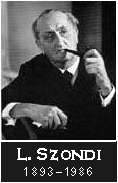
Leopold Szondi contributed to modern thought the notion
of a distinctly ancestral or familial dream. The breakthrough came in l916,
when Szondi was a 23 year old medical student and serving as a medic in the
Austro-Hungarian army. After being wounded in combat, he went to Vienna for
convalescence, and there he fell in love with a language teacher, who was a
blonde, of Saxon and Aryan descent. He recalls:
One night I awoke from a dream, in which my parents
discussed the sad destiny of my eldest half-brother. He had studied medicine
in Vienna more than 30 years before me, and he had also fallen in love with
a language teacher, who was even of blonde, Saxon, and Aryan descent. He had
to marry her and give up the medical exam. His marriage was not happy
(Szondi 1963, 525).
Through this ancestral dream Szondi realized that he was
repeating a familial fate pattern. Instead, he wanted to live his own life;
so on the next morning he left Vienna and returned to his regiment.
In the course of his later medical practice, Szondi came
to understand that images of the ancestors occupy the familial unconscious,
and they become manifest in dreams. The ancestral dream corresponds to the
genetic fact that the goal of forbearers is to survive in the lives of their
descendants (Szondi 1963, 79-81). As a therapist, Szondi was concerned to
help the patients work through hereditary disorders that were displayed in
dreams, because these had a bearing upon the decision-making of the
individual.
Page 101
Other than Szondi's published work, it is difficult to
find documentation of ancestral dreams in modern literature. However, we
have cited, in chapter one, Dostoevsky's dream, on July 6, 1864, in which he
dreamed of his deceased father, "and his old mother entered, my granny, and
all my ancestors." Meanwhile, Hawaiian culture maintains a documented
tradition of familial visions. Deceased relatives appeal in clear visual and
tactual form, usually during a descendant's crisis, and they mandate
personal change or proper behavior (MacDonald and Odel1 1977).
Otherwise, the most accessible source is the evidence
initially compiled in the nineteenth century by the British Society for
Psychical Research. Although Frederic Myers began to document familial
dreams, another member of the society went on to publish a connection of
deathbed visions. William Barrett, Professor of Physics in Dublin,
published his material in 1926, and his work was subsequently reissued
(1986). Barrett provides a helpful classification of different kinds of
visions.
He describes what should be called apparitions of
deceased relatives and friends by those who are dying. In some cases the
dying had already known of the death, and, in others, they learned of the
death while they are dying. Whether their death were known or not, when
beholding a deceased relative, one tends to brighten up with joy and
ecstasy. The following example has been carefully and critically witnessed
by a nurse:
I recall the death of a woman (Mrs. Brown, aged 36) who
was the victim of that most dreadful disease, malignant cancer. Her
sufferings were excruciating, and she played earnestly that death might
speedily come to her and end her agony. Suddenly her sufferings appeared to
cease; the expression of her face, which a moment before bad been distorted
by pain, changed to one of radiant joy. Gazing upwards, with a glad light in
her eyes, she raised her hands and exclaimed, "Oh, mother dear, you have
come to take me home, I am so glad." And in another moment her physical life
had ceased (29).
A familial apparition may disclose the fact that a loved
one has attained forgiveness in death:
Page 102
The dying man… .suddenly looked up, opened his eyes wide,
and looking at the side of the bed opposite to where his wife was,
exclaimed, "Why, Mother, here is Tom [recently deceased son], and he is all
right, no marks on him [from a fatal railway accident]. Oh, he looks fine."
Then after another silence he said, "And here's Nance too." A pause, then
"Mother, she is all right, she has been forgiven" (50).
Barrett explains that the man could die after learning of
the forgiveness of his daughter. She had given birth to a child out of
wedlock and died, after which the baby was born. She had no time to repent.
Barrett records several cases featuring what Frederic
Myers called "travelling clairvoyance," in which the dying behold living
persons at a distance and, occasionally, they share reciprocal visions. For
example, a woman is terminally ill but says she cannot die, until she sees
her children who live in another city. This happens, and then after ten
minutes, she announces: "I am ready now; I have been with my children" (83).
Barrett points out that when notes taken at the place of death and of the
children' s residence were compared, the day, hour, and minute were the
same.
Barrett's cases demonstrate an acceleration and expansion
of thought at the brink of death. The mind becomes more alert and aware.
Such enhanced mental activity occurs clearly in the case of Jack, a deaf
mute, who is dying with rheumatic fever. His hands and fingers are so
swollen that he cannot gesture, but, white lying on his back, suddenly his
face lighted up with the brightest of smiles. After a little while Jack
awoke and used the words "heaven" and "beautiful" as well as he could by
means of his lips and facial expression. As he became more conscious he also
told us in the same manner that his brother Tom and his sister Harriet were
coming to see him (100).
Since they lived in a distant city, this knowledge had to
come from his clairvoyance. After Jack's partial recovery, "he told us that
he had been allowed to see into Heaven and to hear most beautiful music."
Barrett does not develop a general theory of death-bed visions, but he
points to a "transcendental self of the subject independent of
the
Page 103
fundamental units of the physical world-matter, time, and
space" (169). The transcendental self emerges in the face of death and
achieves a psychic relatedness with other selves, whether living or dead, by
means of telepathy. Within a transcendental relatedness the space-time,
causal world of the living is relativized. Barrett's brief description of
the transcendental self is virtually identical to Myers' subliminal self and
Jung's Self, and similar to Szondi's Pontifical selfhood.
V. "TAKE-AWAY" VISIONS
Barrett's seminal study remained unexamined for about
fifty years, until Karlis Osis and Erlendur Haraldsson published an
influential study of death-bed visions (1977). On the basis of one
thousand terminal patients in the United States and India, they found
death-bed visions to be authentic and meaningful factors in dying. One of
their major concerns was to distinguish visions from hallucinations.
Hallucinations are produced by the sick brain as defenses against stressors.
Brain disease, uremic poisoning, 103 F. temperature, and drugs are specific
causes of hallucinations. Sensory content of hallucinations tends to be this
worldly, unclear, and variable.
In contrast, visions manifest a clear and coherent
consciousness, "otherworldly" content obtained by telepathy or clairvoyance,
which is consistently uniform. Although visions may mix occasionally with
hallucinations, they are fundamentally independent of physiological and
pathological processes. While the authors' definitions are conceptually
consistent; their argument is flawed by frequently interchanging terms of
hallucinations and apparitions.
Nevertheless, they observe that most visions last a short
time, whether five, 15, or 30 minutes (61). After the vision ends, the
patient dies relatively quickly, usually within an hour or two. The closer
to the time of death the vision is, the more likely it will reveal
otherworld quality. Primary contents are living persons, the dead, and
mythic or religious figures. About half of all visions have a "take-away"
function, in which deceased relatives arrive to escort the patient to
another world (67).
Normally, dying patients respond positively to the
escorts. Their faces brighten up, and they become elated or transfigured.
Momentary fear, anxiety, or depression may be felt, but these tend to be
transitory. The "take-away" quality is the mandate that causes the mood
elevation
Page 104
of the patient. Visions are distributed equally among
males and females, young and old, educated and uneducated. Higher education
may enhance understanding of the vision, but it is not the cause. Similarly,
a prior belief in life after death may be a contributing factor but not the
cause of the vision Osis and Haraldsson contend that the terminal patient's,
positive affects come from a clear, coherent grasp of a real other world
(80). Otherworldly states have an intentionality irreducible to patients'
needs and desires. The authors also concede that the mind loosens or
dissociates from the body in the face of death (128, 131). They draw an
analogy of dissociation from schizophrenia, but in light of Frederic Myers'
work and Dostoevsky's experience a better analogy for mental dissociation at
death would be epilepsy, in which ecstatic joy is experienced. Nevertheless,
the argument of Osis and Haraldsson clearly deviates from that of
psychoanalysis, according to which elation comes from regression to the
pleasure principle, from a temporary suspension of the reality principle,
and from a return to infantile .omnipotence. In contrast, Osis and
Haraldsson maintain that the joy of the "take-away" visions derives from an
otherworld beyond the reality principle.
VI. ASSESSMENT OF VISIONS
In current discussions, Robert Kastenbaum offers a
critique of death bed visions in his text-book (1991, 324-325). He charges
that the research mode of the Osis and Haraldsson study is impaired by its
retrospective approach. Data were actually recollections gathered by health
care-givers, who lacked training in research methods. Some of their
recollections went back many years and might have become vague or
unreliable. Some of the witnesses even disagreed with one another and,
therefore, were too subjective. Kastenbaum emphasizes the personal needs of
the patient. Since dying patients tend to deny their own deaths, it is
difficult for them to attain acceptance. As biological creatures concerned
with survival, humans cope with death by needs and projections. On the one
hand, we deny death; and, on the other, we project the survival of death in
the form of a desired immortality. Impending death creates a splitting
within the patient. Part of the self denies death, while another part of the
self communicates a fantasy of survival by means of desire. Hence, desire
for immortality arises from the pleasure principle with its defense against
Page 105
a real threat of death. Kastenbaum's argument presupposes
Freud's opinion that the unconscious knows no death and his conception of
the brain as a closed physical system. Kastenbaum's argument also
exemplifies the "split-off" phase, a stage of terminal illness recognized by
psychoanalysis. Esther Dreifuss-Kattan defines the "split-off' phase:
Two opposite ideas are verbalized: one, a full
realization of the closeness of death; the other, a faith in surviving,
often expressed in vivid fantasies about the future. The perception of this
split and the
psychological handling of it is, for those surrounding
the patient, extremely difficult, since the split stands in opposition to
the reality principle that governs our ordinary, day-to-day existence,...
(1990, 102).
Dreifuss-Kattan contends that the suspension of the
reality principle activates the timeless mother-child union and its rich
fantasy' sources. The "split-off" phase is irrational but not psychotic,
because the dying patient acquires a heightened awareness, while ego
functions remain intact. Evidence of the nonpsychotic character of the
"splitting" appears in writings or drawings produced by terminal cancer
patients. Such works embody creative fantasies that offer hope as forms of
reparation. Creativity nullifies the negative effects of disease, such as
pain, and draws out symbolic images from the unconscious. Symbolism makes
restitution and strives for healing in the dying process.
The combined arguments of Kastenbaum and Dreifuss-Kattan
are compelling and clinicaIly sound. Certainly, the "split-off" phase comes
amid the stage of visionary activity in terminal illness.
However, the "split-off" phase has been interpreted differently by Jungian
psychology. It is acknowledged when a patient becomes withdrawn and
demoralized, or seems far-away and detached, as though no human relationship
had any more meaning. The "split-off" phase means the cessation of the
wishing and fearing ego as well as the breakthrough of a spiritual
consciousness (von Franz 1987,111, 116-117). The spiritual
consciousness represents the Self, which transcends time, space, causality,
and survives bodily death. Reparative processes of terminal illness are also
breakthroughs of the timeless realm of the psyche. The Jungian
interpretation has the virtue of recognizing a positive transcendental
function rather than a regression.
Page 106
Having reviewed the clinical context of death-bed
visions, it is necessary to discuss an evaluation. First, the Osis and
Haraldsson study is, admittedly, retrospective and subjective, as Kastenbaum
insists. However, when reading the vision literature as a whole, this
objection cannot be maintained; for data on death-bed visions have been
carefully collected and rigorously analyzed, particularly by the British
scholars in the nineteenth century. Methodologies employed by Myers, Barrett
and their colleagues Calle from the so-called "hard" sciences. Eye-witness
accounts were verified, making the body of literature as a whole reliable.
Ironically, Kastenbaum confesses that he has witnessed several death-bed
visions, and he continues to wonder (1991, 325). His admission implies that
death-bed visions are dramatic, overpowering, and not easily forgotten. To
ensure accuracy witnesses should simply record or write out what is
occurring.
Second, the purported need to deny death for the sake of
survival may be challenged in light of evolutionary genotropism. As defined
in charter two, genotropism is a reciprocal attraction between carriers of
the same or related genes. This means that relatives share higher
concentrations of identical or related genes compared to general
populations. The reason for such genetic clustering is that genes promote
their own survival by creating reciprocal attraction between carriers.
Organisms have the tendency to select similar or identical genetic types,
whether genealogically related or not. Gene relatedness is a fundamental
fact of evolving nature, and it precedes phenotypic traits '\ of appearance,
face, and class.
Genotropism illumines a basic fact that serves as a
cornerstone of the theory of natural selection, namely, the experience of
altruism. Within the animal kingdom animals allow themselves to die on
behalf of a relative or offspring, and they expose themselves to mortal
danger in defense against territorial intruders (Smith 1964). For example, a
parent animal may give up food for an offspring, when resources are scarce.
Birds engage in apparent "suicide" attack behavior toward
a territorial intruder, who threatens the family nest during the breeding
season. While the parent animal might die, at least half of the genes
survive in the descendant's gene pool. For the same reason, when a human
dies in order to save family members, copies of one's own or related genes
will survive (Dawkins 1976, 97).
A corresponding willingness to die among humans occurs in
the clinical pattern called "predilection to death," involving persons who
Page 107
know they are dying and may even predict the time of
death accurately. They look forward to a reunion of familial relationships
in death and, consequently, feel neither grief nor fear (Weisman and Hackett
1961). predilection cases should not be confused with "Voodoo" death or with
suicide, which involve lethality and tools. Predilection to death is a
natural willingness to die, motivated by the needs to escape unmanageable
pain and to resume a love relationship in death.
Within the history of religions the predilection to die
correlates with the "dying at will," as practiced in Hawaii and other
Pacific cultures (Sato 1964, Cooke 1976). One dies intentionally and
naturally, without starvation, tools, or disease. Dying at will is done
mainly by older Hawaiians, who maintain the beliefs of the traditional
ancestral religion and who claim that non-Hawaiians are unable to perform
it. One version of the "dying at will" is the Hawaiian "take my life
instead" ritual. When one is seriously ill, another member of the family
prays to die instead and does die. Normally, it is a child who suffers a
life threatening illness, and an older relative dies in his or her place.
One Hawaiian scholar relates that "her nephew was awfully sick, and my
great-grandmother chose to die that he might live. He lived. She died"
(Pukui 1972, 134).
Dying often coincides with a vision of an ancestor, most
frequently a grandparent or grandchild. Records of visions are kept at Queen
Liliuokalani Children' s Center in Honolulu, and one typical example
follows: "TuTu sat up in bed and said, 'Look! the relatives [Aumakua]
are waiting for me!' and then she was gone" (ibid, 13).
In traditional Hawaiian religion the ancestors belong to
four broad groups of descent, each one correlated with a primal element:
Pele, goddess of the volcano (fire); thunder and lightning (air); sharks
(water); and turtlesand lizards (earth). When received by the ancestors, the
dying patient is transfigured in an appropriate manner (Kamakau 1964,
64-65). For example, descendants of Pele envision columns of fire. These
lines of familial descent are designated by paroxysmal symbols, implying
that familial relatedness copes with the shock suffering of death.
Altogether, the combined evidence of dying at will,
predilection to death, and biological altruism suggests that genotropism
operates in death. The natural willingness to die is motivated by an
unconscious, genotropic attraction to close family members.
Page 108
Third, it is surely correct to emphasize as Kastenbaum
does, that dying patients face death in terms of a need. Psychoanalysis
assigns biological priority to the sexual drive, and since it ceases at
death, then death must be denied. My question is: What need takes priority
in terminal illness? As stated above, preservation of the individual
organism is not absolute in evolution, since in times of mortal danger
altruism compels a willingness to die. This fact conforms to the paroxysmal
pattern rather than the sexual drive. Terminal illness activates the
paroxysmal pattern in defense against the onset of death. This defense takes
shape through dreams and visions, through the symbolism of air, earth, fire,
and water, and through the acceleration of the psyche. Following the
psychiatric study of epilepsy, paroxysmality must be distinguished from
sexuality.
The root need of the paroxysmal pattern is that of
atonement . (inverse by lb). The intent of
accelerating thought at the brink of death is to make restitution as a
condition of wholeness. Once the restitution need is satisfied, one opens up
to a transcendent dimension and seeks to strip away the body. Going beyond
the body fulfills the primal drive for metaphysical participation in
fundamental reality. This paroxysmal-participatory mode usually rotates into
the dying person's foreground as a "split-off' phase.
Traditional Hawaiian religion provides a clear
illustration of the paroxysmal-participatory phase of dying. One turns
toward the ancestors who dwell in the eternal. There is a sea of time, so
vast man cannot know its boundaries, so fathomless man cannot plumb its
depths. Into this dark sea plunge the spirits of men, released from their
earthly bodies. The sea becomes one with the sky and the land and the fiery
surgings that rise from deep in the restless earth. For this is the
measureless expanse of all space. This is the timelessness of all time. This
is eternity (Pukui 1972, 35).
The island represents the waking ego, the ancestors the
familial unconscious, and the ocean the collective unconsciousness. Freely
joining the ancestors transfigures the dead and relativizes the oceanic
horizon into the eternaI.
Page 109
CHAPTER FIVE: DREAMS AND VISIONS OF GRIEF
I. IMAGERY AND GRIEF WORK
Frederic Myers observed that dreams and visions appear to
bereaved survivors for one year after a death, and he justified this
observation by grounding dreams and visions in the veridical afterimage.
(Hughes describes “veridical afterimage” on page 10 as:
“Visions of the dead are called phantasms and are defined as a manifestation
of persistent personal energy," that is, a residue of one's
personality when alive. The residue is an afterimage, to which Myers
attaches the adjective veridical. (in Swedish = sann-färdig, trovärdig;
sandröm. LB). By “veridical afterimage” Myers means a real but
nonmaterial form, left over after one's death. It is carried by telepathy
from the deceased being to the living person, who encounters it
unconsciously through a nonpathological dissociation of consciousness.
Veridical afterimages seem to erupt like waves from the depth of the
subliminal self.”)
Myers' contention accords well with mourning even though
he did not conceptualize the grieving process as such. When grief became
understood clinically in the twentieth century, dreams and. visions were
relatively neglected. The principal theoretical reason was that in "Mourning
and Melancholia" (1917) Sigmund Freud formulated grief primarily as a
process of separation from the deceased (1959 C.P.IV). Attention to dreams
and visions might inhibit the necessary process of detachment; for according
to psychoanalysis they exhibit a failure of reality testing and infantile
regression. In psychoanalysis the imagery of dreams and visions is a
hallucinatory retention of the lost object. Essentially, grief is a personal
response to the loss of a dependent or interdependent relationship. Despite
Freud's pioneering insight, the principal theorist of grief in the twentieth
century is Erich Lindemann, whose classic study of survivors of the Cocoanut
Grove fire in Boston established the definitions of acute normal, delayed,
and abnormal grief (1944). Basic to acute grief is a common
syndrome, comprising bodily distress, specifically, "waves lasting from 20
minutes to an hour at a time," along with tightness in the throat, choking,
difficulties in breathing, need for sighing, feeling of emptiness,
powerlessness, and mental tension or pain (141-142). These bodily symptoms
co-exist with
Page 110
guilt, hostility, loss of behavioral patterns,
identification with traits of the deceased, and preoccupation with a mental
image of the deceased.
Lindemann points out that a morbid reaction could
take place, if the mental image were to replace grieving by the deceased,
whose senses would be altered by the shock of death. "There is commonly a
slight sense of unreality, a feeling of increased emotional distance from
other people (sometimes they appear shadowy or small), and there is intense
preoccupation with the image of the deceased" (142). The latter is "a vivid
visual image of his presence," in the words of one widow (143). At the same
time, the bereaved displays increased activity, mobility, and speech; but
these are not necessarily well-organized or goal-directed. These
characteristics are expected to appear during the first seven or ten days
after the death, which is the period of the most intense grief.
After this initial intensity of grief diminishes
somewhat, the bereaved faces a series of tasks, known as grief work.
Generalizing on Lindemann's papers, grief work consists of (1) real
acceptance of the actual fact of death; (2) feeling the pain; (3) balanced
recollection of the life and death of the deceased; (4) gradual separation
of the bereaved from the deceased; and (5) resumption of interpersonal and
social activity, even while acknowledging the finality of the loss (1944,
1976, 1980).
Central to grief work is the change of the meaning of the
deceased, specifically, the transition from a physical being to a spiritual
presence within the bereaved.
This shift is both
difficult and constructive, because the loss hurts and sometimes requires
taking on a new familial or social role. Although the person has departed,
he or she remains in the minds and hearts of the survivors. Lindemann calls
this change resurrection, and he defines it as a "fervent effort to
resurrect or make permanent what the deceased person had to offer (1976,
202)
“Resurrection" includes a reallocation of the functions
of the deceased in the network of survivors, internalization of one or more
of these functions, and actualizing these for oneself. Avoidance of the
vivid imagery, accompanying these tasks, obstructs resurrection
and delays or disturbs the grief work.
Even though Lindemann recognized the significant role of
imagery in grief work, only a few clinicians have examined it since his
death in 1972. One reason for the relative neglect is confusion in
definitions. For example, in a study of 227 Welsh widows and 66 widowers
Dewi Rees explains that "a sense of the presence " of the deceased spouse
was
Page 111
reported in 46.7% of deaths. He writes that the term
'hallucination' is used to include 'a sense of the presence of the dead
person,' in addition to visual, auditory, and tactile hallucinations" (Rees
1975, 66). His definition is tautological, because it confuses the meanings
of presence and hallucinations. Despite the logical and semantic confusion,
the Rees study contains significant empirical data. Along with "the sense of
presence,
14 % had visual "hallucinations," 13.3% auditory, and
2.7% tactile. "Hallucinations" were more common for those who had happy
marriages, with children, and who belonged to professional and managerial
classes. Rees judged the "hallucinations" to be normal and common,
unassociated with illness or abnormality, but helpful in the grieving
process. To illustrate, same of his case material is quoted below:
"He seems so c1ose" (widowed 7 years). "I heard, how
shall I put it, sounds of consolation for the first three months" (widowed
26 years). "I feel him guiding me" (widowed 15 years).
"I fancy, if I left here, I would be running away from
him. Lots of people wanted me to go, but I just couldn't. I often hear him
walking about. He speaks quite plainly. He looks younger, just as he was
when he was all right, never as he was ill" (widowed 9 months). (69)
If these presences were helpful to the bereaved, then
they should not be described as hallucinations. As defined in chapter four,
hallucinations leave people unchanged. Since these phenomena facilitate
grief work, they should be given a positive reference that respects the
intent of dreams and visions. Presence is an appropriate term, and it has
been defined as an "experience in which the subject, in clear consciousness,
suddenly becomes aware of the presence of another person in the immediate
vicinity, although the subject may in reality be alone, or in the company of
others" (Thompson 1980,628). Despite the tautology in the definition, the
author attempts an original formulation by using the German term
Anwesenheit for "presence." He distinguishes it from sensory objects,
hallucinations, and delusions. Usually, the identity of the presence is that
of a deceased relative, who offers comfort but sometimes a threat. Presence
comes involuntarily, in the manner of an
Page 112
epileptic aura, and it is normal in grief. Therefore, the
presence, if properly defined, facilitates the resurrection phase of grief
work. From the perspective of ego psychology, presence conforms to the
dynamics of introjective-participation. After the death, the bereaved person
incorporates the image of the "deceased" through identification.
Death releases an unconscious introjection mechanism that
works like a camera, photographing images of the lost object (Szondi 1956,
199).
The intensity of the affective and traumatic impact of
the loss influences the sharpness and clarity of the photographic image
(Hyper-Introjektion). The bereaved maintain the images in a mental
album. The primary intent of the introjection is to restore the
relationship, because ego states obey the primal drive for participation in
social and metaphysical reality. As will be discussed below, dreams and
visions of grief may also introject the presence of a deceased ancestor. A
familial introjection bears upon the role of decision-making in grief work,
such as ending mourning or making vocational choices.
Whether personal or familial, introjective-participation
means that fundamentally grief work is a matter of relatedness. Even though
a physical being has died, the relationship has not. The relationship
continues after death, and grief work means that it must change.
Completed grief work signifies the achievement of a
spiritual relatedness with the deceased, or resurrection, as Lindemann
would say, as well as an adaptation to social and
metaphysical reality. Complicated or uncompleted grief work indicates a
maladaptive response to reality, fixation on the introjected object, and
disorganized behavior. Complicated grief work remains a distinct
possibility, because the loss of a dependency relationship, even if
liberating, carries a hidden depressive mood (Szondi 1972, 194).
Similarly, Jungian psychology recognizes that mourning is
partly detachment from the lost object but mainly the creation of a new
relationship with the dead. The medium of bereavement relatedness is the
creative imagination. Drawing upon the work of Jung and Corbin, Greg
Mogenson has developed an imaginal view of mourning as "greeting the angels"
(1992). He means that after the separation phase of grief work the dead
reproduce themselves as essential, imaginal beings, who are autonomous and
who should be respected as ends in themselves. The imaginal forms need not
be interpreted but simply incorporated into the living. As long as the dead
are internalized by the bereaved, then the latter
will not be projecting or introjecting the lost
Page 113
object in the mode of abnormal grief. Rather mourning is
soul-making; for the dead dwell in the soul like photographs in a family
album (24). Grief develops the images in the film of death. Although Szondi
had already stressed the notions of the photograph album and ancestral
presence, the Jungian approach is a constructive affirmation of the adaptive
aspect of grief work. However, the Jungian method tends to neglect the
critical psychodynamic phase of grief work, such as ambivalence and despair.
What if the deceased were greeted not as an angel but as a terror of the
night? What if the dead were felt as hauntings? In such cases, the analysis
should examine the quality of the relationship between the bereaved and the
deceased. Mogenson has written an original and stimulating study of grief,
stressing the transition from relatedness to imaginal being. However, his
selection of case material omits, in some areas, specifically death-related
imagery. For example, in his chapter on bereavement dreams, the examples
chosen derive from a divorce rather than from death (89-97). Divorce yields
a being who has departed but not one who has died. In conclusion,
hallucinations, presences, dreams, visions, and apparitions emerge in the
grieving process, and all but hallucinations contribute to the completion of
grief work. It is imperative to discover and interpret these imaginal
phenomena, because in contemporary society often the bereaved receive no
guidance from established social or religious rituals. The demonstrated
value of traditional mourning rituals is that they channel feelings aroused
by the death, prescribe constructive behavior, and help the bereaved to
reintegrate with familial or social groups. As substitutes for rituals,
dreams and visions appear, and provide a subjective narrative framework. In
whatever form they take, bereavement images reflect the nature of the
relationships involved. They obey the law of participation.
II. BEREAVEMENT DREAMS
Sigmund Freud interpreted bereavement dreams as
fulfillments of a death wish (1953, S.E.IV, 249). The death wish is not
satisfied in the present time but in the past. Hence, to dream that one's
mother has died, after her actual death, satisfies an earlier death wish
against her. While this type of situation may occur, this theory cannot
apply to all cases but only to those in which the grief entails an intense
sense of guilt.
Page 114
In contrast, Jung viewed bereavement dreams in terms of
the process of self-realization. The dream displays the deceased in his or
her primal form, objectively, and devoid of projections and emotions. Jung
achieved this insight, after the death of his wife Emma, who appeared in a
dream, having the quality of a vision:
She stood at same distance from me, looking at me
squarely. She was in her prime, perhaps about thirty, and wearing the dress
which had been made for her many years before by my cousin the medium. It
was perhaps the most beautiful thing she had ever worn. Her expression was
neither joyful nor sad, hut, rather, objectively wise and understanding,
without the slightest emotional reaction
Jung's experience offers an excellent example of a
bereavement dream as a constructive event, but we do not know whether the
dream says something about the nature of his marriage or about the grief
process in general. To supplement Jung's basic insight a theory of
bereavement dreams should acknowledge the respective personal, familial, and
collective/archetypal regions of the unconscious, and indicate how these
bear upon grief work.
Bereavement dreams can arrive shortly before a death or
sometimes after, possibly a few days after or several weeks. Dreams signify
the fact that, although someone has died, the relationship with the bereaved
continues. Dreams reflect the fundamental relational constitution of human
beings. Generally, the content of a normal bereavement dream is clear,
undistorted, and the deceased is portrayed in a youthful, healthy, or
non-terminal manner (Gorer 1973, 430). Should the deceased be presented as
sick, aged, or dying, along with unclear, distorted lines, then the dream
reflects an on-going complication in the relationship with the deceased.
Such a dream signifies that grief work is either inhibited or uncompleted.
When the deceased has no shape at all, then the bereaved has not brought the
relationship into self-consciousness. A severe conflict may be present
unconsciously, and participation is blocked in same way.
In the remainder of this section same examples of
bereavement dreams are presented and discussed. The first comes from a
former student of mine who had a dream, recurring three times during her
father's death. Three days before his death, she had the dream twice,
Page 115
once in the morning and once in the evening. The dream
appeared once after his death. On each occasion the dream was the same. The
significance
of a thrice-repeated dream is that conflict is being
resolved and brought up to the threshold of consciousness (Benz 1968, 15).
As an illustration, Dostoevsky's dream of his father, his ancestors, and the
father's diagnosis of his tuberculosis also came three times (Frank and
Goldstein 1987, 353-354). The student describes her dream as follows:
It was late at night and my whole family was together in
our living room. I was standing in the dining room watching my family. My
father was sitting on the sofa and my two sisters were on either side of
him. My mother was sitting on a chair next to them. My father was playing
with my dog that was very old and feeble. It had been a long time since my
dog was well enough to play ball, and he was running around like a puppy
again. We were all laughing at him as he tried to get the ball away from my
father. My father acted as he had when he was well, smiling and happy. I
could see his face very clearly and I felt good seeing him looking so well.
I was standing away from my family looking and talking to
them. I can't remember what I was saying, but I believe I was complaining
about something being wrong. My father looked up at me and said: "M., don't
worry. Everything's going to be all right. Don't worry." I remember feeling
greatly relieved....
The dreamer's waking consciousness recedes, while
familial figures take center stage. The father's change from a dying to a
healthy state in the dream signifies surpassing the threshold. His message
of consolation, presented as a mandate, indicates positive adaptation in the
dreamer's grieving. The key archetypal symbol is the dog. In reality the dog
was old and feeble, but in the dream the dog becomes a puppy again.
The appearance of the dog is an archetypal affirmation of
normal grief work. In Old Iranian religion and Zoroastrianism the dog is the
mediator between the living and the dead (Boyce 1989, 144). Zoroastrian
Creation Theology ranks dogs next to humans in order of value. In the Hindu
Vedas two dogs are messengers of Yama, god of the dead; and they find those
who are about to die and take them to the
Page 116
other life. In Zoroastrianism two dogs await the soul of
the deceased at the Chinvat Bridge. For the dying, the last rites are
performed three times. Thus, the three fold appearance of the dream, the
ritual use of number three, and the dog reflect the religious culture that
developed the symbolism of the bridge.
A second example comes from a former student, whose
father died in the fall of 1989. Having been a severe a1coholic, he
generated a deep ambivalence in his daughter. She loved him but hated his
drinking. In February, 1990, on the night of his birthday, she dreamed that
"my father was at my house and he was a recovered alcoholic. He said he was
going to be fine and he would never leave me again."
Another dream appeared, in which she could not see her
father's face dearly but knew it was he:
He was very ill and had come to apologize to me for never
really sharing my childhood and watching me grow through my teen years. He
said that it was probably for the best that he wasn't around, because he
wouldn't have been much of a parent because he was too involved with his
drinking.
The house in the first dream represents the dreamer's own
psyche, as inferred from Jung's house dream (1961, 158). Both dreams deal
with the dreamer's need for attachment to the father. In the first dream the
need is satisfied; but in the second it is not, because the absence of the
father's face means that the relationship has not achieved
self-consciousness. Here the grief is intense, and the sorrow over the
father's remorse suggests loneliness, broken bonding, and incomplete grief
work. Viewed together, both dreams convey a profound ambivalence.
A third example consists of a series of bereavement
dreams reported by the Jungian scholar Marie-Louise von Franz (1987,
111-112, 133, 148). Her father had died suddenly, when she was away from
home, and she had the following dream about three weeks after his death:
It was about ten o'dock in the evening, dark outside. I
heard the doorbell ring and "knew" at once somehow that this was my father
coming. I opened the door and there he stood with a suitcase…….. I know
that I am dead , but may I not visit you?”
Page 117
I said: "Of course, come in," and then asked, "How are
you now?"
Her father explains that he has returned to Vienna, his
home-town, that he is studying music and is happy. He says he is only a
guest now:
"It is not good for either the dead or the living to be
together too long. Leave me now. Good night." And with a gesture he signaled
me not to embrace him, but to go. I went into my own room, thinking that I
had forgotten to put out the electric stove and that there was a danger of
fire. At that moment I"woke up, feeling terribly hot and sweating.
Following Jung, she interprets the dream as a statement
of the bereavement situation. Her father had died and had become content.
The motif of the stove and fire at the end is a compensation for the fact
that the dead are cold; e.g. the dead are "split-off" from the living and
their warmth and relatedness.
In my view, the meaning of the stove is entirely
different, and it bears upon the nature of epilepsy; namely, fire as a
psychic equivalent of a latent epileptiform condition (Szondi 1956, 99). The
"danger .of fire" is the threat of pent-up emotion, triggered by the absence
of the father, and probably an upsurge of anger. Waking up hot and sweating
designates a post-paroxysmal consequence of an emotional discharge.
Furthermore, about six weeks after his death, she dreamed
of her father as healthy and alive, even though she knew he was dead:
He said to me in cheerful excitement, "the resurrection
of the flesh is a reality. Come with me, I can show it to you." He started
walking toward the cemetery where he was buried. I dreaded to follow him but
I did. In the cemetery he walked around and between the graves, observing
every one. Suddenly he pointed to a grave and called out. "Here, for
instance, come and look." I saw that the earth there had begun to move and I
stared in that direction, full of dread that a half-decomposed corpse was
about to appear. Then I saw that a crucifix was drilling its way upwards out
of the earth. It was about one meter long, golden-green and shilling. My
father called out, "Look here! This is the resurrection of the
flesh."
Page 118
As a Jungian, her starting point is ancient alchemy and
the archaic pre-Christian psyche. Accordingly, the green-gold crucifix is
animated metal, and in alchemy this symbolizes a union of opposites. The
suffering implied in the archetype of the crucifix is that of unreconciled
opposites. Hence, the dream portrays the resurrection body as a union of
opposites, which is the fulfillment of the self and which is joined to the
ego, namely, her father's identity.
I read this dream instead as an expression of grief work.
Here resurrection simply means newly completed grief work, as Lindemann has
explained, but the crucifix and the dread indicate that the dreamer has not
yet made the decisive sacrifice, or break from the deceased, and resumed
social interaction. Her grief work is not finished.
Finally, she describes a dream coming five years after
her father's death, in which she and her sister jump onto tram number eight,
heading for the
center of Zurich. They realized that they have made a
mistake and are going in the opposite direction. The conductor
(controlleur) walks through the tram, wearing a hat with the letters
EWZ, which designate the Electricity Works of Zurich.
At the next tram stop we got off and there a taxi drove
up near us and out of it-came my father! I knew it was his ghost. When I
started to greet him he made a sign not to come too near him and then walked
away to the house where he had lived. I called after him. "We don't live
there any more." But he shook his head and murmured, "That doesn't matter to
me now."
The key dream motifs are the number eight and the
conductor (controlleur). In alchemy eight is the number of
completion, and the "controlleur" is associated with the control in
spiritualistic séances "who mediates between the medium and deceased
spirits. Since the "controlleur" is from the electrical works, he
signifies a transformed frequency of currents. Thus, death as the goal of
self-realization is also an energy transformation beyond a certain
threshold.
Her insight into the threshold function of the dream
contributes to a unified theory of dreamwork, as developed in chapter four,
section two. Here I would observe that the three bereavement dreams have had
the threshold function of working the grief to that of separation from the
deceased. The notion of electrical works relates to that of heat and fire in
the first dream, where it means pent-up emotion, such as anger. In
Page 119
this, the third dream, the e1ectricity denotes the
sublimation of anger. The dreamer has essentially come to terms with her
father's death and is able to live with the anger of his abrupt departure.
_ Sublimation of anger points to the possibility of
restitution, as expressed archetypically. Historically, alchemy did not
evolve in complete separation from Christianity; for example, the Lutheran
mystic Jacob Boehme used alchemy to interpret the world as alive (Koyre
1968, 45). Thus, the number eight could also refer to the eighth day of
Creation or the resurrection. Making a Christian application of the number
eight allows the second dream, with the resurrection of the flesh, to cohere
with the third dream. Since restitution is a liberating experience, making
possible participation in fundamental reality, then the controlleur
would be the pontifical self which is the inner controller.
III. BEREAVEMENT VISIONS
In the grieving process the sense of presence often comes
in the form of a vision. The visionary presence is involuntary, frequently
overpowering, and usually consoling; it is neither a sensory object nor a
feeling. Since
the vision comforts the bereaved, it may appear toward
the end of mourning, signifying the completion of grief work. In the
following two examples the recipients of the vision do not startle, but in
the absence of anxiety achieve a deeper and wider participation.
The first case illustrates how the presence, which comes
during a marital crisis, helps a man accept his grandfather's death:
Suddenly I felt someone behind me, and turned around and,
God, it was my grandfather. He was sitting there, perfectly real, and kind
of smiled at me. My body felt relaxed, I wasn't shaking any more, and seeing
him there was so strange that I wasn't even startled. We just looked at each
other, maybe for half a minute, and then he just was gone. I cried for some
time, but I felt after that I had made my peace with him. I still missed
him, but things were somehow different. I wasn 't carrying him around
inside of me, he was finally gone (Hoyt 1980-1981, 106).
The second example comes from a former student, whose
father died on January 26, 1979, when she was nine years old and the
youngest child in the family. He died unexpectedly in an automobile
accident.
Page 122
My student informs me that the story has an epilogue. A.
had attended the funeral of her great grandmother and took home a rose from
a bouquet.
A. placed the rose in a vase filled with water and placed
the vase on her bedroom window sill. Naturally, the rose had died within a
few days, and the petals had withered away. Over the next few weeks, and
parallell to A.'s visitations, the rose stem sprung to life, and to this day
it still remains alive.
The rose remained alive, at 1east, until July, 1992, when
I officiated at the wedding of the student and A.'s mother. In my view the
angel is an exact projection of the physical features of the mother, and the
angel's white dress is the mother' s wedding gown. The projected presence of
the mother assures the child in facing the momentous change brought about by
the wedding. The mother had been divorced for several years and was
preparing to be remarried.
The springing to life of the rose is an example of
psychokinesis, which psychoanalysis explains as an externalization of
aggressive energy, usually by adolescents feeling sexual conflict. The
discharge of energy is destructive of objects in the environment. However,
the psychoanalytic explanation fails to fit in this case for two reasons:
the subject is pre-pubescent and the energy is constructive not destructive.
Meanwhile, the other episodes are genuine ancestral visions, and, in the
absence of a convincing psychoanalytic explanation, may have discharged
energy that effected the rose. It is already known that dying organisms emit
intense electromagnetic energy (Morse with Perry 1992, 142). While this
might be too speculative, the projected image of the mother, the ancestral
visions, and the new life of the rose express, respectively, the personal,
familial, and archetypal unconscious regions of the girl.
IV. TERRORS OF THE NIGHT
When Frederic Myers conceptualized the subliminal self,
he acknowledged a phenomenon of nocturnal paralysis, believing it to be a
nightmare associated with hysteria (I 1903/1954, 124). It occurred on the
border between sleeping and waking, and it produced imagery with so much
visual power that it lingered as an afterimage.
Page 123
A similar observation appears in the new scientific
school of dreams. Dream-like forms, called hypnopompic hallucinations, come
on arousal from sleep and extend into waking consciousness; and when they
combine with sleep paralysis, terror results. (Hobson 1988, 8). The
neurological reason is that the brain cannot switch instantly from one state
to another.
The neurological explanation neglects the personal
significance of the
phenomena. Clinically, this factor has been identified as
a night terror, and, in contrast to the nightmare, it comprises four primary
characteristics:
(1) feeling of fear or agonizing dread by seeing or
hearing an intrusive presence; (2) awakening from sleep; (3) feeling of
pressure on the chest to the point of suffocation or strangulation; and (4)
becoming paralyzed and unable to move (Hufford 1982, 10-11). The intrusive
force may have location, motion, or gender. With the assault by this
presence one's eyes open widely, the heart pounds, and one perspires. Nearly
all of the victims (90%) are lying on their backs.
Since victims are lying on their backs, psychoanalysis
interprets night terrors as projections of repressed sexual or incestuous
desires. However, the primary characteristics are epileptiform and,
therefore, suggest that the night terrors represent the paroxysmal pattern.
In any case, they are neither abnormal nor depressive in themselves, but in
the grieving process they pose potential complications for grief work.
To illustrate I select the experience of a former
student, a middle aged woman, who studied with me in the fall semester,
1975. She had married a veteran of the Second World War. Once, in combat, he
was hit in the
chest by a projectile, and shrapnel remained above the
heart. A military physician recommended surgical removal of the shrapnel,
when he returned home. He promised he would, but after the war ended, he
failed to do so.
In February, 1953 he died of a coronary occ1usion. His
young widow found herself alone, having to raise their little boy, and
manage the household. In a paper for me she wrote: "I functioned in a state
of shock. It all seemed unreal. I experienced nausea, loss of appetite,
tightness in the throat and chest, and emptiness as though part of me had
died. "
For a while, she considered suicide but gave it up with
the realization that her son needed at least a parent. She had difficulty
making decisions and fervently prayed and wished that her husband might
return to help her.
Page 124
It happened for the first time about two months after his
death.
A white, ghost-like form appeared to be standing at the
foot of my bed. I could feel a presence and I tried desperately to see his
face but there was none. It seemed as though he wanted to say something but
was unable to and just stood there. The tension of waiting for something to
happen frightened me and I found myself trying to scream. The emotion was so
real that I didn't realize that I was asleep until my scream awakened me and
I found myself sitting straight-up in bed. I could see the vision so clearly
that it was difficult for me to believe that my eyes were not opened until I
awakened.
Between 1953 and 1975, the presence came regularly. She
looked forward to it and tried not to be afraid, but every night she
screamed in terror and became paralyzed. Remarkably, this presence, which
originally stood at the foot of the bed, began to move slowly toward the
corner, turn, and go along the side. Over the span of 22 years, the presence
slowly inched toward her. It seemed to be getting closer and closer and I am
afraid to come in contact with it because I fear it will smother me.
Recently I have gotten awake with my mouth filled with saliva about to choke
on it. If he is coming to take me with him I am only too glad to go. I have
been ready for death since his death occurred.
During the same 22 years, but not lasting as long, she
had a bereavement dream co-existing with the night terror:
I can see him as clear as can be in his original form but
he
has never communicated with me. There is always a group
of people around and I try to get his attention, but he ignores me. My
feelings are hurt and I stand around waiting for him to recognize me and to
come toward me but he never does. When I awake I am emotionally distressed.
About two years after the death, she married and
eventually bore two more children. The family moved from one city to another
within Pennsylvania. Nevertheless, the presence "followed" and visited her
at
Page 125
night, always in the same manner. Despite her marriage
and move, she
still wanted to be buried next to her first husband. She
thought she was crazy; but when she told me her story in 1975, I suggested
that her night terror reflected a complicated and unfinished grief work. On
the one hand, the dream had the features of a normal bereavement dream but
indicated an unsatisfied need for attachment with the deceased. On the other
hand, the
terrifying presence, with its absence of distinct form,
implies that the death has not been integrated into self-consciousness. The
ambivalent absence and presence, desire and fear manifest on-going conflict
in the relationship.
Underlying this ambivalence were two dynamic forces. One
was a clinging to the deceased, a futile hanging on to him which created the
ambivalence (Szondi 1980, 263). The other was a chronic guilt, probably due
to the fact that she never encouraged her first husband to remove the
shrapnel from his chest. Thus, a guilt-laden, agitated depression informed
her background self, and, meanwhile, in the foreground she adapted to social
reality by sustaining family life and working as a secretary.
She accepted my explanation of unfinished grief work,
and, by gaining this insight, the presence ceased its regular visitations.
However, the vision did not disappear entirely, but would reappear under two
conditions. One, if her first son, having grown up and married, would come
home for a visit, as on a holiday; and the other, when she would exchange
emotion with him by letter or telephone. In either case, the presence would
come precisely on the night before his visit or on the night after the
emotional exchange. These two conditions imply that she was sustaining the
bond with the first husband through the son.
This case demonstrates that night terrors, seemingly
supernatural forces, derive from human relationships. The intensity of
threat presupposes a distance in the relationship; for as one gets closer to
death, anxiety diminishes. Since the relationship is impaired by chronic
grieving, then the startle pattern is activated phobically. Normally, the
consoling presence of dreams and visions suppresses the startle and comforts
the bereaved.
However, the night terror reveals a personal splitting,
in which the ego, bereft of wholeness, submits to the intrusive force and
wishes to die. The night terror frustrates the need for restitution, so that
this need can only be satisfied in death.
Page 126
V. HAUNTINGS AND RADIANT APPARITIONS
Occasionally, night terrors overlap with hauntings, which
are exterior energy forces, acting intentionally, and appearing in a
specific place, either for a short or long duration. Frederic Myers
conceived of hauntings as "split-off" parts of a veridical afterimage. With
the establishment of psychoanalysis, hauntings would be interpreted as
projections of repressed or forbidden wishes by persons having low tolerance
for frustration (Kastenbaum 1984, 124).
Some common hauntings are footsteps in the hallway,
shuffling
sounds, loud noises, opening doors, rocking chairs,
luminous "ghosts," and the moving of bed covers. Less common would be
enhanced scent from flowers. A former student describes her grandmother's
terminal cancer:
My grandmother bad received these beautiful baby red
roses from a friend. And they were set on a table near where my grandmother
was lying in her bed. And my grandfather had told my mom and aunts that
every time he would enter the room and would go between the roses and my
grandmother the scent was so strong. My mom told me that she can remember
him describing it as a "scented path." This "scented path" was a direct path
from the roses to my grandmother.
The scent expresses the shock of anticipatory grief, in
as much as the sense of smell is a paroxysmal-epileptiform motif, as stated
in chapter two.
Frequently, hauntings emanate from shock deaths, such as
suicides and homicides, when restitution cannot be met. Marie-Louise von
Franz theorizes that emotional intensities of death involve a struggle
between bodily based affect and pure psychic energy. The trauma of dying
itself intensifies the psyche which, in the internal bodily struggle, expels
affects explosively. She offers an example:
When I was about twenty-four years old, I lived in a
rented room in the house of a sixteen year old girl and her nurse. One night
I dreamed that a terrible explosion occurred. The nurse and I crouched
behind a wall in order not to be hit by stones and lumps of earth flying
about. When I awakened I was informed
Page 127
that during the night the girl had committed suicide with
sleeping pills (von Franz 1987, 84).
'She explains that with suicide the life energy is not
used up naturally, and in the danger the archetype of fire takes over the
energy. As argued in chapter two, fire symbolizes pent-up emotion, which is
discharged to satisfy the need for restitution. With a suicide restitution
cannot be made in life bur only in death. Experimental data confirm that
affective energy may be experienced telepathically in dreams (Ullman and
Krippner 1973).
In her study of apparitions Aniela Jaffe has generalized
on a wide range of case material and arrived at useful conclusions. When the
dead are manifest apparitionally to relatives or close friends, they appear
radiant and transfigured by a sublime beauty. Unrelated, deceased beings are
disclosed as anonymous, veiled, shadowy, grey, or dark presences (Jaffe
1963, 56-57). Radiance denotes familial relatedness or friendship, and
radiant apparitions in the veridical afterimage facilitate or help complete
grief work. For example, a deceased father appeared to his daughter, several
years after his death. He had died, when she was nine years old, and she
grieved inconsolably for many years. One night on Christmas eve,
suddenly I heard the door open and there were soft
footsteps with a strange noise of knocking. I was alone at home and was
rather frightened. Then the mirac1e happened -my beloved father came towards
me, shining and lovely as gold, and transparent as mist. He looked just as
he did in life, I could recognize his features quite clearly, then he
stopped beside my bed and looked at me lovingly and smiled. A great peace
entered into me and I felt happier than I had felt before. . . then he went
away (57)
VI. PROJECTIVE SHOCK VISIONS
On January 26, 1983 a former student of mine, then a
social worker, discussed with me one of her current cases. A 25 year old
musician was grieving the death of his wife in a brutal automobile accident.
Two young children survived the death of their mother, and one child was a
six month old baby boy. The man had frequent flashbacks to the scene
Page 128
of the accident during the day, and at night he often
awakened with a startle. After awakening, he would behold his wife standing
at the foot of the bed. He would separate from his body, float up to the
ceiling and look back upon his body in bed, while his wife was calling to
him. He would cry out to his parents, sleeping in the other room, to come
and see that his wife had returned. She would say no and explained that she
only wished to talk to him.
These visions took place during the first six months
after the accident. Throughout that period, the baby slept in the same bed
with his father; he too would awaken startled, as did his father, and he may
have been aware of his mother standing at the foot of the bed. With the
coming of the vision the man would feel fear and exhilaration. He wanted to
go with her, but he had to stay with his children.
This case is unique with the combination of a "take-away"
vision, "out-of-body" state, and symptoms of acute grieve. The cycle of
daily flashbacks and nightly startle conveys an intensity of grief with a
deep sense of anxiety. The fear and exhilaration comprise the ambivalence
that is characteristic of early grieve. The flashbacks are an ad hoc
introjection (Augenblick-Introjektion), which recollects the accident
with an underlying guilt and depression. The flashback functions as a
"possession-ideal" (Besitzideale), which triggers a desire to have
the lost love object (Szondi 1956, 199). This desire is a motivating factor
in the "out-of-body" phase of the grieve. The bereaved man strips away his
body, expands his psyche, in order to have his wife again. Thus, amid the
ambivalent character of early grieve work introjective and projective
thought modes interact on a paroxysmal-hysteriform base. Both introjective
and projective modes operate as defenses against death anxiety.
In the same year Elisabeth Kiibler-Ross reported a
similar situation, in which grieve work was completed. A man suffered the
death of his wife and children, who were burned to death in a fiery
explosion, when their car was hit by a gasoline truck. Unable to resolve
this tragedy, the man lost his job and home, became suicidal and addicted to
cocaine, heroin, codeine, and vodka, in a desperate attempt to evade the
grieve. At one point in his despair, when drugged and drunk on a country
road, he saw a large truck approaching:
He watched, half-conscious, as the truck drove over him.
He then became aware of drifting out of his body without any pain
Page 129
or anxiety. He floated away and approached a light.
Suddenly
out of this light came his family! His wife and his
children-as
happy, healthy, and smiling as he remembered them, all of
them
together. "They did not speak, but I was able to
understand
everything. I suddenly knew that they were weIl. They had
no
scars, no bum marks. They were just there to show that
they
were all right and together" (Kiibler-Ross 1983, 212).
He decided not to join them in death but willed to atone
for his losses by
achieving a constructive life. The loss of his wife and
the loss of his children created a two-fold grieving process. Parental loss
of a child complicates grief work severely. The child is an extension of
oneself, so that it is difficult to achieve detachment from the lost object.
Such a loss inflicts a deep narcissistic wound, involving extreme ego
phases. Thus, the grief was blocked by a total despair and negativism, as
exemplified by suicide and addiction. These were inadequate forms of
substitutionary participation with the dead. His shock on the country road
stripped away his body and expanded his psyche to the point of a momentary
participation. The vision of his family had the characteristics of a normal
bereavement dream as well as those of a near-death experience. The
projective participatory shock vision resolved the despair, released his
will to act, and provided a joyous atonement. The scenery of the vision
(seelische Schauplatz) came out of the familial unconscious, which is
the origin of the man's decision-making ability.
(130, white page)
Page 131
CHAPTER SIX: ECSTASY OF MORTAL DANGER
I. ACCELERATION OF THOUGHT
The foregoing study of death-bed visions and bereavement
dreams has shown that the shock of death generates a radiant being,
which facilitates
acceptance or participation, particularly in familial
relationships. In this chapter our study extends to those cases, in which
people have come close to death by trauma or by disease, survived and have
been changed in some way. In his work Frederic Myers cited a case of
apparent death and urged others to study this kind of situation (1903/1954,
II, 315).
The principal theorist in modern times was Albert Heim,
Professor of Geology at the University of Zurich, who was born in 1849 and
died in 1937. Professionally, he conducted research on the structure of the
Alps and, in the course of his work, suffered several falls. He reflected on
his own falls and studied those of thirty other persons. In 1892 he
published a paper analyzing the impact of the falls, and it has been
translated into English by Russell Noyes and Roy Kletti with the title
"Remarks on Fatal Falls" (1972, 45-52).
Heim discovered that 95 % of fall victims had the same
kind of experience, regardless of the nature of their mishap, and he
summarized the uniform core as follows:
.. .no grief was felt, nor was there paralyzing fright of
the sort
that can happen in instances of lesser danger (e.g.
outbreak of fire). There was no anxiety, no trace of despair, no pain, but
rather calm seriousness, profound acceptance, and a dominant mental
quickness and sense of surety, mental activity became
Page 132
enormous, rising to a hundred-fold velocity or intensity.
The relationships of events and their probable outcomes were overviewed with
objective clarity. No confusion entered at all. Time became greatly
expanded. The individual acted with lightning-quickness in accord with
accurate judgment of his situation (46-47).
Heim added that in some cases there may be a life review,
the hearing of beautiful celestial music, or a transfiguration by light.
During the crisis, victims act consciously and not
reflexively. The impact of the shock reveals a natural necessity to which
they surrender. Giving into the necessity evokes love, harmony, and fusion
of subject and object. In the face of death conflict dissolves. However,
should any illness be present already then the victim's consciousness may be
clouded.
Heim achieved a fundamental insight, namely, that in
the most profound startle the mind accelerates rapidly, achieving active
control without pain. In contrast, superficial surprises result in a
paralysis of thought and action. Thus, dread exhibits a distance from the
object or from the danger. Heim's insights imply that mind varies with
respect to the intensity of shock. Both high and low level threats
presuppose a permeable continuum of paroxysmal activity. To be close to
death is to be less threatened, to be distanced more so.
"Paralysis also comes to those who witness fatal or near
fatal accidents. From the outside the trauma seems horrible and has long
lasting effects; but from the inside the trauma delivers the victim into an
intensely pleasurable state.
In the absence of preceding illness it ensues in clear
consciousness, in heightened sensory and ideationaL
activity, and without anxiety or pain. Those of our friends who have died
-in the mountains have, in their last moments, reviewed their individual
pasts in states of transfiguration (51).
Enhanced peace, joy, and painlessness are psychic
equivalents of death.
Although Heim's paper contained seminal insights, it was
essentially
neglected until 1930, when Oskar Pfister published a
psychoanalytic
analys is of his findings. Pfister's paper has been
translated into English by Noyes and Kletti with the title "Shock Thoughts
and Fantasies in
Page 133
Extreme Mortal Danger" (1981, 5-20). Pfister acknowledges
that in
moments of danger thought speeds up or slows down, but he
wonders which occurs under what conditions. After reading Heim's paper,
Pfister
points out that shock-thought is determined by two
activities. One is
reality based, and the other is an autistic denial of the
shock itself. The
denial derives from the intensification of thought,
exclusion of fear, and
pleasurable fantasies. Since Pfister himself had fallen
twice in the mountains, he asserts that the "fall and its danger are
first realized, then derealized. Previously, Pfister had written a letter to
Heim, inquiring about his personal fall experiences. Heim replied in a
letter on December 17,
1929, which Pfister quoted in his paper. Several lines
are excerpted
below:
In the moment in which I slipped in a difficult place it
was clear to me that I would fall helplessly and quite probably to my death.
This quick insight produced, however, no fright, no anxiety. I then had a
series of singularly clear flashes of thought among a rapid, profuse
succession of images that were clear and distinct. Thoughtful recollections
were mixed with exhilarating representations, perhaps also hallucinations. I
couldn't say what the exact succession was. I believe that it was almost
instantaneous. I can perhaps compare it best to rapidly projected images or
with the rapid sequence of dream images. I saw the images as though they
were projected on a wall. One gave way to another, but all without haste, in
a pleasing
sequence and with copious changings, without any
emotional interruptions .
I acted out my life, as though I were an actor on a
stage, upon which I looked down as though from practically the highest
gallery in the theatre. Both hero and onlooker, I was as though doubled.
My sisters and especially my wonderful mother, who was so
important in my life, were around me. It was a feeling of submission to
necessity. There I was arching over me...a beautiful blue sky. There sounded
solemn music It seems that the theatrical performance of my life
Page 134
began with school and ended with the fall backwards into
emptiness or sky (9-10).
Pfister defines Heim's images as autistic fantasies that
"replace and repress" thought about physical reality. The principle is the
same as that in dreamwork; "To protect us from shock, the unconscious
occupies us with fantasy, manufacturing it from emotionally comforting
images that are meaningless because [it is] torn out of context" (12). From
Heim's experiences, Pfister deduces the following defenses against the
threat of mortal danger; (1) replacing disturbing content with
non-threatening material; (2) defending against danger by making it
delusional or weakened, as with deja vu; (3) admitting pain but
without details; and (4) overcoming of dread by comforting and pleasing
fantasy (13). Pfister takes over Freud's concept of the stimulus barrier,
which means that the mind pervades the entire sensory system, defending
against threats in accord with the pleasure principle. With reference to
mortal danger the pleasure principle generates shock fantasies -as forms of
defense. Pfister also confirms Heim's insights into the degrees of shock but
explains that the observed acceleration of thought is actually a separation
from reality through derealization, which "is like the feeling of being a
mere spectator and seeing one's life passing across a stage" (14).
Derealization resembles splitting, even though the identity of the observer
remains intact. Pfister acknowledges different kinds of shock fantasies that
transform reality. Some project comforting memories, others those of the
future, metaphysical places, celestial music, or religious beliefs. These
are like' day dreams in the sense that they protect waking consciousness and
prevent sleeping or fainting. In contrast, dreams protect sleep by allowing
the sleeper to enjoy wish-fulfilling images. Both dreams and shock fantasies
are regressive, because the life review presents only the pleasurable
moments of one's past and not one's entire life. The deja vu
diminishes danger by giving the victim the impression of having been through
the crisis previously. The pleasure principle triumphs over the reality
principle through the absence of pain and the displacement of death by
childhood wishes. When the threat of death invades the sensory systems,
pleasurable fantasies erupt like a flash into consciousness from the
unconscious. Fantasies are projected by the unconscious will to live, and
the flash is released by the preconscious, acting as a filter between
consciousness and
Page 135
unconsciousness. Shock fantasies totally dominate
consciousness, expelling any awareness of death. In conclusion, the
principal value of Pfister's paper is his preserving Heim's original
findings; otherwise, he succeeds only in presenting a questionable
interpretation, because Freud's theory of mind has been challenged by
neurology. In the remainder of this section I sketch an interpretation of
Heim's findings which are summarized as follows: (1) acceleration of
thought; (2) reduction of pain and anxiety; (3) consciousness of death; (4)
projected imagery and duality of observer and observed; (5) submission to
necessity; and (6) aura of emptiness.
The intense acceleration of thought indicates adaptation
to mortal danger and a turning toward fundamental (= transcendental.lb)
reality. The turn takes place in the submission to necessity.
Within fundamental reality time and space are
relativized, and personal being is transformed into pure form without
matter, extension or continuum. The reduction of pain and anxiety
presupposes the annulment of the startle pattern and an opening into a
transcendent reality. Since pain varies with cortical levels, its
reduction reveals the hierarchical organization of the brain. Higher
meanings nullify the pain messages of the sensory systems. With its
complexity the mind can adapt to life-threatening crises without regressing.
projection is aided by dream work, which functions to generate
meaning and value and not just to protect sleep. Adaptation also includes
knowledge of death, and this facilitates transcendent meaning and value.
The work of projection in the ego is to activate an
optimal drive for metaphysical reality: Projection is a normal function of
a healthy mind. The duality of observer and observed conforms to Szondi's
participatory theory of dreamwork, advanced in chapter four. Observing does
not mean splitting or de-realizing; rather it signifies the receding of
waking consciousness, when it surpasses a threshold and becomes hypnagogic.
At this point the background self comes out in the form of unconscious
personal, familial, and archetypal content. Frequently, the life review
unfolds on the stage of the psyche prompting choices or submission to
necessity. Finally, the "aura of emptiness" means that the self has become
hypnopompic by means of epileptiform seizure activity. The Heim aura is like
the Dostoevsky aura, with its sublime feelings of peace, joy, painlessness,
and harmony. The seizure coincides with the shock of mortal danger and the
resulting aura is both defensive and participatory. The sense of emptiness
is not derealization
Page 136
but an adaptive fulfillment of the drive for
participation. The aura of emptiness actualizes pontifical selfhood.
II. THE DEATH-FEIGNING REFLEX
In current discussions the tradition of Heim and Pfister
is carried on by Russell Noyes, who not only confirms Heim's findings but
also accounts for them by the concept of depersonalization. Noyes draws upon
the work of Martin Roth and Max Harper, who claim that depersonalization
informs both epilepsy and phobic anxiety (1962). They treat epilepsy as a
purely neurological disturbance and neurosis as purely emotional, involving
mainly phobic and avoidance reactions. Their approach goes against the
neuropsychiatric perspective, stated in chapter one, according to which
epilepsy has both neural and emotional aspects and neuroses derive from
specific genetic groups.
Roth and Harper define depersonalization as "that
dissociation or duplication of consciousness which is particularly
associated with any heightening of stimulation that evokes acute fear or
anxiety" (219). When confronting danger, depersonalization helps one to
survive through vigilance and detachment. However, under extreme conditions
normal adaptation may become exaggerated by inducing a "phobic-anxiety
depersonalization syndrome, which manifests a "jerky, over- responsiveness.
. . irritability, restlessness, insomnia", with closed-eye hallucinations if
awake or hypnagogic hallucinations if falling asleep. In a neurosis energy
overflows in the forms of traumas, palpitations, excessive perspiration,
intolerance of heat, and attacks of panic. Hence, neurosis is a maladaptive
variant of adaptive vigilance.
With the data offered by Roth and Harper Noyes claims to
have discovered a neural mechanism, which is activated in times of
danger. The mechanism responds to perilous stimuli in alternating modes:
heightened arousal, on the one hand, and dissociation of
consciousness (depersonalization), on the other (Noyes 1979, 78). The former
enhances vigilance, and the latter reduces potentially disorganizing
consciousness. In either case, anxiety is present.
Noyes makes depersonalization a psychological defense
against death. To be depersonalized is to mimic death, becoming numb, empty,
and lifeless so as not be threatened. In the mimicry the ego splits into an
observing self, separated from the threat in order to survive. The other
part of the ego, the observed and embodied self, is sacrificed as it takes
Page 137
the brunt of the shock. Altogether the splitting is
characterized by separation from the body, loss of emotion, altered sense of
time, derealization of the physical world, and alien sights and sounds.
These traits are obtained from falls, automobile accidents, near-drownings,
cardiac arrests, combat explosions, and allergic reactions.
As a polar mechanism, depersonalization adapts to two
kinds of danger. First, if one perceives impending death but does not
actually die, then one experiences hyperalertness, including accelerated
thought, enhanced seeing and hearing, altered sense of time, feeling of
bliss, and possibly a life review. This hyperalertness-depersonalization
would supposedly account for Heim's findings.
Second, if one actually dies and is resuscitated, then
one enters a mystical state. Mystical depersonalization goes beyond a
psychological defense to a genuinely spiritual dimension. It brings deep
feelings of knowledge, clear images and visions, derealization of the body,
recollections, control by outside forces, and revelation of joy and harmony.
An example of this mystical harmony comes from a soldier
whose jeep was blown up by a Nazi mine in World War II:
Almost immediately after the explosion, I was certain
that death had occurred. I experienced no physical sensations, no sense
perceptions. Rather I seemed to have entered a state in which only my
thoughts or mind existed. I felt total serenity and peace. I had no
remembrance of anything, only a realization that life had ended and that my
mind was continuing to exist. I had no realization of time passing, only of
one moment which never altered. Neither did I have any concept of space,
since my existence seemed only mental. I cannot stress strongly enough the
feeling of total peace of mind and of total blissful acceptance of my new
status, which I knew would be never ending (Noyes and Kletti 1982, 61).
This mystical-depersonalization may unfold in three
stages: (1) The impact of death evokes alarm, followed by resistance, fear,
or struggle; then an upsurge of life energy that is blocked by an urge to
surrender. (2) Having lost control, one beholds the life review as a
panoramic replay of positive biographical events, when the observing self
splits off from the body. (3) one enters a transcendent state of ecstasy,
which is
Page 138
ineffable, timeless, spaceless, and unified, disclosing
ultimate truth (Noyes 1972, 179-180).
Noyes' theory goes beyond Pfister's by properly
emphasizing that the mind adapts to extreme danger and does not regress.
Noyes is more
coherent in the sense that he respects the complex unity
of the brain-mind system and displays more precision in search of a neural
location for the experience. He also acknowledges the limitations of
scientific method, when he accepts a mystical and religious dimension.
Nevertheless, I believe he appeals to a questionable
model of epilepsy, and so I offer a critical assessment of Noyes' position.
An even marc coherent explanation may be gained by recognizing that epilepsy
and phobic anxiety, mimicry and mystical ecstasy are polar eruptions of the
paroxysmal pattern. As conceptualized by Szondi, the paroxysmal pattern
shares a genetic homology with the "feigning-death reflex"
(Totstellreflex), which is a phylogenetic defense against danger that
immobilizes oneself so as to appear dead (1960, 113). For humans the same
reflex informs the clinical fact that epilepsy mimics or substitutes for
death. The paroxysmal pattern also accounts for the acceleration of thought
in the midst of danger, which yields a sense of ecstasy.
The paroxysmal pattern unfolds in a three fold rhythm:
(1) accumulation of affect; (2) explosive discharge of affect, making one
lose control and become unconscious; and (3) movement toward restitution or
even the mystical ecstasy. This model may be considered as the motor force
behind Noyes' three fold scheme of mystical experience: (1) alarm,
resistance, struggle; (2) life review; and (3) transcendence.
In my view, depersonalization is the wrong term, because,
as Noyes himself says, it narrows attention, reduces feeling, and causes a
dullness or numbing (Noyes and Kletti 1982, 62). Depersonalized people
become estranged from themselves, lifeless automatons and seemingly dead.
They neither feel anything nor recall memories. When compared to epilepsy,
depersonalization may come after or between seizures, bur it certainly does
not fit the Dostoevsky aura. Both Heim and Noyes describe profound joy
and ecstasy at the brink of death, but these are not a
depersonalization.
Depersonalization is essentially a psychotic state, in
which al perceptions and feelings are destroyed (Szondi 1977, 326-327). In
contrast, the shock of mortal danger instigates the startle (reflex) and
then, by means of accelerated thought, generates a psychic intensity
co-existing
Page 139
with diminishing spatio-temporal forms. The
intensification of thought
and feeling causes the waking consciousness to recede,
while the primal drive for participation emerges from the unconscious.
Paroxysmal participation rather than depersonalization coheres with Noyes'
findings as well as Heim's.
III. DESTINY AND THE PRIMAL FORM
In 1944 Carl Jung suffered a heart attack, and he wrote
in his autobiography that he "hung on the edge of death and was
being given
oxygen and camphor injections" (1961, 289). After
recovering, his nurse told him that a bright glow bad emanated from him,
while clinically dead. Jung said that he had floated up into a space:
Far below I saw the globe of the earth, bathed in a
glorious blue light. I saw the deep blue sea and the continents. Far below
my feet lay Ceylon, and in the distance ahead of me the subcontinent of
India. My field of vision did not include the whole earth, but its global
shape was plainly distinguishable and its outline shone with a silvery gleam
through that wonderful blue light (289).
Jung entered a temple through a dark chamber and felt
that his entire bodily existence was being stripped away in a painful
process, leaving the basic care of his life:
This experience gave me a feeling of extreme poverty, but
at the same time of great fullness. There was no longer anything I wanted or
desired. I existed in an objective form; I was what I had been and lived. At
first the sense of annihilation predominated, of having been stripped or
pillaged; but suddenly that became of no consequence (291).
Jung considered his life to be a fragment, an excerpt
from a story, without beginning and without end. While floating in space, he
saw the universe as an artificially constructed three-dimensional box.
From the direction of Europe the image of his physician
floated up and delivered a message. He, that is, Jung had to return to
earth. Jung resisted the return and, at the same time, worried about his
doctor; for once one attains primal form, one (other) must die. The doctor
did die a few
Page 140
days after Jung's recovery, hut no explanation is given as to
why Jung survived, assuming he also attained his primal form.
In the days following his resuscitation Jung alternated
between waking and dream consciousness. In his "split-off" phase he floated
again into the emptiness of the universe and felt a profound ecstasy. His
feelings of beauty were the most intense he had ever experienced, "utterly real;
there was nothing subjective about them; they all had a quality of absolute
objectivity" (295). He portrays his vision as "the ecstasy of a non-temporal
state in which present, past, and future are one." Nothing fit into an extensive
continuum; everything was one and whole. Jung means individuation or
self-realization, which is finished in death. His self-realization was
symbolized by his beholding the heavenly wedding in the garden of pomegranates,
in Jerusalem, and in a c1assical amphitheatre at the end of a valley surrounded
by hills.
Sometime later, Jung wrote in a letter that, during his
illness whatever "you do, if you do it sincerely, will eventually become the
bridge to your wholeness, a good ship that carries you through the darkness of
your second birth, which seems to be death to the outside" (1973,358-359). Here
Jung affirms his primal form with the symbol of the bridge.
Two months before his death on June 6, 1961, Jung dreamed of
arriving in Bollingen made of gold. Bollingen was the name of the tower that
Jung built beside Lake Zürich; he began construction in 1923, the year of his
mother's death, and completed it in 1955, the year of his wife's death. Building
Bollingen was a part of Jung's grief work. So in the dream, two months before
his own death, Jung "held the key to the tower in his hand and a voice told him
that the 'tower' was now completed and ready for habitation" (cited in von Franz
1987, 130). This dream reflected the dream he had immediately after completing
the tower, in which he saw a replica of the tower standing on the distant shore
of the lake.
Taken together, Jung's vision and related dreams clearly
illustrate projection and symbolism of shock events. The stripping away of his
bodily existence was the start of his projective-participatory mode of being.
The strength of the "stripping" might be genotropic, since Jung's biography
gives evidence of projective, even schizoform factors. For example, he was a
psychiatrist, his maternal grandmother a spiritualist medium, his first cousin a
medium, the maternal grandfather a physician and professor, all of which
indicating a hereditary tendency toward
Page 141
projective expansiveness in decision-making. The ecstasy of
the non
temporal state, which he attained, manifests the exaltation
of the power of being and pontifical selfhood, as represented himself by the
bridge symbol. His participatory state grew out of the shock of the heart attack
and exhibited paroxysmal symbolic motifs, such as "floating" high up in space
(air), beholding light (fire), seeing the subcontinent of India (earth), and the
deep blue sea (water). When he achieved his primal being, he saw his life as a
thread of destiny, which is the function of the life review, and the revelation
of his destiny took shape as a primal necessity.
IV. ANALYSIS OF THE CORE “NDE”.
In the generation following the death of Carl Jung his vision
came to
be known as a near-death experience. This well-known term,
designated NDE, was developed in a popular book by Raymond Moody, who studied
150 near-death cages (1975). That a new term had to be created meant that the
classical heritage of visions, which Jung represented, had either been unknown
or lost to contemporary American society. After his initial publication, Moody
published a more extensive study, based upon one thousand cases, that
established the core traits of the NDE: (1) sense of being dead; (2) painless
peace despite "painful" experience; (3) bodily separation; (4) entrance into a
dark region; (5) rapid rise to the heavens; (6) meeting deceased friends or
relatives bathed in light; and (7) encountering a Supreme Being; (8) the life
review; and (9) reluctance to return (1988, 2). These characteristics are taken
from accidents, resuscitations from clinical death, and other traumas, such as
nonfatal suicide attempts. Moody suggests that one or more of these experiences
constitute the NDE.
Moody emphasizes that NDE survivors feel love and peace, lose
a fear of death, and gain a new appreciation of knowledge as well as a deeper
spirituality. Ironically, with greater wisdom and deeper feeling they may have
difficulty interacting with the ordinary social world, following their return
from death or unconsciousness. Their difficulty derives from the fact that,
while clinically dead, they had "separated" from their physical bodies and
discovered a new spiritual "body," in which they became whole, mobile, and
complete. The spiritual "body" has neither defect nor handicap. Similarly,
Elisabeth Kübler-Ross adds that "amputees had their legs again, those who were
in wheelchairs could
Page 142
dance and move around without any effort, and blind people
could see"
(1983, 208). Moody goes on to say that a Supreme Being is
encountered as a Being of Light, which is intense but non threatening. Nonverbal
communication in the form of telepathy takes place between the Being of Light
and the person in the spiritual "body" (Moody 1988, 12).
Telepathy entails a dimension of thought existing
independently of
sensory-muscular systems. Other investigators support this
claim on the
grounds that knowledge increases as brain activity decreases
and therefore, discloses a transcendental source beyond psychological and
physiological causes (Owens, et. al. 1990). Further, a study of the transforming
effects of NDE’s, over a span of ten years, finds decreased death anxiety,
increased psychic ability, zest for life, and a higher level of intelligence
(Morse with Perry 1992, 58-59).
Moody also identifies a life review, which tends to unfold as
a third person, three-dimensional, full color panorama. The Being of Light
presents the life review, which contains the consequences of the actions
committed in one's life, including shameful and evil deeds. The encounter with
the Being of Light usually comes after one floats through a long, dark tunnel in
the disembodied or spiritual state. As long as one occupies the spiritual
"body," one displays a flow pattern of form and energy, in which time is
compressed and spatial boundaries surpassed.
To compare the Moody-type NDE with the classical models of
Heim
and Jung would demonstrate a basic convergence. Moody's
discovery of a rapid ascent, telepathy, relativization of space-time, and Being
of Light presupposes an acceleration of thought. Throughout NDE accounts
acceleration occurs in the out-of-body state, as illustrated in a description
of a cardiac arrest:
Almost immediately I saw myself leave my body, coming out
through my head and shoulders (I did not see my lower limbs).
The "body" leaving me was not exactly in vapor form, yet it seemed to expand
very slightly once it was clear of me. It was somewhat transparent, for I could
see my other "body" through it. Suddenly I am sitting on a very small object
traveling at great speed, out and up into a dull blue-grey sky, at a 45-degree
angle (MacMillan and Brown 1982, 48).
Page 143
However, unlike Jung, Heim and Moody's patients discovered
deceased relatives in the NDE’s. Jung failed to clarify the distinctive familial
dimension of the unconscious, and, consequently, clinicians who follow him
employ an incomplete model of the unconscious. Since the familial unconscious is
omitted in the NDE literature, investigators conceive of deceased relatives as
actual entities, whose postmortem existence proves life after death. This seems
to be Moody's position,
and, as an example, one of his subjects says that, during a
difficult labor, she
lost consciousness, and heard an annoying hulling, ringing
sound. The next thing I knew it seemed as if I were on a ship or a small vessel
sailing to the other side of a large body of water. On the distant shore, I
could see all of my loved ones who had died -- my mother, my father, my sister,
and others. I could see them, could see their faces, just as they were when I
knew them on earth. They seemed to be beckoning me to come on over, and all the
while I was saying, "no, no, I'm not ready to go" (1975, 74-75).
I interpret the noise in the head as an epileptiform seizure,
as would Moody but in another context (1975, 140). The water is a paroxysmal
shock symbol, and the sailing is the cross-over archetype. Meeting relatives is
the same as encountering their forms in the familial unconscious. The key
element is the woman's decision to return, a factor consistent with the familial
origin of decision-making.
The issue of the unconscious was raised by Michael Sabom who,
when assessing Moody's data, insisted that no medical model of the unconscious
had yet been proposed as a verifiable concept (1982, 7). Sabom conceives of the
unconscious as a period of time wherein the person loses all subjective
awareness of self and environment. This notion closely resembles that of
clinical death, a state in which all external signs of consciousness,
reflexes, respiration, and cardiac activity are absent, but the organism is not
fully dead. Without any medical intervention, within five or six minutes, the
organism will proceed on a natural course toward biological death, which is the
total and irreversible cessation of all metabolic activity. Under certain
conditions clinical death is reversible.
Page 144
Sabom essentially confirmed Moody's findings, and he
emphasized that with separation from the physical body one becomes an essential
self, invisible and nonmaterial. One goes into an autoscopic phase with a sense
of timelessness, reality, and death; feelings of peace; and absence of pain. A
unique capacity of the essential self is a striking clarity of thought,
characterized by acceleration. One subject recalls:
I could have moved away from my body anytime I wanted to....
There wasn't a thing that was mechanical about it, like an automobile or
anything. It was just a thought process. I felt like I could have thought myself
anywhere I wanted to be instantly. .
I just felt exhilarated with a sense of power (Sabom 1982,
34).
Some of Sabom's subjects went from an earthly environment to
a transcendent realm through a dark region or void toward light. In the
transcendent region they encounter non-visual presences or visualized spirits,
who are deceased relatives or religious figures, with whom verbal, nonverbal,
telepathic, or gestural communication takes place. A life review may occur,
usually early in the process, prior to a full loss of consciousness (50). The
NDE ends with a return to the body, after one has reached a limit.
Sabom's work is analytic and carefully crafted, but the
question arises: Is the loss of subjective awareness sufficient for the
acquisition of the transcendental experiences? I believe Sabom's data would
become more coherent, if his "negative" model of the unconscious were replaced
by the tripartite view proposed in chapter two. Non-visual presences or deceased
relatives would emanate from the familial unconscious and visualized spirits the
collective. Telepathy presumes an expansion of mind beyond the subjective ego
and participation in a transpersonal relatedness. Likewise, the life review
presupposes the retention of one's actions in an unconscious dimension which
exists independently of the vital signs.
Failure of researchers to acknowledge a complete view of the
unconscious, particularly the familial, implies a preference for linear and
sequential categories. Along with Sabom, Kenneth Ring is credited with verifying
Moody's data. Ring sorted out the basic NDE characteristics into a statistically
probable stage theory:
(1)
affective well-being; (2) separation from the body; (3) immersion in a
dark void or tunnel; (4) seeing the light at the end of the tunnel and moving
toward it; and (5)
Page 145
entering the light (1980, 67-68). Along the way, one
could encounter
the life review, deceased relatives, and Spiritual Being,
before returning
to bodily consciousness. Ring emphasizes that deceased
relatives encourage the return, for the completion of responsibilities, for
example; but the Spiritual Being offers one a choice of returning or not. In
contrast, Moody has stated that choice or encouragement could come either from
relatives or the Being of Light. Ring also amplifies the life review by adding a
flash-forward, instead of a flash-back, precognitive, planetary, and prophetic
visions, such as those of impending catastrophes, landmass changes, earthquakes,
or war (1984, 183-192). Prophetic visions are rare; but when they happen, they
disclose a scenario of cosmic necessity and regeneration.
Ring's stages are consecutive and invariant. His so-called
"invariant hypothesis" has been challenged by Bruce Greyson, who posits four
distinct categories: cognitive, affective, paranormal, and transcendental (1985,
968). He argues that the nature of the NDE shapes the functional type. For
example, when death is
not anticipated, as in an accident, then transcendental,
affective and cognitive forms co-act with equal frequency.
When death is anticipated, then affective and transcendental
forms dominate. Thus, in the expected NDE, cognitive aspects are rare; and these
include time distortion, acceleration of thought, and sudden understanding. The
implication of Greyson's argument is that NDE’s have diverse origins without
consecutive stages.
When viewed together, Greyson's and Ring's theories pose a
subject- object dichotomy, respectively. Greyson introduces a subjectivist bias,
when making thought acceleration and time distortion cognitive features.
Ring presumes the reality of the object in proposing a linear
model. The
emerging conclusion of this chapter is that thought
acceleration derives from fundamental reality, in which subject-object,
space-time forms are relativized. Disclosure of fundamental reality occurs in an
epileptiform shock event that dissolves such distinctions as cognition and
affect.
NEGATIVE NDE’s
All investigators acknowledge that not everyone who comes
close to
death has the NDE. A recent study has estimated about 40-45%
of persons have one (Brooks 1991, 22). Obviously, this raises questions about
the other 60-55 %. One explanation is that persons who do not go far enough
toward death lack the NDE, because the experience is a
Page 146
memory, created "on the way back," by patients attempting to
make sense of the crisis (Kastenbaum 1991, 323). Upon recovering, they are able
to integrate the feelings with a narrative recollection. This argument
presupposes the Freudian model of the psyche, according to which one recollects
the trauma, overcomes resistance, and works it through with feelings and
symbolic forms. To explore this line of thought I draw upon a case study,
conducted by one of my students, who is an experienced emergency medical
paramedic. On the night of February 9, 1991, he was called to the home of a 26 year old, married woman, mother of
two sons. She was "pale, breathless, and without a pulse," in a state of
ventricular fibrillation, a form of clinical death. After defibrillation and
intravenous treatment, she was taken to a hospital, where a defibrillation
system was surgically implanted. Throughout the paramedic process, she received
oxygen therapy.
When speaking with the woman later, the paramedic learned
that she had no memory from one and one half days before the trauma until six or
seven days after resuscitation. While in the hospital, family members observed
swelling in her face. The paramedic interpreted the swelling to mean increased
carbon dioxide and decreased oxygen levels. Since paramedics needed almost six
minutes to reach her home, this cerebral anoxia might have blocked the short
term memory.
Nevertheless, the victim has had a recurrent dream, coming
regularly long after her cardiac arrest. She dreams of herself
lying in a hospital bed with nurses and doctors around her.
They appear to be talking to her; however, she is unable to interpret or respond
back to them, while
at the same time the nurses and doctors are performing acts
of patient care.
The dream seems to be an accurate recollection of the
hospital setting; yet when asked to recall what happened, she described
darkness, loneliness, and an increased fear of death. Despite this negative
image, she acquired a heightened spirituality and zest for life, which belong to
NDE’s. She began to work for the Ladies Auxiliary of the fire department, Little
League World Series, and Read Start.
Except for her new intensity, this woman does not precisely
exhibit the traits of the NDE. Psychoanalytically, the woman gets a narrative
recollection "on the way back" but fails to work through the trauma, due
Page 147
to a persistent fear of death as darkness and loneliness.
Instead of imposing a backward-forward sequential model, it would be more
appropriate to make a threshold analysis, as with death-bed visions. The woman's
recollection does not achieve wholeness, because she fails to resolve some type
of conflict, probably in her family relationships.
So-called negative NDE’s are reported in the literature
occasionally, and, as an example, Robert Kastenbaum quotes one survivor of an
automobile accident:
I was thrilled to meet this person or was it an angel--and
then all at once I saw that she or it was truly horrible. Where the eyes were
supposed to be were slits and kind of blue-green flames flickered through them,
through the eye-places. I can still see this demon, this whatever-it-was. With
my eyes wide open, I can still see it (1991, 322).
A pioneering study describes negative NDE’s as dominated by
fear and anguish, with out-of-body states, movement through a dark tunnel or
void, being of light, judgment of past deeds, and meeting deceased
acquaintances. However, the movement through the tunnel has a downward
trajectory, and the transcendent environment is hellish, dark, misty, with a
cave or lake of fire, and demonic beings (Irwin and Bramwell 1988, 38-40).
To illustrate, the authors describe an automobile accident,
in which the driver, a 50 year old woman, is lifted up to a high place and goes
through a tunnel to a field of light. She sees a church in the distance; so she
walks toward it and enters through the front door. Inside the sanctuary people
are wearing black robes and red hoods. She advances toward the altar, on top of
which stands a silver jug and six silver goblets.
I stood there wondering where I was and what I was doing
there, when a door opened to the right of the altar and out came the devil. He
came over to the altar, looked me straight in the eye and told me to pick up a
goblet. I picked up a goblet and he picked up the big silver jug and started
pouring. I saw that what he was pouring from the jug was fire, and I
screamed, dropped the goblet and started to run. I just ran and ran. I didn't
know where I was running to. And then I saw a big fence, a stone
Page 148
fence and the gates opened and I passed through. Then I came
to another fence made out of iron bars, and that just opened, and again I ran
through. All the time I was getting warmer and warmer and brighter and brighter
(42).
The experience ended, when she awakened in a hospital room.
These two cases exhibit fire, a figure of evil, and fear. The authors generalize
from the second that the NDE is a holistic event with contrasting phases. They
oppose the notion that different NDE’s have diverse origins. In my view, they
are correct, and their interpretation may be amplified by reconsidering
paroxysmal symbolism. Fire represents pent-up Cain affects, and the devil
archetype indicates that the anger, rage or resentment lack restitution. Running
away is a hysteroid reaction, a fear growing out of the pent-up anger, and the
opening of the doors is an attempt to work the anger through the hierarchical
layers of the brain-mind system. Getting warmer and warmer means the build up of
the affect to an epileptiform seizure. In both cases pent-up emotion indicates
unresolved conflict and the failure to achieve integration, transcendence, and
participation.
VI. PEDIATRIC NDE’S
The current search to understand NDE’s includes those of
children,
who are relatively free of cultural conditioning and who
offer the possibility of a pure experience. Generally, pediatric NDE’s are like
those of adults, except that they omit a life review due to their short life
span. Children tend to discover loving beings, specifically next of kin, who
have preceded them in death.
One child who was almost lost during very critical heart
surgery shared with her father that she was met by a brother with whom she felt
so comfortable; it was as if they had known each other and shared each other's
lives. Yet, she had never had a brother. Her father was very moved by his
daughter's account and confesses that she did have a brother, but he had died
before she was born (Kübler-Ross, 1983, 208).
This case illustrates how the NDE penetrates the familial
unconscious, existing at a deeper level than the personal unconscious.
The familial unconscious is the medium through which siblings
are reciprocally attracted to each other by means of genotropism.
Genotropism operates in the death state by virtue of the fact
that relationships survive death and are preserved unconsciously in the family.
The case material even includes family pets in the pediatric NDE’s. One
investigator describes the drowning of an eight year old boy, who separates from
his body and proceeds through a tunnel toward a light. He has no life review,
and time stops in the tunnel. He turns right and discovers two family pets: a
Springer spaniel, who had died when the boy was three, and a deceased cat. They
lick the boy's face, and then he pets them (Serdahely 1989-1990, 59). The NDE
ends, when the boy awakens in a hospital.
In a subsequent publication the same investigator reports the
case of a young girl, clinically dead for thirty seconds. She enters a dark
region in a peaceful, painless state, when a lamb approaches, comes close, and
then runs away (Serdahely 1990, 249-250). The lamb had also been a deceased pet.
Psychoanalysts would interpret these encounters in terms of transference. The
Being of Light is a transference of the love of the father in a protective
manner. The transference satisfies the need to deny death and allow the triumph
of infantile omnipotence. In the two cases cited above the pets substitute for
the parents, but the projected need remains the same. Further, the out -of-body
state is an uncoupling of the mental ego from the bodily ego. The former splits
off and observes the latter (Gabbard and Twemlow 1984, 160,238). This position
rests upon a philosophical monism, according to which the physical and
psychological processes are identical. Hence, the so-called splitting of the
egoes is only a matter of perspective and not a real separation, because nothing
exists outside the brain. However, the author of the pet studies reports the
mother of the eight year old boy had a premonition of his fall and that
throughout his unconscious state; she spoke to him in a loving manner. Her
premonition posits clairvoyance at a distance with translocal and transcausal
relatedness. Since the boy could hear his mother and his father speaking, while
unconscious, he maintained a level of awareness independent of the comatose
brain. These facts refute a monism and transpersonal state of being with a
reciprocal family participation.
Page 150
Meeting deceased pets indicates that the death state
activates the need for attachment. Pets are familiar beings and, as such, belong
to the background self. Szondi defines the background self psychologically and
biologically, but he does not restrict it to the same species (1977, 234).
As long as pets satisfy the need for attachment through
contact-bonding, then their relatedness could be preserved unconsciously. The
decisive insight of the pet cases is that instinctual drive material operates
during clinical death. Szondi derives the need for attachment from the contact
drive (1963, 479).
A definitive analysis of childhood NDE’s comes out of the
work of Melvin Morse. He conducted a study of 121 children, who were intubated
or attached to artificial lung machines, thus ruling out anoxia as a cause.
Nearly all of his children, as well as 25 % of adults, see the light (Morse with
Perry 1990, 115). Light normally appears after bodily separation and travel
through the tunnel. The light is a warm, caring, wrap-around presence that is
not confined to the boundaries of the body.
If the light was exclusively physiological and eyesight was
to cease, Morse argues, then darkness ought to appear. Instead, light dawns in
death, and so it cannot be derived from "spasm of rigor mortis in the optic
nerve" (133). The light radiates life-giving, transforming qualities, and it
even extends beyond physical boundaries of the body. Thus, light cannot be
reduced psychoanalytically to a transference of the father's love.
Morse describes a child, who fell overboard from a boat into
the dark murky waters of Puget Sound in Washington. Her father jumped into the
water and made several surface dives in an attempt to recover her. Because the
water was so dark, he could not see her. After diving unsuccessfully, he finally
saw a light in the depths of the waters. He swam toward the light and saw that
his daughter's limp body was emitting it. He grabbed her and took her to the
surface, where she was rescued. Hence, at the point of death the light shone in
the darkness' of the waters.
Morse's cases reveal that the light takes a symbolic form,
particularly the cross-over archetype. For example, six year old Daniel was hit
by a car.
He left his body, traveled down a dark tunnel to the light,
where he saw three men, behind whom was a rainbow bridge that stretched across
the sky" (40). The boy did not go with the three men, because he wished to
return to his parents.
Page 151
Seven year old Cary was dying of leukemia. He moved up on a
beam of light to heaven, crossed over a rainbow bridge, and visited a crystal
castle (53). God told him that he would die at a specific time, and this
prediction turned out to be correct.
VII. EXPLANATIONS OF SEIZURES
One of the significant aspects of Morse' s work is his claim
to have discovered the neurological cause of the NDE. The right temporal lobe of
the brain contains a genetically coded program for the NDE, which operates in
the shock of mortal danger (100). In a subsequent study he explains that
everything but the light may be located physiologically in the brain (Morse with
Perry 1992, 67). The light shines only in death, and the energy of the light
flows into the organism through the right temporal lobe, where it comes to a
peak, releases energy, and even radiates outside the body. The build up and
release of light through the organism causes the most profound transformations,
including the clinically observed decrease of anxiety and increase of paranormal
psychic ability, involving telepathy and precognitive dreams. Morse documents
the fact that survivors of NDE’s have four times as many psychic experiences as
non-NDEers (89). Ironically, 25% of adult NDE survivors stop wearing watches,
simply because they cease working (132). Morse speculates that discharge of
light in the NDE changes the electromagnetic forces in the cells and body; and
these energy forces effect the watches. Morse' s conclusion bears upon the
modern scientific study of epilepsy; for to locate the NDE in the right temporal
lobe is to establish a neurological relationship with temporal lobe epilepsy.
Demonstrating that the light cannot be located means that the NDE opens up the
brain to a transcendent reality. Morse's description of the build up and
discharge of light parallels the accumulation and explosion of affect in
temporal lobe epilepsy, including the Dostoevsky aura. The factor which connects
the NDE and temporal lobe epilepsy is the paroxysmal pattern, as described by
Szondi but unknown in American clinical circles.
The relationship between epilepsy and the NDE has been
discussed by other investigators, whose work should be examined because they all
make differing philosophical assumptions. First, the neurologist Michael.
Persinger claims that temporal lobe epilepsy and NDE’s are variants of
a general continuum of psychic seizures. The temporal lobe
region
Page 152
comprises projection, visual imagery, hearing, vestibular
movements, and sensations of balance, all of which are found in epilepsy and
NDE’s. Even Moody connects projections to migraines and epilepsy (1988, 124).
Persinger cites the following NDE case:
Suddenly I felt myself being lifted up, like the movement in
an elevator. I felt like I was moving down a long corridor-I could see my body
slowly moving away from "me." I was spinning around and around in the soft
darkness. Then I stopped, it was like floating. At first I felt terror, then I
heard a voice and all the fear left. The voice said, "Go back; it's not your
time," and I knew it was God, I did not want to return; the feeling of
infinite peace was all around me and I hated to return to the pain of my life
(Persinger 1987, 26-27).
Persinger points out that the sensations of "being lifted
up," "floating," "moving," "hearing a voice," and "infinite peace," belong to
the temporal lobe seizure syndromne. Absent from the example are the light and
meeting deceased relatives, neither of which can be fully explained
neurologically. Persinger interprets the NDE as depersonalization caused by
instability in the temporal lobe. As argued in section two, this concept does
not fully account for the rich feelings and perceptions of the NDE. Persinger's
use of the notion depersonalization betrays his philosophical commitment to an,
epiphenomal monism, which affirms the primacy of physical reality, derivative
status of mind, and the brain as a closed system.
Second, Morse grounds his study in a philosophical dualism,
when he posits a soul independent of brain issues but disclosed through the
genetically coded neural circuits (1990, 108). He draws upon the work Wilder
Penfield, who electrically stimulated his patients' right temporal lobe, in the
"Sylvian fissure," producing out-of-body states, music, life review, deceased
persons, and presence of God. Morse does not assign exclusive priority to the
right temporal lobe reactions but to a nonmaterial soul, capable of surviving
biological death. However, it is not clear how the independent soul relates to
the effects of the electrical stimulation of the brain, which Morse cites in
Penfield's work.
Likewise, Michael Sabom appeals to Penfield's work and also
frames the NDE in a dualism. Sabom summarizes the characteristics of temporal
lobe epilepsy, as established by Penfield: (1) sensory illusions;
Page153
(2) feelings of fear, sadness, or loneliness; (3) visual and
auditory
hallucinations; and (4) forced thinking or crowding of random
ideas
(1982, 173-174). Assuming these to be definitive of epilepsy,
Sabom
contrasts them with NDE traits: (1) undistorted perception of
the environment; (2) pervasive calm, peace, and joy; (3) absence of taste and
smell; (4) life review, comprising a succession of several meaningful elements
instead of a single, random event; and (5) absence of forced thinking (174).
Sabom concludes that the NDE is not identical to epilepsy, but it involves a
psychic mechanism that separates from the body and exists independently of the
brain.
Sabom illustrates the contrast between epilepsy and
the NDE with two cases. The first involves a "severe infectious illness and
grand mal seizure at age fifteen," as recalled by a 73 year old woman:
Then I became separated and I was sitting way up there
looking at myself convulsing and my mother and my maid screaming and yelling
because they thought I was dead. I felt so sorry for them and for my body…..
Just deep, deep sadness. I can still feel the sadness. But I felt I was
free up there and there was no reason for suffering. I had no pain and was
completely free (20).
This case clearly contradicts the claim, cited above, that
epilepsy has visual hallucinations and distorted thought. The sadness derives
from a clear perception of the reactions of the mother and maid, but it is
overcome by painlessness and freedom. As with the Dostoevsky aura the conquest
of suffering is predominate, so that any conceptual distinction between epilepsy
and the NDE collapses.
Secondly, Sabom describes "a grand mal seizure associated
with severe toxemia of pregnancy" in a 20 year old woman:
I knew something was going to happen.. .and then I went
unconscious.. and I was looking down and could see myself going into
convulsions, and I was starting to fall out of bed, and the girl in the
next bed screaming for the nurses.The nurse caught me and put me back and by
then there were two other nurses there and one came back almost immediately with
a tongue depressor on my tongue. And they got the sides up on the bed and they
called the doctor
It was a feeling of height, great distance, a light feeling
like being up in a balcony looking
Page 154
down and watching all this and feeling very detached as
though I was watching someone else, like you might watch a movie....
It was a very calm, relaxed feeling, a feeling of well-being
if
anything.. .(29-30).
This case also contradicts Sabom's claim of sensory
distortion and fear in the epileptic seizure. It clearly illustrates the
paroxysmal symbolic motif of height, as well as the stripping away of the body
in projective participatory being, and the sense of peace in the Dostoevsky
aura.
Although Sabom intends to separate NDE’s and epilepsy
sharply, his own cases do not support the distinction. The characteristics of
epilepsy, cited by Sabom may be attributed
to complex partial seizures, but they do not correspond to
the profound knowledge of epilepsy achieved by the asylum doctors. Nowhere is
the Dostoevsky aura considered in the discussion of epilepsy. Dostoevsky
discovered that the sublime ecstasy of the aura made distinctions of normal and
abnormal irrelevant. Yet he also discovered the fundamental polarity of
epilepsy, joy balanced by mystic terror, light by darkness, peace by guilt and
the dread of punishment. Dostoevsky knew that mystic terror was the condition to
behold the light, because the goal of the seizure was to manifest restitution.
It is not my intent to identify epilepsy and the NDE but
to derive them from the paroxysmal pattern, including its polarity of Cain and
Abel tendencies. Grounding these phenomena in the paroxysmal pattern shows that
they are governed by the basic need for atonement in the face of death.
Appealing to the paroxysmal pattern illumines the fact that
negative NDE’s fail to achieve restitution, a factor inhibiting participation in
fundamental, transcendent reality.
Monism and dualism are simply inadequate explanations for the
radiant shock of death-related events. Monism presumes the primacy of physical
objective reality, and dualism uncritically retains a dogmatic conception of
death as a separation of soul and body. Despite the aid of medical technology,
investigators employ questionable philosophical assumptions uncritically.
Uncritical thought is further characterized by the absence of historical
scholarship in the NDE literature. When viewed historically, it becomes apparent
that the insights of Albert Heim in the nineteenth century remain fundamental
and still unintegrated in current discussions.
Page 155
VIII. MIND AS ACT
In the remainder of this chapter I sketch a theory of the NDE
with reference to the foregoing clinical and metaphysical issues. My proposed
theory also embraces the dreams and visions of death and grief. A general theory
of these phenomena should abandon a view of reality as exhaustively physical,
objective, sequential, and locomotive. Such a theory should also give up the
attempt to locate mind as an entity, capable of separating from the bodily
brain. The conception of mind as entity carries on the older notion of soul as
entity as well.
I propose to conceive of mind as act. The principal reason is
to explain the primary datum of shock events, namely, acceleration of thought.
The classical theory of mind as act was formulated by Susanne Langer, who
assumed with Alfred North Whitehead that events are the basic constituents of
nature. Within every domain of the universe the act informs all movements and
elements. The act is an indivisible whole, consisting of an initial moment,
acceleration, consummation, and dosing phase (Langer 1967, 291). The potential
for the act is the impulse, which is a tendency toward completion. Acts are not
isolated events but moments in a series, which unfold in flow patterns
characterized by regularity and probability. Acts relate with one another in
diverse patterns of interacting. Interacting patterns exhibit contraries and
alternates, which appeal in rhythms. The various regions of the universe have
specific forms of rhythmic interacting. When conceived as a whole, the universe
appears to be a vast ocean of wave-like patterns of ebb and flow, undulating
forces of energy and mass.
Human life is distinguished by the advanced evolution of
feeling, which provides for the specialization of thought through form and
imagination. Mind as act comprises feeling and imaginal form. Just as the act
rises to a consummation before ending, so, in the same way, feelings need to be
completed in imaginal forms (Langer 1972, 285). In this way acts of thought may
be felt as well as remembered.
The philosophy of mind as act accounts for current
neurobiological models. Contemporary neurology identifies the neuron as the
discrete functional unit of the brain. The neuron is a cell with an electrical
element and membrane boundary, functioning as an action potential that produces
phases of excitation and inhibition. Altogether, the brain comprises billions of
individual neurons, each of which releases its own energy in pulsating rhythms
of coming into being and passing away.
Page 156
Consciousness is the wave-like pattern that emerges in the
instantaneous firings of the billions of neurons. The flow of consciousness
includes the rhythm of neural excitation and inhibition. The phase of excitation
generates feeling and form according to the paroxysmal
pattern, as it applies both to dreams and to epileptic seizures.
Langer's definition of the act conforms precisely to Szondi's
conception of paroxysmality. The paroxysmal excitation of the brain coincides
with acceleration of thought amid shock events. Since the concept of act informs
thought fundamentally, then the entitative notions of brain and mind are
derivative. To conceptualize events in terms of brain and mind as entities puts
the issues on a secondary level of reflection. Consequently, monism and dualism
are equally derivative and beside the point. Because acting is relating and
relating is rhythmic, there is no need to distinguish the physical from the
psychological aspects of the brain. Functions in the brain are themselves
derivative from the wave-like rhythms of feeling and form.
In the shock of mortal danger the paroxysmal excitatory
function of the brain dominates while sensory-muscular systems and pain stimuli
are inhibited. The startle network is the starter, igniting thought to
accelerate. The shock accelerates thought to such an intensity that the order of
space and time, extension and succession recedes. The dynamics of thought
acceleration have been suggested in a letter by Carl Jung:
It might be that the psyche should be understood as
unextended intensity and not as a body
moving with time. One might
assume the psyche gradually arising from minute extensity to
infinite intensity, transcending for instance the velocity of
light
and thus irrealizing the body… (1975,45)
Here Jung understands the brain as a transformer station, in
which the intensity of mind turns into perceptible frequencies or extensions.
This is a helpful idea, and I would add that the ego phases, such as projection
and introjection are also grounded in the frequencies. My explanation of
thought-acceleration correlates with Albert Einstein's theory of relativity.
When systems are accelerated from rest, they cannot be accelerated beyond the
speed of light. This postulate excludes those systems, in which particles do not
accelerate but move at the speed of light as soon as they exist, such as
neutrinos and photons.
Page 157
Einstein's postulate does not exclude tachyons or
supraluminal particles, even though they may not be confirmed experimentally.
Nevertheless, a rod accelerating up to the speed of light would disappear, and a
clock, moving at the same velocity, would become slower and eventually stop when
reaching the speed of light.
By analogy, when thought accelerates to a higher-level
intensity, it becomes luminous, approaching the speed of light, as it were.
Since the
speed of light is not an absolute limit, the possibility of
supraluminous intensity remains open for radiant forms of dream, vision, and
telepathy.
As thought accelerates, simultaneously, spatial extension
vanishes, and temporal succession slows down to a point. The body is no longer
felt, because its form has been transcended; thus, the light that radiates in
the NDE is the accelerated intensity of thought itself.
Through the acceleration of thought, the radiant shock of
death reveals fundamental reality. In current cosmology the universe is
understood as a flowing, indivisible whole of energy, which may be symbolized by
a vast ocean (Bohm 1980, 210). The same symbol appears in the thought of
Frederic Myers, William James, and Carl Jung. All life arises from the cosmic
sea of energy. Local space-time regions shape the order of daily life, but they
are derivative and dissolve into the oceanic background of energy at death.
Location is a limited and abstract representation of a region but not
fundamental. When humans confront the threat of death, their thought processes
accelerate to luminous intensities and change into their essential and
unextended beings. Having ignited the paroxysmal pattern the shock of death
culminates the primal drive for participation in social and metaphysical
reality.
IX. ARCHETYPICAL PARTICIPATION
When Raymond Moody published his original NDE case studies,
he suggested parallels between them and the history of religions, particularly
the Bible, Tibetan Book of the Dead, and the visions of Emanuel Swedenborg
(1975,111-128). These citations are not stated on the basis of critical
scholarship, but they do suggest the cross-cultural experience of the light. The
cumulative research findings, conducted since Moody's initial publication, also
confirm the primacy of light in the NDE.
Appropriately, Moody's suggestions stimulated scholars to
find historical parallels to the NDE. One of the most definitive works is
Page 158
Carol Zaleski's study, claiming that the NDE is the current
version of the classical otherworld journey (1987). She argues that the
otherworld journey of the ancient Shaman is the prototype and that it is
associated with initiatory death and rebirth rituals. She illustrates her
argument with the classical Christian otherworld journey, which comprises the
following stages: (1) exit from the body; (2) encounter with a spiritual guide
or gate keeper; (3) travel to heaven, purgatory, or hell; (4) confronting
obstacles (e.g. fire, mountains), test bridge, and weighing of deeds; (5)
followed by re-entry, with a command to return, personal transformation, and
narrative recollection of the event (45-77). She interprets the otherworld
journey as a form of imagination, intended to maintain a mythic model of the
cosmos
and to offer guidance to people during cultural crises
(192-204).
/ By comparing the Moody type NDE to the classical Christian
otherworld journey, Zaleski demonstrates convincingly that diverse symbols shape
the phenomena in different cultural periods. For example, the older type has the
two deaths motif, according to which an easy exit from the body signifies a
saintly character, but agony denotes a sinner. The current version has only a
pleasant exit. The older form features a hierarchy of being, reflecting the
stratification of Medieval society. In the current model everyone is equal.
Whereas in the older type, persons receive commands; in the newer one people are
given choices whether to live or to die.
While Zaleski's book deals mainly with Western Christian
civilization, an earlier study grounded the NDE in four archetypes of the
history of religions: (1) One enters an out-of-body state and becomes a
spiritual body, inaudible, invisible, and nonmaterial. In this essential being
one floats or hovers over the corpse. (2) One meets deceased relatives or
friends. (3) The meeting coincides with the encounter of a border, limit, or
dividing line toward which one crosses over the water by means of a boat,
bridge, or rainbow. (4) One beholds the light (Holck 1978-1979).
In my view, the Holck study rather than the Zaleski comes
first in the order of historical priorities. The Holck paper identifies the
crossover pattern, which, as archeology demonstrates, is an archaic archetype
derived from the perceived cyc1e of the sun. In the primeval imagination the sun
moved across the sky to the Western horizon before descending below the earth to
begin the otherworld journey (Lauf 1980, 89-91). Journey as descent preceded
that of ascent, which informs the Zaleski
Page 159
and Moody types. The otherworld journey as an ascent informed
ancient Greco-Roman culture, whereas that of descent occurred in the ancient
Near East.
The four primordial archetypes, identified by the Holck
study, reflect the basic paroxysmal shock symbols. The motif of crossing over to
a border or floating through a tunnel represents the archetype of water. Radiant
light is an expression of fire. The darkness of the tunnel or void signifies an
epileptiform loss of consciousness in the sense of "blacking out." The
transition from darkness to light is also epileptiform, and it signifies a shift
from an unconscious to a transpersonal state. The Dostoevsky aura is the
standard. Meeting deceased relatives and friends is not so much archetypal as
genotropic and familial. Friends are gene relatives who, along with blood
relatives, occupy the familial unconscious. In the Moody type of NDE the
relatives are bathed in light, which means that the ancestors dwell in the
supraluminous threshold of accelerated thought forms. The ancestors
attain in death an unextended psychic intensity, the forms of
which are preserved in the generations of the family. These. ancestral forms
enter the dreams and visions of descendants, in accord with the biological
principle that organisms strive to perpetuate their genes in subsequent
generations.
It is well-known that Moody personalizes the Being of Light
and defines it theologically as God, Christ, or angel (1975, 59). Naming the
Being of Light as divine is intended to support his contention of parallels
between the Bible and the NDE (112-113). However, designating the Being of Light
as God is a theological judgment that surpasses the boundaries of clinical
methodology. It is questionable with respect to the biblical tradition, which
assigns priority to darkness, an issue to be explored further in chapter seven.
In contrast to Moody's opinion, I suggest that the Being of
Light manifests the pontifical ego or participatory selfhood. Since the light
emanates from the tunnel, which derives from the archaic cross-over pattern,
then the most precise historical parallel would be the Persian Chinvat Bridge,
on which the deceased discovers his or her destiny as a radiant being of light
(Daena). The Being of Light, discovered on the bridge or its equivalents,
is one's own primal form, projected as a radiant intensity, culminating the
acceleration of thought, and creating participation in fundamental metaphysical
reality.
Page 160
To illustrate the relation between the bridge and the light,
a case reported by a nurse and cardiologist is considered. The nurse was a
former student of mine who took care of an 81 year old male. He sustained an
extensive myocardial infarction and was admitted to a coronary care unit. While
there, he suffered two nonfatal cardiac arrests, the first lasting 32 seconds
and the second 23. In each instance he left his body with the knowledge of his
own death and traveled on a beam of light:
Ahead of him, the beam stretched to infinity, at what
appeared to be a forty-five degree angle and was aimed upward. On each side of
the beam was a dark abyss. As he moved with the beam of light, he described
sensing the most beautiful colors imaginable which were present in the beam of
light, but were unlike colors on earth.
Accompanying the light was an "eerie" sound, and he described
the sound as a whistling sound, as if it were possible to hear the speed of
light. He stated that he did not encounter any people and did not hear any
voices, only this eerie, rushing sound.
For this man, who "died" twice, the light unfolded as a
rainbow bridge, spanning a dark unconscious abyss. The uncanny sound echoed the
shock of his own psyche accelerating into luminous archetypal form. In two NDE’s
he became a radiant being, with exalted participatory power, beyond unfathomable
waters of the cosmic sea.
CHAPTER SEVEN: DEATH, MOURNING, AND REJOICING
I. LAND OF NO RETURN
Beginning with this chapter our study of death as a shock
event turns to the theological sources, specifically, to the Bible.
Generally, the ancient Hebrews conceived of death as a dissolution of the whole
human being, a draining of its vitality, and a scattering of its power
(Silberman 1969, 19-20). Life was conceived as a whole, and its vital power
extended from the individual to the community, offspring, and property. Death
was a breaking of this extensive continuum but not extinction. Death was not so
much a separation event but a variety of states of powerlessness or weakness. If
the body were struck down by a traumatic force, some vitality could persist in
scattered parts of the whole. If death were by murder, then the vital fragments
would evoke the need for retribution.
Before the fall of Samaria, in 722-721 B.c.E. the Hebrews
considered death to be the natural end of the life span, under the following
conditions: (1) the deceased had lived a normal span of time (Gen. 6:3, 120
years; Ps. 90: 10, 70 years); (2) had left behind children for mourning and
remembrance; and (3) had been buried in a grave to prevent vengeance by the
corpse and disruption of the order of the world (Jacob 1962, 802). Normally,
burial took place in a rock-cut, chamber tomb, belonging to the family of the
deceased.
Abraham represented this natural type of death; he
lived 175 years. and was "buried in a good old age" (Gen. 15: 15; 25:7), as did
Job, who died" old and full of days" (Jb. 42: 17). The phrase "gathered to your
kin" also designated a natural death, and it referred to national leaders
Page 162
like Moses and Aaron (Deut. 32:50). The phrase "to sleep with
one's ancestors" indicated the natural death of kings, primarily in the books of
Kings (I Kgs. 14:20; 15:24; 22:40, 50) and Chronic1es (II Chron. 9:31; 12: 16;
16: 13; 27:9). Likewise, the phrases "to lie down in death" and "lying in the
grave" meant a natural death. That these phrases are indirect verbal statements
implies the Hebrew belief that dying was involuntary. The Hebrews imagined the
dead occupying a region below the earth called Sheol, an underground pit, where
all the individual graves intersected. The idea of Sheol was inferred from
burial practice, and it coincided with the earliest conception of a "beyond" in
the Old estament (Tromp 1969, 23).
Sheol could be regarded as an unconscious realm that erupts
into life, as long as this idea were not hypostatized as "the Unconscious." In
any case, Sheol would conform to the notion of the familial unconscious, in as
much as burial meant joining the ancestors. The Hebrews thought of death in
relation to their neighbors, particularly the Canaanites, who conceived of the
underworld as a city, whose name meant "pit" or "abyss" in Ugaritic and Hebrew
cognates (Astour 1980, 229). The underground city was ruled by Mot, the
Canaanite god of death and a voracious monster with large dangerous jaws that
extend from the earth to the heavens and the stars. Mot has lips and tongue,
throat, stomach and limbs; he is a personal, demonic being who rises up from the
underground to swallow the living violently. Thus, Canaanite mythology projects
the image of death as killing and eating. Although Sheol resembled Hmry,
the Hebrews could not assimilate
'entirely the Canaanite mythology of death. The Hebrews'
settlement in
Palestine, where they met the Canaanites, was governed by the
Mosaic prohibition of other gods (Ex. 20:3-4). Since no other gods were
permissible in Israel, the Hebrews "broke" the mythology of death but retained
some of its shock-images. Various Canaanite images were grafted onto the notion
of Sheol enabling the people to face realistically the eruptive horror of death.
Some of the richest images of Sheol are found in the Psalms and the book of Job.
Sheollies in "the depths of the earth," which is balanced by "the heights of the
mountains" (Ps. 95:4). Since the roots of the mountains penetrate the earth,
they shake with God's anger: "The foundations also of the mountains trembled and
quaked, because he was
Page 163
angry. Smoke went up from his nostrils, and devouring fire
from his
mouth; glowing coals flamed forth from him" (Ps. 18:76-78).
Sheol contains many pits, into which the wicked fall, when hit by burning coals
(Ps. 140: 10). To die is to go "down into the depths" (Ps.
107:26a). The notion of depth emphasizes the unbridgeable gulf between the
living and the dead. Sinking into the depths also accounts for any weakness,
suffering, sickness, or distress. Weakness is like falling, being dragged down
to low or distant places. These images of "going down" and "falling" are
paroxysmal conceptions of death as a shock-event. Many of the images of death
entail the shock symbol of the earth. Job says of the dead: "Hide them all in
the dust together, bind their faces in the world below" (40:13). Hiding faces
means to suppress their personalities. Similarly, Isaiah proclaims:
"Then deep from the earth you shall speak, from low in the
dust your words shall come; your voice shall come from the ground like the voice
of a ghost, and your speech shall whisper out of the dust" (29:4).
Generally, the Old Testament distinguishes between earth,
ground, and dust. In the Creation Narrative dust signifies transistorizes; for
after Adam eats the fruit of the Tree of Knowledge, God declares: "You are dust
and to dust you shall return" (Gen. 3:19b). Earth lies beneath the "dust of the
ground" (Adamah), from which the man (Adam) has been created (Gen. 2:7a).
Terms for the ground and man are related, the former feminine and the latter
masculine. The divine breath or spirit flows from the man into the ground and
binds them into a unity. The bond is broken, however, when Cain murders his
brother Abel.
The ground "opened its mouth to receive your brother's blood
from your
hand" (Gen. 4:11). The blood flows out of the corpse into the
ground, rupturing the primal bond and poisoning the earth. The image of the
ground swallowing Abel's blood reflects the Canaanite myth of the devouring jaws
of Mot. Thereafter, death remains the "Hungry one” of the desert. Job explains
that their "strength is consumed by hunger, and calamity is ready for their
stumbling. By disease their skin is consumed, the firstborn of Death consumes
their limbs" (18:12-13). Anyone who is so consumed becomes a mythic son of Mot.
The Creation Narrative also employs the shock symbol of water, as it relates to
Sheol. "In the beginning when God created the heavens and the earth, the earth
was a formless void and darkness covered the face of the deep, while a wind from
God swept over the face of the waters"
Page 164
(Gen. 1: 1-2). Here the primeval ocean (Tehom) is
supported by the massive earth yet encircles it; and its waves surge with
elemental force
always ready to threaten chaos (Tromp 1969,44, 59, 61). The
primeval ocean has a subterranean connection with Sheol: "For the waves of death
encompassed me, the torrents of perdition assailed me; the cords of Sheol
entangled me, the snares of death confronted me" (II Sam. 22:5-6).
Still other passages combine elements of earth and water to
imagine the terror of Sheol. The desolate pit contains watery sands, quicksand,
and a "miry bog" (Ps. 40:2). The pit is like a muddy cistern (Jer. 38:6).
Sinking into the muddy waters conceals the dead from the face of God (Ps. 143:7)
and traps them behind prison bars (Jon. 2:6). The miry bog and muddy waters
destroy all hope; for they lie in the deepest place, an unfathomable abyss,
falling into which brings only ruin and destruction.
The eruptive force of the abyss is well expressed in Psalm
124, where death as the savage enemy would "swallow us up alive" (v. 3), "flood
would
have swept us away" (v. 4), "given us as prey to their teeth"
(v. 6), and "the snare of the fowlers" (v. 7). Hidden in the muddy waters, miry
bog, or desolate pit, death lurks ever ready to seize, strike, and slay.
Behind the oldest texts, an archaic cosmology links Sheol
with the desert, the ocean, and the night as the zones of death (Pedersen 1926,
458-459). The desert is the place of death due to the loss of fertility in the
ground, after the murder of Abel, and it is indistinguishable from the
wilderness: "my soul thirsts for you; my flesh faints for you, as in a dry and
weary land where there is no water" (Ps. 63:1b). However, the Old Testament does
not equate death with the desert exclusively, because Sheol is mainly a watery
place with channels to the primeval ocean.
Several passages in Job view Sheol as night or darkness:
"before I go, never to return, to the land of gloom and deep darkness, the land
of gloom and chaos, where light is like darkness" (10:21-22); "they are thrust
from light into darkness and driven out of the world" (18: 18); "they despair of
returning from darkness" (15:22); and he "has set darkness upon my paths"
(19:8b).
Sheol has two mountains standing at the border, where a river
flows along a border. To die is to cross the river. Job declares the river to be
a place of judgment: "that he may turn them aside from their deeds, and keep
them from pride, to spare their souls from the Pit, their lives from
Page 165
traversing the River" (33:17-18). Since the river is absent
in Canaanite
Mythology, Job's description reflects the influence of
Mesopotamian thought. In Mesopotamian mythology the river is called
Hubur. It flows
at the edge of the earth, at the Western horizon, which is
reached after crossing a vagt, barren desert. The water of Hubur
encircles the earth and separates this world from the dark shores of the beyond.
Those shores are so distant, so poorly discerned, that one does not know whether
they be above or below the primeval ocean (Bottero 1980, 31-32).
In Mesopotamian mythology the dead cross the river Hubur
and, once going beyond the dismal banks of water, they enter the land of no
return. Beyond the frontier the dead find an immense, muddy, obscure cavern,
where they dwell in darkness, immobility, and silence. The context is
essentially the same in the Old Testament wherein, upon burial, the dead cross
the river, which is like an underground tunnel, and are forgotten. For "there is
no work or thought or knowledge or wisdom in Sheol, to which you are going"
(Eccles. 9: 10). God's face is hidden from those in the land of forgetfulness
(Ps. 88: 12, 14). The dead have neither joy nor possessions (Jb. 15:29). The
dead dwell in the land of no return: "Can I bring him back again? I shall go to
him, but he will not return to me" (II Sam. 12:23).
II. DESCENT TO SHEOL AND MOURNING
The various images of Sheol in the Old Testament coalesce
into the
paroxysmal symbolic motif of descent. In the Bible and the
ancient Near
East the image of descent corresponded to prescribed rituals
of mourning. Thus, Sheol refers not only to the underground pit but also to
grief. The mythic image projects what the community acts out ritually. The same
ritual context appears in Canaanite mythology, when Mot slays his brother Baal
the god of fertility. El, the Supreme god and father of Baal and Mot, begins to
grieve:
Then El the kind, the compassionate:
descends from the throne and sits on the footstool,
from the footstool and [descends and] sits upon the ground.
He strews stalks of mourning on his head,
Page 166
the dust in which he wallows on his pate.
His clothing he tears, down to the loin cloth,
his skin he bruises with a rock by pounding,
with a razor he cuts his beard and whiskers,
He rakes his upper arms,
he plows his breast like a garden,
like a valley he rakes his chest.
He raises his voice and shouts:
Baal is dead: What will happen to the people?
Dogon's son: What will happen to the masses?
I am descending to the underworld, after Baal"
(Anderson 1991, 60-63).
Anat, the sister and consort of Baal, grieves as well, and
she
descends to the underworld, going by way of the edge of the
desert at
the Western horizon and accompanied by Shapshu, the
sun-goddess.
Anat seizes and slays Mot, thereby freeing Baal and restoring
him to the
world of the living. The restoration of Baal requires the
cessation of
mourning and the return to social life, as announced by El:
In a dream of El the Kind, the compassionate,
in a vision of the Creator of all, the heavens rained down
oil '
the wadis fan with honey El the kind, the compassionate was
glad:
he put his feet on a stool, he opened his mouth and laughed;
he raised his voice and shouted; "I now take my seat and
rest,
my soul rests within me,
because Baal the conqueror lives,
the Prince, the lord of the earth is alive!"
(Anderson 1991, 67)
Mourning is also explored in the Mesopotamian Epic of
Gilgamesh. Gilgamesh, King of Uruk and two-thirds divine, suffers the
death of his
friend Enkidu, who had learned of his impending death through
a
precognitive dream (Tab. 7; Co!. 4):
Page 167
He seized me and led me down to the house of darkness... The
house where one who goes in never comes out again, The road that, if one takes
it, one never comes back, The house that, if one lives there, one never sees
light, The place where they live on dust, their food is mud (Gardner and Maier,
1984, 178).
When Enkidu dies after his dream, Gilgamesh is devastated and
realizes that he too will die one day (Tab. 9; Col):
Gilgamesh for his friend Enkidu bitterly cried. He roamed the
hills. "Me! Will I too not die like Enkidu? Sorrow has come into my belly. I
fear death; I roam over the hills. I will seize the road" (Gardner and Maier
1984, 196)
This passage portrays Gilgamesh crossing the Steppe, which is
the same as descending into the underworld (Bottera 1980, 32). The crossing
implies a state of shock and panic; for Gilgamesh cries, pulls out his hair,
takes off his clothing, puts on lions' skins, and refuses to eat food. Such
actions mean that Gilgamesh has regressed to a primal state of nature, which
Enkidu originally represented (Tigay 1982, 202203). Enkidu had walked the
Steppe with wild animals, was hairy, ate grass, and did not like human food. His
friendship with Gilgamesh had been a part of his humanization. Clinically, the
grieving of Gilgamesh reveals a mania and contact-seeking for the lost "object"
and for immortality, as a conquest of death.
However, Gilgamesh encounters Siduri, the bar-maid, and he
explains to her (Tab. 10; Co!. 2):
Enkidu whom I love dearly underwent with me all hardships.
The fate of mankind overtook him. Six days and seven nights I wept over him
until a worm fell out of his nose. Then I was afraid. In fear of death I roam
the wilderness (Gardner and Maier 1984, 212).
This passage confirms a ritually prescribed period of seven
days of mourning and indicates that Gilgamesh grieves beyond that limit. He who
has delayed burial, kept searching for the deceased, and wandered the Steppe has
identified with the dead and exhibited acute chronic grief.
/Pages 168 to 172 seem to be lost (I will try to refind
them. Ed)
Page 172
procession, thus contradicting the idea of death as "the land
of no return." The apparent cause of such manifestations was the absence of
burial (Bottero 1980, 40-41). The rituals focused on the skull; that is, the sun
deity would speak through a skull of the deceased, who in turn, would return
through it. Some rituals were used to prevent the apparitions of the dead from
occurring. One text describes the skull being kissed or licked to prevent the
grinding of teeth during sleep (Finkel 1983-1984, 14). This suggests that the
dead returned to the living through epileptic seizures.
Although necromancy took place in Israel, (I Sam. 28) it was
forbidden in the normative Mosaic tradition (Deul. 18: 11). Whereas in the
archaic period of Israel, the dead were thought to occupy Sheol totally
alienated from God, the prophets proclaimed that God himself descended into
Sheol (I Sam. 2:6; Amos 9:2a). Therefore, necromancy came into conflict with the
power of God.
The prophets introduced into Israel a new vision of God as
the Divine Warrior, who occupies a throne in the heavenly courtroom, surrounded
by members of the divine council (I Kgs. 22: 19-23). The prophets proclaimed God
as supreme over the elements and over the gods of the ancient Near Eastern
mythologies. The power of the Divine Warrior was displayed in the unique
biblical form of the cross-over pattern, beginning with the Creation Narrative,
in which "a wind from God swept over the face of the waters" (Gen. 1:2b). Thus,
the primal act of Creation involved a crossing over the elements of chaos, an
act which simultaneously was a release of power over the realm of the dead.
The primeval cross-over of Creation was reenacted in the
Exodus, when God commanded Moses and Aaron to perform a blood sacrifice, after
which he "will pass through the land of Egypt that night, and I will strike down
every firstborn in the land of Egypt " (Ex. 12: 12a) This night of terror allows
the Hebrews to escape from bondage in Egypt and cross over the Red Sea by means
of the ebb and flow of the water:
The Lord drove the sea back by a strong east wind all night,
and
turned the sea into dry land; and the waters were divided.
The Israelites went into the sea on dry ground, the waters forming a wall for
them on their right and on their left. The Egyptians pursued, and went into the
sea after them.. ..(Ex. 14:21b, 22, 23a)
Page 173
The Egyptian army became stuck in the mud; ie. they descended
into the miry bog of Sheol. Then Moses stretched out his hand, and the waters
returned, drowning the Egyptians (Ex. 14:27-28). The waters that submerged the
Egyptians were the same waters over which the Spirit of God crossed at Creation.
The triumph of the Divine Warrior in the Exodus anticipated the Revelation of
the Law on Mt. Sinai and, after settling in Canaan, the establishment of the
Temple. Solomon constructed the First Temple as a "bridge" between the divine
and earth, since it was built according to the heavenly model (Ex. 25-9, 40;
26:30; 27:8). The Psalmist exc1aims: "The Lord is in his holy Temple; the Lord's
throne is in heaven. His eyes behold, his gaze examines humankind" (11:4).
The Temple liturgy celebrated the enthronement of the Divine
Warrior, and it included sacrifices and acts of praise as recalled in the
Psalter. Rejoicing in the temple was a public act of avowal, comparable to the
royal custom of inscribing words on public monuments (Kugel , 126-127).
By rejoicing one created a verbal monument, establishing a
participation in the presence of God and standing in opposition to the
inscriptions on the walls of tombs. The Temple liturgy also conquered death, and
this conquest was signified by the holy water in the courtyard, waters
representing the primal sea of chaos, the abyss of Creation (I Kgs. 7:23-26; Ps.
74:12-17).
The prophet Isaiah integrated the presence of the Divine
Warrior and the Temple with his vision of the Holy.
. ..I saw the Lord sitting on a throne, high and lofty; and
the hem of his robe filled the Temple. Seraphs were in attendance above him..
.And one called to another and said: "Holy, holy, holy, is the Lord of hosts;
the whole earth is full of his glory." The pivots on the thresholds shook at the
voices of those who called, and the house filled with smoke. And I said: "Woe is
me! I am lost, for I am a man of unclean lips".. ..(Isa. 6: 1b-2a, 3-4)
The prophet's stammering reflects that of Moses before the
"Burning Bush" (Ex. 4: 10) as a form of stuttering, which is a psychic
equivalent of epilepsy (Szondi 1973, 106). Only an angel can cleanse Isaiah's
stuttering and allow him to stand in the presence of the holy.
Isaiah formulated an admission liturgy, which featured the
divine fire:
Who among us can live with the devouring fire? Who among us
Page 174
can live with everlasting flames?" (Isa. 33: 14b). Since the
age of the patriarchs, fire had been the divine element in covenant-making (Gen.
15:17-18a; Ex. 3:2; 19:18). Fire emanated from the Spirit of Creation and became
an agent of divine revelation: "you make the winds your messengers, fire and
flame your ministers" (Ps. 104:4).
Isaiah also formulated a historical eschatology, using
Canaanite mythic images and cross-over motifs. He envisaged God's
ultimate conquest of death and the cessation of mourning: "he will swallow up
death forever. Then the Lord will wipe away the tears from all
faces(Isa.
25:7b-8a) The end of mourning coincides with the resurrection of the dead: "Your
dead shall live, their corpses shall rise. O dwellers in the dust awake and sing
for joy!" (Isa. 26: 19a)
The Divine Warrior will defeat the demonic forces of death.
"On that day the Lord with his cruel and great and strong sword will punish
Leviathan the fleeing serpent, Leviathan the twisting serpent, and he will kill
the dragon that is in the sea" (Isa. 27: 1). This passage restates the Canaanite
myth of Baal, who slays the "Crooked Serpent, the seven headed beast of the
sea" (Gray 1961, 132). In the oracle of Isaiah the serpentine monster is a
transpersonal force of death and chaos. It anticipates an impending catastrophe
in the history of Israel, namely, the Babylonian Exile (586-538 B.C.E.), when
political subjugation by a foreign power prevented the realization of historical
eschatology. When the words of the prophets could not be carried out
historically, then the vision of the Divine Warrior shifted to a transcendent
visionary plane, and apocalyptic eschatology came into being.
IV. DREAMS AND VISIONS OF THE NIGHT
In the Old Testament epochal cross-over events take place at
night (e.g. Passover); and the same theme occurs in the New Testament (e.g. the
birth of Jesus). Since the night reflects Sheol, cross-over events are
full of danger and intrigue. In the history of religions the night is an
archetype with three symbolic forms: (1) a time of terror, oppressive
silence, or death; (2) a time of oblivion, as in sleep or death; and (3) a time
of revelation (Bleeker 1963, 74-76). As a time of revelation, the
night is sacred.
Night is primordial; for in the Creation Narrative it comes
from the darkness of the abyss (Gen. 1 :5). Biblical revelation occurs at night
through dreams and visions (I Sam. 3). Between the Revelation of the
Page 175
Law on Mt. Sinai and the settlement in Canaan, God says he
speaks directly to Moses but indirectly to the prophets through
dreams and visions (Num. 12:6-8). The same linking of dream and vision is
confirmed by the prophet Joel (2:28), who declares: "Your old men
shall dream dreams, and your young men shall see visions." The purpose of dreams
and visions is explained by Job:
For God speaks in one way, and in two, though
people do not perceive it. In a dream, in a vision of the night, when deep sleep
falls on mortals, while they slumber on their beds, then he opens their ears,
and terrifies them with warnings, that he may turn them aside from their deeds,
and keep them from pride, to spare their souls from the Pit, their lives
from traversing the River (33:14-18).
A vision is an experience of an event that is not present and
that reveals an immediate understanding, regardless of distance and sense
perception (Pedersen 1926,
141). This definition presupposes that life is a whole and
that all events are interrelated. Dreams are like visions in the sense that they
disclose potentialities for coming occurrences. There is no distinction between
dream and action; for dreamwork is expressed in the perfect tense as completed
action. The specific dream content may be that of a promise, prediction, or
mandate. For example, Jacob is promised offspring in the context of a ladder
that "bridges" heaven and earth (Gen. 28:10-16). Dreams of Joseph (Gen. 37:5-11)
and Pharaoh (Gen. 41: 1-45) predict events symbolically and need to be
interpreted. Solomon's dream at Gibeon mandates for him "a wise and
discerning mind, riches and honor," if he keeps the statutes
and commandments (I Kgs. 3:4-15).
The Bible grants priority to visions and treats dreams
critically. The Mosaic tradition governs the interpretation of dreams. If one
were to practice divination through dreams, thereby deriving knowledge from
other gods, then one would be put to death for treason (Deut. 13:1-5).
The standard of dreams is divine truth (Jer. 23:23-28). As preparation for
revelation through dreams and visions, a period of deprivation like mourning was
recommended. When waiting for the Sinai Revelation in the desert, the Hebrews
cleansed themselves for three days (Ex. 19: 10, 15), and Moses fasted forty days
and forty nights, even lying prostrate (Deut. 9:9, 18). When Moses ascended the
mountain to
Page 176
receive the Revelation, his face was lowered; after receiving
it, he descended and his face shone (Ex. 34:28-35). Moses' radiance confirms the
Revelation as a gift of joy, an act in which God had no reservations (Muffs
1975, 26-27). The joy is a revelation of God's everlasting willingness.
During the Babylonian Exile, Ezekiel had a great vision of
the divine glory and the throne chariot (1: 1-27). He sat among the exiles by
the river, as though bereaved, "for seven days. At the end of seven days, the
Word of the Lord came to me" (Ez. 3:15-16). In the post-exilic period, Daniel
underwent ritual mourning in preparation for a night vision. He sustained
"prayer and supplication with fasting and sackcloth and ashes" (Dan. 9:3). At
the time of his vision, he says: "I had eaten no rich food, no meat or wine had
entered my mouth, and I had not anointed myself at all, for the full three
weeks" (Dan. 10:3).
Daniel gains from his ritual mourning "insight into all
visions and dreams" (Dan. 1: 17b). Nebuchadnezar has a dream, and only Daniel
can interpret it through a vision of the night (2:19). The God of Daniel's
ancestors "reveals deep and hidden things; he knows what is in the darkness, and
light dwells with him" (2:22). The setting of Daniel's night vision is clarified
as follows:
I, Daniel, alone saw the vision; the people who were with me
did not see the vision, though a great trembling fell on them, and they fled and
hid themselves (10:7). So while he was speaking this word to me, I stood up
trembling. He said to me, "Do not fear, Daniel " (lO:11b).
"My Lord, because of the vision such pains have come upon me
that I retain no strength. How can my Lord's servant talk with my Lord? For I am
shaking, no strength remains in me,
and no breath is left in me" (10: 16b-17).
These passages indicate that Daniel suffers fear, trembling,
and ecstasy, which represent the paroxysmal-epileptiform context of apocalyptic
eschatology. Altogether, the visions
ombine into a night terror, by inhibiting Daniel's breathing
and rendering him powerless. The night terror indicates a psychic distance
between the visionary and a transcendent realm. The night terror signifies
profound anxiety. The psychic distance is maintained in a final vision, which
employs the cross-over images of the river and the distant shore:
Page 177
Then I, Daniel looked, and two others appeared, One standing
on this bank of the stream and One on the other. One of them said to the man
clothed in linen, who was upstream, "How long shall it be until the end of these
wonders?" The man clothed in linen, who was upstream, raised his right hand and
his left hand toward heaven. And I heard him swear by the One who lives forever
that it would be for a time, two times and half a time, and that when the
shattering of the power of the holy people comes to an end, all these things
would be accomplished (12:5-8).
Immanent consciousness is expressed by the banks of the river
downstream and transcendent consciousness, as the bearer of revelation, by the
river upstream. The vision promises that when the political and religious
persecution of the people ends, visions will cease. The time of the end remains
a secret; for it is decreed only by the Divine Warrior in heaven. The task is to
endure persecution through wisdom and piety, so as to join the heavenly council
arter death and be radiant forever (Dan. 12:2-3).
V. JESUS' "CROSS-OVER" MINISTRY
The Gospel of Mark continues the apocalyptic eschatology of
Daniel, beginning with the proclamation of John the Baptist, who cries out
(boao) in the desert: "Prepare the way of the Lord, make his paths straight"
(1 :3). The proclamation is followed by John's baptism of Jesus, an event rich
in shock symbolism: "And just as he was coming up out of the water, he
saw the heavens torn apart and the Spirit descending like a
dove on him. And a voice came from heaven, 'You are my Son, the Beloved; with
you I am well pleased.'" (1:10-11) The passage contains a paroxysmal parallelism
of ascent (anabainon) and descent (katabainon). Through the sacred
power of water, the fiery spirit establishes a participatory bond with Jesus,
making him a "bridge," as it were (Bleeker 1963, 85). The baptism is sanctified
by three eschatological signs: (1) opening of the heavens; (2) descent of the
Spirit; and (3) the heavenly voice.
Further, cross-over motifs appear in the healing ministry of
Jesus; when he crosses " the sea to the other shore, he performs a miracle (Mk.
5:21-34). The next two passages portray Jesus crossing over the waters
Page 178
and reenacting the same motif, as in Creation and Exodus when
the evening had come, he said: "Let us go across to the other side." And leaving
the crowd behind, they took him with them in the boat, just as he was. Other
boats were with him. A great storm arose, and the waves beat into the boat, so
that the boat was already being swamped. But he was in the stern, asleep on the
cushion; and they woke him up and said to him, "Teacher, do you not care that we
are perishing?" He woke up and rebuked the wind, and said to the sea, "Peace! Be
still!" (Mk. 4:35-39).
This passage reenacts Psalm 107:29: "he made the storm be
still, and the waves of
the sea were hushed;" a Psalm which affirms praise and
thanksgiving for deliverance from Sheol. The Greek term for rebuke (epitimao)
is strong, and it means an aggressive discharge of energy against the
demonic forces of death. As with Old Testament visions, this episode takes place
at night, the time of apocalyptic revelation.
When evening came, the boat was out on the sea, and he was
alone on the land. When he saw that they were straining at the oars against an
adverse wind, he came towards them early in the morning, walking on the sea. He
intended to pass them by. But when they saw him walking on he sea, they thought
it was a ghost and cried out; for they all saw him and were terrified. But
immediately he spoke to them and said, "Take heart, it is I;
do not be afraid" (Mk. 6:47-50). The episode designates an
apocalyptic situation, as revealed by the Markan code word "immediately"
(euthus), used throughout the Gospel to stress
the urgency of the end-time. The passage declares that this
Jesus, who now walks on the water, is the same as the divine Spirit that swept
over the dark waters at the Creation. The terror of the disciples is a natural
response to the anxiety of the primal abyss.
Terror continues to build, when Jesus predicts his future
suffering and death: "The Son of Man must undergo great suffering, and be
rejected by the elders, the chief priest, and the scribes, and be killed, and
after three days rise again" (8:31). An objective sense of danger accumulates,
because Jesus' ministry collides with traditional temple
Page 179
religion. That Jesus intends to reform temple religion is
indicated in the transfiguration, which is an apparition that correlates with
the pervasive danger: Six days later, Jesus took with him Peter and James and
John, and led them up on a high mountain apart, by themselves. And he was
transfigured before them, and his c1othes became dazzling white, such as no one
on earth could bleach them. And there appeared to them Elijah with Moses, who
were talking with Jesus. Then Peter said to Jesus, "Rabbi, it is good for us to
be here; let us make three dwellings, one for you, one for Moses, and one for
Elijah." He did not know what to say, for they were terrified. Then a c1oud
overshadowed them, and from a cloud there came a voice, "This is my Son, the
Beloved; listen to him!" Suddenly when they looked around, they saw no one with
them anymore, but only Jesus (Mk. 9:2-8).
The transfiguration consists of an apparition, since the
verbs for "appeared" (ophthe) in verse four and "saw" (eidon) in
verse eight are variants of the same term (horao). They denote
non-sensory vision, as will be argued below in section seven. In the passage of
Jesus walking on the water, cited above, the verbs for "saw" also derive from
the verb (horao) for non-sensory vision.
Jesus is beheld, on the one hand, in relation to Moses, the
prophet who had been commissioned as a "bridge" between God and the people
(Deut. 18:15-18). On the other hand,
Jesus is viewed in relation to Elijah, the keeper of the
sacred tradition who appears in times of messianic change. Elijah had not
actually died, according to tradition: "As they continued walking and talking, a
chariot of fire and horses separated the two of them, and Elijah ascended in a
whirlwind into heaven"
(I Kgs. 2: 11). Motifs of ascent and whirlwind are paroxysmal
images of a shock event,
that of Elijah's passing into heaven.
The mountain, on which the transfiguration occurs, is the
exclusive place for revelation in the Bible. Allusions to the three dwellings
(skenas) in verse five denote the "Tent of Meeting," where God dwelled
(skn) with his people, during the desert sojourn between the Revelation on
Sinai and the settlement (Ex. 25:8; 29:45; 36-40:35). Reenacting the image of
the desert dwelling, prior to the building of the temple, is intended to renew
temple worship in terms of the prophetic tradition.
Page 180
The voice, approving Jesus as the "beloved son" is the same
eschatological sign of the baptism, and it means that Jesus hears the prophetic
tradition in the impending "Day of the Lord".
Finally, the Transfiguration stands at the center of the
Gospel narrative, and in the second half the setting shifts from the mountain to
the city of Jerusalem. After entering the city, Jesus goes directly to the
temple, where he preaches an apocalyptic sermon (Mk. 13). Since his predictions
of suffering and death lead to a confrontation with the temple authorities, his
purpose for going to Jerusalem is to die and, thereby,
bring about a reversal of the established order. The temple
complex, inc1uding city and mountain, had been built as a "bridge" between
heaven and earth (Ps. 48); but Jesus' death will overturn the sacred order of
Creation.
VI. EMPTYING OF TEMPLE AND TOMB
The Gospel narrative culminates in the cruciflxion of Jesus.
To cope with the shame and horror of Jesus' death, Christians used selected Old
Testament texts, such as (1) apocalyptic eschatology (e.g. Joel 2-3; Zech. 9-14;
Dan. 7); (2) prophecies concerning Israel and her future (e.g. Isa. 6:1-9, 7);
(3) Psalms of the suffering righteous and the servant songs (e.g. Ps. 22, 38,
69; Isa. 42-53); and (4) other miscellaneous passages (Weber
1979, 31).
As reported in Mark, Psalm 22 was the principal text for
dealing with Jesus' death. While hanging on the cross, Jesus cries out the first
verse of Psalm 22: "My God, my God, why have you forsaken me?" (Mk. 15:34b).
Jesus is surely affirming the entire Psalm, since, in Jewish liturgical
practice, reciting the first verse represents the entire passage. In Hebrew
logic the part embodies the whole. Although the first verse of Psalm 22 laments
abandonment, the rest of the Psalm declares praise. Jesus' cry of abandonment
complements the cry of John the Baptist, stated at the beginning of the Gospel:
"The voice of One crying out in the wilderness: 'Prepare the way of the Lord,
make his paths straight'" (Mk. 1 :3). In each passage the verb for crying out is
the same (boao), a fact suggesting that abandonment prepares the way of
the Lord.
To understand what Jesus thought in the face of death it is
necessary to consult the remainder of Psalm 22. The Psalmist goes from the cry
of abandonment to the faith of the ancestors; "Yet you are holy,
Page 181
enthroned on the praises of Israel. In you our ancestors
trusted; they trusted, and you delivered them. To you they cried, and were
saved; in you they trusted, and were not put to shame" (vs. 3-5). The Psalmist
admits he is a worm not human, scorned, despised, and mocked by "all who see me"
(vs. 6-7). Nevertheless, God has been present, since his birth (vs. 9-11). He is
dried up, in the dust, near death. Bulls encircle him like lions; dogs are
around him (vs. 12, 16). Evil-doers divide his clothing and cast lots for it (v.
18).
from "you comes my praise in the great congregation; my vows
I will pay before those who fear him" (v. 25). With avowal and rejoicing the
Psalmist exults in the dominion of God over all the earth. Even the dead and all
future generations will obey the Lord (vs. 28-31). Then the Psalm concludes with
a claim of deliverance for the descendants who are yet to come.
Several decisive themes in Psalm 22 are quoted by other
Gospels, which were written after Mark: abandonment (Matt. 27:46), being seen by
all (Lk. 23:35), mocking (Matt. 27:39), dried up (Jn. 19:28), division of
garments (Matt. 27:35; Lk. 23:34; Jn. 19:24), and trust in God (Matt. 27:43).
References
to the animals reflect symbolic functions known in the
history of religions. The bull is a sacrificial animal, and the dog is the
guardian of the dead. In the Psalm these are trace-images,
suggesting the degradation of Jesus' death. In ancient Israel
the Psalms of praise represented public acts of avowal in the temple. Jesus'
implied affirmation of praise was performed publically, not in the temple, but
in the context of a shameful death. The overall effect of Jesus' avowal was to
shatter the traditionally sharp dichotomy of tomb and temple, mourning and
rejoicing. When Jesus died, "the curtain of the temple was torn in two, from top
to bottom" (Mk. 15:38). The ritual dichotomy eroded, further, because the
crucifixion occurred during the season of Pass over and the festival of
UnIeavened Bread (Mk. 14: 1), two festivals appointed as times of celebration
and sacrifice (Num. 28:16-25; Lev. 23:5-14).
Mark portrays the essence of the crucifixion as the mystery
of darkness. "When it was noon, darkness came over the whole land until three in
the afternoon" (15:33). At three o'c1ock, Jesus cries out in abandonment, only
after enduring three hours of darkness in silence. The darkness makes the death
a cosmic event; for the darkness is that of the cosmic sea, the abyss of
Creation (Grayston 1952). The darkness at noon recapitulates the horror and
violence of Sheol (Ps. 88), the waters
Page 182
of which flow from the subterranean ocean of the primeval
chaos (Ps. 7: 12-20). During the silence of the darkness, all things return to
the primal state under the power of God. When Jesus affirms Psalm 22, light
returns, indicating a "re-creation" of the world. Just as darkness covered the
Passover in Egypt, so is the darkness of the crucifixion a new Exodus. Through
the mystery of darkness, the apocalyptic death of Jesus overturned the sacred
order of Creation as represented by temple religion.
Matthew elaborated the apocalyptic nature of Jesus' death
even further: "The earth shook, and the rocks were split. The tombs also were
opened, and many bodies of the saints who had fallen asleep were raised"
(27:52). Luke emphasizes the falling of the mountains, the darkness covering the
land, and the failing of the sun's light (23:30, 4445). Luke's image of the
falling mountain comes from the prophet Hosea (10:9) and
that of darkness from Amos (8_9). Altogether images of
earthquake and darkness indicate that the revelation occurs in the eruptive
forces of Sheol in death and grief, rather than in the temple.
John interprets Jesus' death as fulfillment of Zechariah's
apocaIyptic vision. In John the bystanders "look on the One whom they have
pierced" (19:37), which is a quotation of Zechariah 12:10: "...when they look on
the One whom they have pierced, they shaIl mourn for him, as one mourns for an
only child, and weep bitterly over him, as One weeps over a firstborn." The
historical setting for Zechariah was the rebuilding of the Temple after the
Babylonian Exile, spanning a seventy year period of fasting and mourning
(Zech. 8: 19). By anaIogy, the grief for Jesus is the same as
that of the exiles, who mourned until the Second Temple was rebuilt.
Matthew states that the Second Temple, built after the Exile,
had become corrupted, as indicated by Judas' betrayal of Jesus for "thirty
shekels of silver" (26: 15). The same phrase appears in Zechariah (11: 13) and
signifies the corruption of the Temple treasury. The corruption of the Temple
justifies the judgment in the crucifixion; since the Temple has become corrupt,
it can no longer represent Creation.
The judgment of the Temple is correlated with the empty tomb
episode in the Resurrection Narrative. In Mark the women go to the tomb in the
morning to anoint the corpse of Jesus. Following the Old Testament custom,
anointing with oil may be interpreted as an act of joy (Anderson 1991,46).
Isaiah stipulates the anointing of oil for those who have emerged from death and
grief (61:3) and who obtain joy amid
Page 183
sorrow (35:10). By going to the tomb to anoint the body, the
women intended to come to terms with their grief.
When the women arrive at the tomb, however, they discover the
stone has been rolled away, and it is empty. An angel announces that Jesus has
been raised from the dead and would meet them in Galilee. The women react by
fleeing from the tomb in fear (Phobos), trembling (tromos), and
ecstasy (ekstasis). Mark restates the Greek text of Daniel (10), where
the same terms are found in the context of an apocalyptic night vision (Kee, et.
al. 1973, 141). In both Daniel and Mark the fear, trembling, and ecstasy follow
a period of mourning and
anticipate catastrophic end of the world order. In Mark the
episode of the empty tomb complements the eschatological signs of the baptism.
The opening of the tomb parallels that of the heavens and the
ascent of Jesus corresponds to his "being raised" (egerthe) as expressed
in an aorist passive verb with aggressive, punctiliar action. The heavenly voice
of the baptism is that of the angel in the tomb. Unlike Daniel in Mark the
ecstasy of the women is a vision of a new day and not the night.
VII. CRUCIFIXION AFTERIMAGE
Matthew, Luke, and John present what are commonly calIed
resurrection appearances. After his death Jesus appears to his disciples in
Galilee in Matthew (28: 16-20), in Jerusalem in Luke (24:36-49), and the sea of
Tiberius in John (21:1-24). The intent of these appearances is to make
restitution for Jesus' death (Perrin 1977, 33). In light of the narrative
context I contend that the appearances are actually apparitions and that they
derive from the afterimage of Jesus' death. Frederic Myers has explained that
apparitional activity blinds up one week before an expected death and then from
a peak gradually levels off to one year, when it ends. The New Testament
describes a similar pattern but reverses the timing. The build up of
apparitional activity begins with the transfiguration, as linked with Jesus'
prediction of his own death and culminates in the crucifixion, probably within a
one-year limit. The shock of the crucifixion releases radiant energy within a
span of time that is no longer than one week. Radiance signifies the renewaI of
Creation and shines forever. My argument is based upon the fact that the
principal verb in the Resurrection Narrative is horad, which means
beholding through the
Page 184
mind, comprehending, or recognizing. This verb correlates
with the noun hararna, which means a striking vision, whether sleeping or
awake. The verb may be contrasted with blepo, which means seeing through
the eye, watching, or noticing things. In Matthew, the figure in the grave is an
angel, who announces that the Risen Jesus will meet the women in Galilee. The
context turns quickly from fear, as was the case in Mark, to great joy. The
women run to tell the disciples, and together
they confront Jesus in his apparitional being; and he says to
them: "Greetings" (Matt. 28:9), They "seize" his feet and worship him. Following
Hebrew thought, where in the part represents the whole, feet mean the entire
personality. Since the seizure lacks force, the verb (krateo) should be
translated as apprehending, holding fast, or relating to. The apprehension of
Jesus occurs apparitionally in great joy, since intense grief for his death has
ended. Whereas the grief is not resolved in Mark, in Matthew it is.
Luke innovates by separating the Resurrection from the
Ascension and placing the apparitions in a forty day interval between the two
events. The Road to Emmaus story combines the desert tradition of hospitality
(Gen. 18:1-8) with the apparitions. Two men are walking along the road and
joined by a stranger, who is actually Jesus. They talk with sadness about the
death of Jesus, and when they arrive at Emmaus, they break bread with the
stranger, whose identity as Jesus is immediately revealed. Welcoming the
stranger is a revelation of Jesus' presence and an incorporation of the deceased
into the community. Welcoming the stranger coincides with the resolution of
grief.
Jesus suddenly vanishes; he goes to Jerusalem and greets the
disciples, who are terrified and think he is a ghost. Jesus says: "Look at my
hands and my feet; see that it is I myself. Touch me and see; for a ghost does
not have flesh and bones as you see that I have" (Lk. 24:39). They respond with
joy, and he eats a piece of broiled fish with them. This episode is
apparitional, but secondary corporeal traits inhere with the vision. The command
to see (v. 39) employs horad, which, therefore, requires that the verb
for touch (pselopho) be translated as "attachment" or "feeling." The
second verb to see, at the end of the verse, is theoreo, which means
"being a mental spectator," with or without open eyes.
Luke's narrative emphasizes the early Christian tradition of
divine necessity. Jesus died in accordance with the scripture; his suffering and
death were necessary to fulfill the Law, prophets, and the Psalms (24:44 .
Page 185
46), Thus, the purpose of the apparitional phase is to reveal
the divine necessity. Luke describes the Ascension as follows:
Then he led them out as far as Bethany, and, lifting up his
hands, he blessed them. While he was blessing them, he withdrew from them and
was carried up into heaven. And they worshiped him, and returned to Jerusalem
with great joy; and they were continually in the Temple blessing God (Lk.
24:5053).
The Ascension is an exaltation of Jesus to a state of glory
or radiant being, which coincides with the release of joy and the cessation of
mourning. The motif of ascent echoes that of the heavenly journey, which is the
Hellenistic counterpart to the older Hebrew notion of descent into Sheol.
Manifesting joy and blessing in the temple indicate that the reform of Temple
religion has been accomplished.
Finally, John also deals with the resurrection apparitions in
the context of Jesus' ascent to God the Father. Jesus appears first to a
bereaved Mary Magdalene, saying:
"Do not hold on (haptou) to me, because I have not
yet ascended to the Father. But go to my brothers and say to them, 'I am
ascending to my Father" (Jn. 20: 17) Then he appears to his disciples at
night and declares: "'Peace be with you.' After he said this, he showed them his
hands and his side, then the disciples rejoiced when they saw the Lord" (Jn.
20: 19b-20). This episode is followed by Jesus' conferring the Holy Spirit
and apparitional signs to Thomas, the seven disciples, and to Peter.
The Johannine apparitions should be viewed in terms of the
earlier farewell discourse, particularly chapter 16. Jesus acknowledges their
sorrow on his departure from the world and explains that "you will weep and
mourn, but the world will rejoice; you will have pain, but your pain will turn
into joy" (Jn. 16:20). The anguish of grief is compared to the labor
pains of birth, so that when a child is born joy replaces suffering. Hence,
Jesus counsels that "you have pain now; but I will see you again, and your
hearts will rejoice, and no one will take your joy from you" (16:22).
Jesus encourages detachment from him and from the world on
the grounds that sorrow turns into joy. Therefore, Jesus' command to Mary
Magdalene must be interpreted as: "Do not cling to me," which is one
|