|
PP step by step - 4
We will push a little
further the representation of the PP´s by using a computer-processing
tool, i.e. models of spreadsheet (sometimes indicated like "Sorter") We will
not describe their way of working that belongs to another stage. Here it just
is a question of illustrating the PP´s within the framework of a
computerized use of the szondi test results. We already went through the
procedure for the encoding (to note the choices) on a paper sheet.
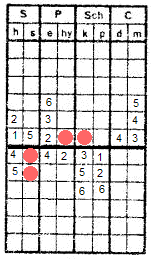
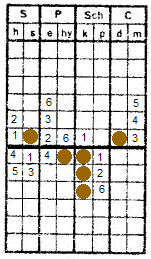
It is indicated on
the left diagram of left (where the PP1 factors are pointed in green); we
will now consider the encoding using the computer, (the green circle
indicates a factor pertaining to the PP1): 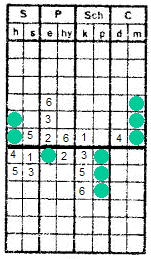 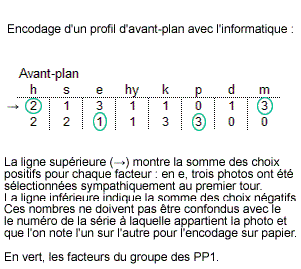
=====================================================
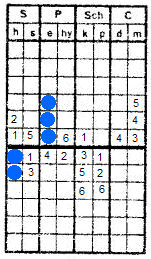
We will use the first
two profiles of an szondi test, which belongs to that of Alphonse. The
following example will show you how the complete encoding (foreground, VGP,
and background, EKP) of two profiles in a computer looks like. I surrounded
the PP1 and the PP4: 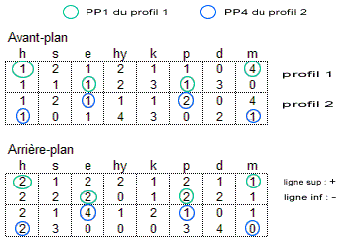
In Excel, one
launches then calculation with the F9 key, the computer selects the suitable
rules and then shows the proportions between the sympatric and antipathetic
choices. That gives the following results:
For the
calculation of the PP, the computer shows all kinds of tables and graphs, but
before that, we will show it ourselves for the two profiles of
Alphonse:
Profile 1:
Foreground (VGP)
PP1 = 1 + 1 + 1 + 4 = 7, PP2 = 1 + 2 + 1 + 3 = 7,
PP3 = 2 + 2 + 3 + 0 = 7, PP4 = 1 + 1 + 1 + 0 = 3 Total: 24
Succession in the
order:
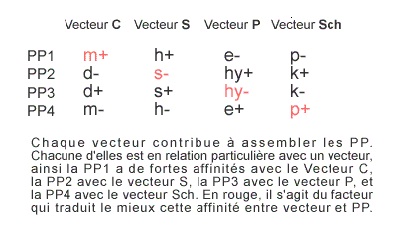
h+ → e
→ p- → m+/ s- → hy+ → k+
→ d-/ s+ → hy- → k- → d+/ h-
→ e+ → p+ → m-.
=========================================
Background (EKP)
PP1 = 2 + 2 + 2 + 1 = 7, PP2 = 2 + 2 + 1 + 2 = 7, PP3 = 1 + 0 + 1 + 1 = 3,
PP4 = 2 + 2 + 2 + 1 = 7. Total:
24.
Observe: the total
must always be equal to 24 because there are 48 photographs in all, i.e. 24
with the first turn and 24 others to the second turn.
=================================
Profile 2
Foreground (VGP) PP1 = 6, PP2 = 4, PP3 = 9, PP4 = 5. Total:
24.
Background (EKP) PP1 = 6 PP2 = 10 PP3 = 1 PP4 = 7 Total: 24
For all two
profiles, the total sum for
each PP is of:
Foreground (VGP)
PP1 = 7 + 6 = 13,
PP2 = 7 + 4 = 11, PP3 = 7 + 9 = 16, PP4 = 3 + 5 = 8.
Total: 48
Background (EKP)
PP1 = 7 + 6 = 13, PP2 = 7 + 10 = 17, PP3 = 3 + 1
= 4, PP4 = 7 + 7 = 14.
Total: 48
It is tiresome to
calculate all the instinctual positions of all the 10 profiles for the
foreground (VGP), the background (EKP) and the total of both, it takes in
average 40 minutes of concentration for these small calculations and it is
tiring for the eyes. It is an enormous saving of time and concentration if one
can use data processing for this kind of calculations.
That also explains why the szondians necessarily did not
use the entire theoretical arsenal at their disposal before the arrival of
the data-processing tool. The test of szondi requires a tiresome computing
time indeed to obtain all the indices, the PP, and other test data.
Here follows the
presentation of the results of the two profiles calculated in the spreadsheet
almost instantaneously: 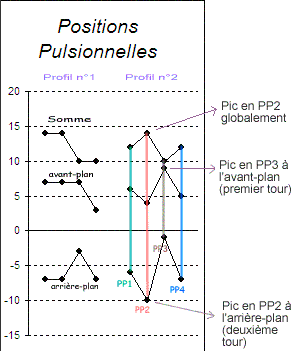 The
graph takes again the two profiles, the first on the left, the second on the
right. The three levels of addition (foreground (VGP), background (EKP) and
total for the two plans) are represented with different heights along the
four axes, which are used to symbolize the four instinctual positions. The
graph takes again the two profiles, the first on the left, the second on the
right. The three levels of addition (foreground (VGP), background (EKP) and
total for the two plans) are represented with different heights along the
four axes, which are used to symbolize the four instinctual positions.
a). On top is held
the Total Sum for the Foreground (VGP) and the Background
(EKP) then comes
b) A little lower
the Sum for the foreground (VGP), finally
c) At the bottom, one
sees the curve that represents the Sum for the background (EKP).
In fact, the points
are connected by a fine line for better seeing the drawing of the peaks,
although they are really not important, they are the four points for each
height. The fact that the sum for the background (EKP) is presented negative
does not have any importance, it is an artifact for this kind of chart.
However, it should be
known that if the peaks point upwards for the foreground (VGP) and the total
sum; for the background (EKP), the peaks point towards their top while being
directed downwards.
On the graph of the second
profile, on the right, the points belonging to the same PP were
put in color. It is seen clearly that Alphonse expresses, in his second
profile in the background (EKP) a tendency to act in a PP2 way, whereas he in
the foreground (VGP) he expresses himself rather in a PP3 way.
Here is thus a man
who that day presents himself using a verbal communication of the adaptive
type (PP3), like a man who has not many fantasies and who adapts himself to
reality as it is (a position which considerable cools down the inner
imaginary world) However, one will not become astonished to observe that
during the conversation he expresses often very often personal narcissistic
concerns (PP2), in short just the opposite.
Indeed, Alphonse
started that day with a moralistic speech of the kind "One should ….", only,
this time he did not come for that, but to speak about himself and his
interior stagnation and of the past. Instead of adapting himself, Alphonse
does only the opposite, i.e. he keeps to fixed and retarded positions. The
general picture is in favor of PP2, it is signal how this person is in the
situation of a narcissistic reinstatement (to restore an image of oneself
which seems failing), but still it is necessary now to evaluate if this
tendency to narcissistic reinstatement is dynamic or defensive.
If one looks at the
first profile it looks like he prefers to remain in his own world
(predominance of PP 2) without dealing too much with morality (predominance
of the PP1). However, as the PP4 goes up a little in the second profile, he
seems able to cast a glance at his interior condition and even perhaps to
renew it. Indeed, he presents a p+ (factor p: 2/0 in the second profile,
foreground (VGP). That is a good sign, although if one looks at the background
(EKP), one sees the reverse, i.e. a p- (factor p: 1/3 in the second profile,
background (EKP)).
The (p+) of Alphonse
will make him to speak in an independent way, but his "hidden" (p-) wants in
fact that one, so to speak, "takes care of him". Just like a draftsman
starts by making a sketch of his drawing before deepening the features with
meticulousness, the PP´s allow to quickly tracing the general outline
of a test. The test of Alphonse gives us a general idea of it. Lastly,
we also have a presentation of the PP´s in a table by using the
percentages: 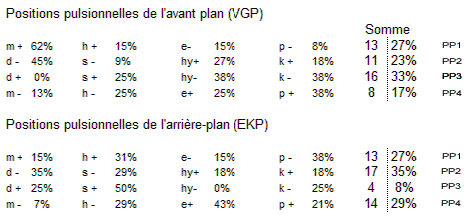
There are still other
graphs which are used to deal with the PP:
For example, with the
following calculation: (PP4 + PP3) minus (PP2 + PP1) if we obtain a positive
total, it is that the tested subject is able to invest the symbolic system to
the disadvantage of the force of his fantasy life. In such a case he
consequently has then better assets to become aware of his difficulties,
contrary to a subject who gives a negative result with this calculation.
Obviously, these are
only approximations, and it is the complete result of a whole string of small
signs, which in general let us decide. Data processing is an assistant and
not an intellectual guide.
The end of Part 3
|