|
PART 2
Circuit
interpretation.
Herewith
follows the second part of Karl Louvet´s introduction to the “Circuit
inerpretation”. He describes here the philosophical framework he uses to
explain the development of the different drive levels; this time focused on
the theoretical start and finish from P0 to P5. The translation of these 12
pages was still more difficult than that of part 1 because Karl used several
Lacan concepts which were difficult to translate as I never studied
Lacan´s theories.
Karl´s
philosophical vieuw is described in a more extended form in the works of KEN
WILBER , e.g in: “Sex, Ecology, Spirituality”, Band 6, ca 800 pages.
In case you
will be surprised by the conclusions of Karl it might be worth while to
remember Prof. Richard Hughes reference to
Szondi´s religiosity:
“Behind his
professional roles of physician, scientist, scholar, and teacher lies one
basic quality. Szondi was a genuinely religious person, a man of profound
spirituality and prayer. Prayer essentially is participation with God. The
analysis of destiny gives way to an ultimate mystery, to which one transfers
one’s entire being in solemn gratitude. Meditation on an ultimate mystery
empowers a pure experience of love and joy”
The
contents of the next translation Nr.3 will be less philosophical and more
technical and will explain the Patoanañytical method to calculate the
different levels of functioning. (I hope you read this translation with some
tolerance for my shortcomings as a translator. Anyhow in case anybody can
make a better translation I will immediately transfer yours to the Forum in
exchange).
Leo Berlips,
editor
==============================================
PP step by step
– 1 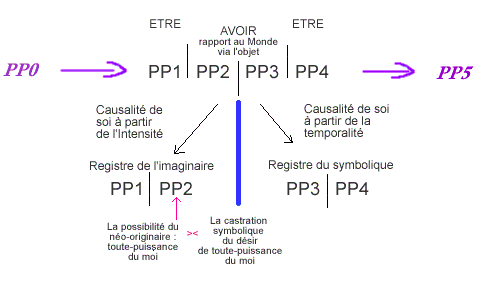
In the
beginning in PP1 the contact has as a basic quality that it is like a
sandbag. Everybody is together, there is no a difference between anyone.
For example, at a party all are together, everybody
is considered in the same way and on the same equal footing: woman, man, old
people, child, having the same nationality or not. It is the same price for everyone; one is in the same
bath so to speak. Now, if I start to
say to a person: “And you, you are a woman, and me I am a man, and if I
touched you?” then I introduce the difference of the sexes. Idem if I take
account of the age or of the difference in nationality. These differences
need not necessarily to taken into account, it is precisely all typical for
each level to take in account one after one these differences, whereas in the
(basic) contact, one experiences it without being conscious of it. It
is the same thing with the objects, one sees them, but they are not
considered for themselves. In this form of contact, what counts is to be with
the others, despite the kind of the objects they are.
On the other hand, at
the stage of the PP2, there is an important super object and that is Oneself,
and what counts consequently at a party is to be seen with one’s beautiful
clothing, one’s bronzing, etc. and when this Ego goes towards people, it
chooses particularly towards whom he goes, preferably towards the same type
as oneself, as good (looking) as oneself, another person who will spotlight
the existence of the “beautiful Ego”. Therefore, the question of the
object,that oneself is becomes important and passes before anything else.
To refer again to the meeting where the difference between the
sexes plays a role, there are two possibilities: either the meeting is
counted for (registered) in time and it is a couple, or the meeting is not
accounted for in time and it is a passing fancy (“one night’s stand”. lb)
with the intention to experience sensual and sexual intensity.
The aspect
“intensity” is rewarded each time that the other only is regarded as an
object in the service of oneself, something that can be reciprocal. In any case,
if time is taken in account during this meeting, then the “intensity” aspect
passes to the second plan and decreases to leave the place for a relation
where I now myself became the object of this relation, in other words I do
not decide any more all alone how that meeting will evolve.
In the case when the deeper ground
of the the Ego (causalité de soi) has
an “intensive sensoric-sexual aspect”, the subject is guided by an image of
himself – the Super object - to which he subjects the other objects. They
are selected according to narcissistic criteria.
For example, the presentations of the
homosexual - photographs of the faces of the type (h) chosen positively - and
of the sadist - photographs of the faces of the type (s) chosen positively -
were gathered in the test within the same vector: the Sexual vector,
including the factors (h) and (s).
They have in common not to want/to be
able to account with the evolutionary and historical temporality in order to
remain fully in the Ego’s “intensive sensory-sexual orientation. (Causalité de soi) In other words they want
to avoid the symbolic castration (limitation) which oblige us to accept
death, ageing, and to refuse the personal absolute power of one’s desires.
Under these conditions, the others are apprehended as objects in the service
of a narcissistic scenario, which presupposes a “contract of mutual pleasure”
between partners. This is not necessarily pathologic. It is a mode of
existence, which prefers to stick to a certain stage of development in order
to exploit all the assets, even if it means to lose something on the side of
the relation with time.
In the PP2 group the cause of suffering of the
members is their intensity. With the entry into the PP2, the
relation with the World will pass more and more by the objects, but the
object acts like a magnifying glass that reinforces, concentrates and
increases the libido flow.
In PP1, the
intensity is diluted by all kinds of successions caused by the multiple
facets of the environment, there is no concentration, everything comes and
goes. On the other hand, in the PP2 the object dominates and with it the
intensity follows a course of intensification, organization, consolidation.
The PP2 generates the
mechanism of retention and that strongly concentrates the libido. If the
search for intensity of experiencing in the PP1 remains diluted, in the PP2
it becomes instead a research for the power of intensity, a persistent
intensity that is constantly within the range of the subject thanks to
his/her imaginary, it is the triumph of narcissism.
Likewise, in
PP3, that what make people suffer is the actual time, the present).
To live in the
present and in a world of objects is to experience the actual time, the
present (temporalité) more intensively, accentuated by the prism of
the object. The
factory´s timetable means to start every day the same hour, right on
the minute, with the penalty to become nervous if one arrives too late.
The factory is the object that reinforces the
experience of the actual time beyond the fluid nature of time.
The subjects in PP4
avoid this effect of the magnifying glass caused by the relation with the
omnipresent objects during the whole day; they are more fluid in their
relation to time. Their time is not as pressurized by a series objects,
“which await their turn”. The temporal object, is like a child that has just
been born and who imposes a demanding observance of time; it is the queue to
the supermarket counter where one has “no time”, i.e. another object imposes
its time on us, as for example an appointment we cannot miss. If
intensity marks as much both the PP1 and the PP2, the PP2 undergo much
stronger the impact of it, because they advance (transitent) primarily by the
object. If the present characterizes as well the PP3 and the PP4, the reign
of the object in PP3 gives them a focused temporal power that leads to a
temporal plus value (surenchère), which has nothing to do with the
steady succession of evolutionary time.
In PP2, this higher
plus value of the power of intensity can be explained starting from the
concept of the retention of the libido. By mans of the objects, the subject
channels the libido towards internal high temperatures, structured around
rigid axes, which support the narcissistic vault of the subject. In this
bubble of space-time specific to the subject in PP2, the peaceful water of
the continuity of time (moderation, temperance, lower intensity on the long
term) cannot spread out on the fire of their All might. Their desire “to live
intensively” ends up burning their soul, but they will continue only to
listen to themselves and to continue their insatiable search with the means
that remain to them. In addition to the constant overheating of the
intensity of their experience, the relation to the retracted time causes a
tough feeling of impermanency. To calm this feeling that their passage leaves
no trace, they turn to an adoration of specific time periods, to music, to
places, to specific people, etc. These adorations reflect to them an image of
stability and pseudo-permanence. In the same way, they wish implicitly that
such adoration is dedicated to them, for the same reason, to testify to a
will of permanence. The “statue of oneself” replaces the “natural” subject in
the temporality of the World. But that does not hold, because the more they feel impermanent, the
more they increase the intensity of their experiences, the more they rigidify
their life, the more they pervert/divert the relation with time. It is a
vicious circle, a typical logical loop of the stabilized PP2 whose discomfort
oozes, like the ransom to be paid for the devoration of time in orgies of
insatiable intensities and (insoupçonnables).
The concept of the
object is essential to understand the PP2 and the PP3. If in the PP2, the
privileged object is oneself, in the PP3, it is the reverse. The others,
meaning a group, or community, is the object that exerts its power over
oneself. It is necessary to yield to the schedules, to the education, the
rules, good manners, and to the moral and become an object among others in
the service of the Community object.
The positions in
the PP3 are legalist-realistic-adaptive. If we return to
our history of the couple, his partner’s parents receive the young man, there
he is presented regarding engagement and marriage: the temporal aspect takes
precedence henceforth over the sensory-sexual (intensoriel) aspect. The
deeper ground (causalité) of the exchanges between the partners has
more the quality of a “marriage contract” than that of a “contract of
pleasure”, it is the choice of duration instead of that of intensity. If the
intensity allows the subject to keep his way of living nder control, the
duration obliges him to subject himself to a temporality that largely exceeds
his personal “jurisdiction”.
From PP1 towards
the PP2, we observe the inauguration of the narcissistic object that is
the same as oneself, the beautiful image of oneself. From PP2 towards the
PP3: we note the primacy of the Community object that is not at all
oneself and to which one must subject oneself. The PP2 and the PP3
function largely through objects, which have the priority over (are more
important) than the vector of “To Be”. This means that
“To Have” this object
(or to match with its priorities), it is to succeed. To lose it, is to miss
one’s blow.
This is not the case
in the PP1 and the PP4 where the object does not occupy a central place, but
peripheral. If in the PP1, it is the environment that counts, in the PP4, it
are the reigning values and principles, in the meaning of that what transcend
the laws and the rules that function in a “local” setting, somewhat like
ethics transcends morals.
In other words the inner
judgment concerning what is truth is exerted beyond the jurisdiction of
the standards in force in a specific community (in a certain area and in a specific
time), “from time immemorial” so to speak. This freedom of the PP1 and
the PP4 compared to the object makes them much more suited to tune in with
the World, while the PP2 and the PP3 lock the subject in the narrow story
which we presented before in connection with the everlasting question of the
object.
Let us take again
the four instinctual positions
PP1:
To be”, and not the privileged object, is the deeper
layer (causalité de soi) of oneself by way of the intensity but in an
unspecified way. For example, it means to have fun without making any
difference between place, time, or partner, it is to enjoy oneself without
seeking a personal stake in this pleasure. One wants just to be with in what
is going on, “to be inside”, in the bath. It is the intensity for sake of intensity, and one takes
the least possible account of the differences.
PP2:
“To have”, is the deeper layer –fundament-
(causalité) of the person and is determined by the intensity and
mediated by the privileged object that is the same as oneself (the other
objects are in the service of the subject). For example, the “contract of pleasure” and mutual
valorization is a relation which avoids any form of limitation (castration)
by refusing to be taken up in the historical and evolutionary temporality,
i.e. death and of course old age.
From another point
of view, in the PP2, we meet a relation of type retracted time, that is for
example expressed by the reaction (hy+) which belongs to this level (hy+) =
to choose photographs of the (hy) type according to a proportion in which the
sympathetic choices (hy+) dominate the (hy-) antipathetic choices. These are
photographs of faces of people presenting in a clear way the hysterical
disorders taken during the time when szondi worked.
Thus, the person who
got hysteria has a memory problem and does not want to know too much
any more what occurred, he represses like one says, and then produces
“intensive reactions”, generally in the form of crises. It is as if the libido ebbed towards
the censor and the intensity caused by its prevention and hinders it to run
in a homogeneous way during a long time. In addition, the reaction (hy+) is
also found in the little child who is extreme glad in front of a mirror while
looking at itself: it discovers its own image; it is the specular imago that
will found the narcissism of this child, the “me I”. What is intense at that
moment is that subject´s time suddenly starts, he was not aware of its
existence and now suddenly perceives he exists. Even here one thus finds in
this new experience a relation with retracted time and a focus on sensory
intensity as the base (causality) of oneself. This difference - the
advent of a selfimage (sense of oneself) - will change everything in the
relation with the others. Before, that it did not have importance, now the
self image will become dominating in the relation to others. It is the
narcissistic object’s domination that from now is essential in the relation
with the World. It is it to such a degree that this object has all the
qualities of a sphincter: it closes and opens the door according to the
approval that emanates from himself (depending on if one corresponds or not
with the subject´s image , one is accepted or rejected). The reaction
(hy+) translates this need for the visibility of the object = that what one
self is: to show oneself, to show a affects, to produce one’s personal cinema
or get a one´s crisis like one says.
In another area, the
uprooted (displaced) person who suffers by the situation of being in exile
has also a problem in his relation to time, but for other reasons. From then
he will have to reconstitute a visibility to alleviate the detachment of his
identity from the historical time of his lineage (background). Under these
conditions, a skid is possible when the subject is destabilized: then either
he shows too much visibility of himself or not enough. Normally our own
visibility should not be any more a problem as such, except if the line of
time is broken in one way or another, in this case, the need to be seen
becomes again an imperative need to be satisfied, a little like the child
vis-à-vis his mirror.
PP3: “To
Have”. On this level the subject is an object among the others in the service
of the community, it is the base (causality) of oneself determined by
historical and evolutionary temporality, but within the framework of the
community. In other words via the privileged object which is the community.
For example, the marriage contract, the professional contract, the work
schedule, regular payments, etc
PP4: “To Be”. On this level one is not a
privileged object, the foundation (causality) of oneself is determined in a
precisely way by temporality by taking into account of time, but without
really taking account of the framework of the community in which we live.
That occurs beyond the usual standards, it is to live in time but in another
larger time perspective. What occurs today might be interesting, but without
true interest, for tomorrow is another day and thus it is since ever. (the
night of times). It is the human person as the living memory of the time that
passed, passes and will pass.
The idea of time as
an ongoing process dominates the PP4, thus the subjects in PP4 experience
“processual” events, they feel part of processes which influence them (take
care of them) and on which they finally do not control.
In contrast, the
scientific community presents the facade of a speech pretending it to have
the qualities of the type PP4, seemingly objective and almost ascetic, but
actually the question of the object is dominating.
appendic of the
connection to the origin, by dictating a trajectory (logos) primarily
directed towards the vector “To Have” rather than towards that of “To Be”. A
scientist belongs initially to his scientific community, its language, its
codes and to no other community, on this depends his legitimacy. It is a kind
of sect where a key language dominates that not has to be “corrupted” by an
“inappropriate” vocabulary. His alienation from his objects to be measured is
permanent, and his speech is decapitated when it is the subject of his
statement. “It speaks” scientifically starting from his mouth, it is
“objective”. This decapitation of the subject is found again in the relation
to the World, in particular by decapitating all the religious myths developt
during the progress of humanity. This massacre of the symbolic human capital
in the shape of presenting it as an object of anthropological studies, is a
new formula of colonialism and is typical of the reign of the object: to
fetter continuity in formulas by pretending that only that what can be
formulated can exist and that truth is that what can be cut up in pieces.
(dépeçable).
Impossible to mentally reach the
conscience of an unconditional Unit in all things under these conditions of
objectivity (a term which describes well to what we refer)
Thus here we are with
regard to a speech presented like a re-examination beyond the local differences,
i.e. pretended to be a speech of the type PP4, but primarily oriented towards
an objectiv dynamic. Temporality + privileged relation with the object = PP3.
All that this science can exude, it is the wadding in of the consumer
society, the cutting-up of the subject and its formulation in objective
terms. The absolute power of the obsessional thought applied to the
scientific study is only an alternative of the absolute power, a little more
perverse than the others because it presents itself like the most legitimate
to the eyes of the community. Thus to justify the progress of science, we
enter a society which finally presents progress like a regression. The Nazis
did not do better at their time, besides with very scientific means. The
famous rationality of the scientist, their evaluation, (pondération)
their sense of measurement, in short the moderation of the followers of
science only acts within the framework used to satisfy the desire of the
absolute power, (pas dans le but= ) . The investment (stake) of scientific
thought is free of any castration; it does not have any limit. The scientists
have neither God nor Master; they prostitute themselves with all the
budgets. Consider the amazing example of Mgr George Lemaître,
astrophysicist and mathematician Walloon (Charleroi 1894 - Leuwen 1966),
author of a relativistic model of the Expanding universe (1927) who
formulated then the first cosmological theory according to which the
Universe, originally very dense, would have started expanding following an explosion
(1931). It is he who conceptualized the origin of the universe with the Big
Bang. It was a chanoine, a Christian within the church. He perverted (in the
meaning of an abduction) completely and scientifically his vocation of faith
by gulping downs the divine origin of the World. Where God was reigned, he
put his formulas. Thanks to Mgr. Lemaître, we are equipped with a
scientific representation of the Origin, i.e. all that is in the Universe can
be given a scientific explanation starting from this representation. It
should well be understood that there is no representation of a pure universal
Origin. The representation of the Origin has ipso facto a
totalitarian quality. By principle, the only way of avoiding that, it is not
to represent the Origin. This “Christian” was in the first place a typical
scientist, he injected the original dimension of the religion in the heart of
science and science has petrified in one blow the religious representations
of the World, in other words the essential mysterious representations, which
precisely avoided to be filled with something based on our limited
understanding. (pour éviter justement d'y mettre quoique ce soit
à notre portée). One could not do worse nor betray more clearly
the alliance with God.
The difference
between the imaginary and the symbolic.
The symbolic
system, are in fact mental images (that of the father, flag, church, etc)
which control other mental images, i.e. those of the imaginary one. These
symbolic images systems have more authority on the subject than the other
images because they “are connected”. They are connected to the Third, i.e.
what represents the reference in the community and which guarantees the
respect of the differences. It is thus a significant (with a specific form)
which holds its persuasive force by something with an
important meaning (a
common background).
It gets the authority
and its relay by the figure of the father, not the father himself, but the
father as a representative, for the family, (and) all the other people who do
not belong to the family but need however to be hold in account. These
“connected” aspects of the symbolic images that animate and govern our mental
life translate the process of linking to that what exceeds us. The quality
and the power of the images which control our spirit will in general depend
on the successful function of this process.
It is the temporality
which is used as a matrix for these stages of the psyche (PP3 and PP4),
because the meaning of time is precisely what connects everything. In any
case, the temporal bond is a widespread bond that easily can be registered
within the scope of the human understanding. This is not the case of the Tao
for example, a “concept” much more difficult to apprehend within the
framework of our understanding. The more the subject reaches to a
historical and evolutionary sense of time, the more he is connected to
himself through all his successive states, and the more he is also connected
to what preceded him. As he takes better into account the succession of the
various states of consciousnesses through the passing of the hours, of the
days, of the months and the years, and even of the generations, he is able to
remain (d'une seule pièce) a whole person vis-a-vis his desires which
naturally go in all directions. He who is disconnected from the system
of the whole (unit) - not his own in particular, losing the principle of the
whole in any case – gets there by cutting out himself yielding to the force
of his dissimilar desires in the course of time. To avoid this dispersion or,
if it is more serious, these cleavages, the subject “castrates himself” by
limiting the force of his desires (and those of the others on him too) thanks
to holding a good relation with a stable and constant time. That implies a diversity
(panoplie) of images which control the other images, of which in particular a
consistent image of the father who
Who is preserved from
the risks of everyday life (qui soit préservée des aléas
de la vie humaine.) This complicated route of time is in the long run
“destiny” shaping and has a price: it is necessary to die one day and not to
forget it. Many are those who prefer not to know, even if it means to retract
a little more the relation to time. This permanent conscience of our own
finitude is precisely what the person who feels “unhappily to have been
born” tries to forget. He does not anymore give himself a choice and then
tries an exit towards the neo-originating and then is in the situation of
“eigher to move or to go under”. It is the arrangement of the almighty Ego,
the absolute in daily life. Beyond all this architecture, the “wise”
subject enters into a temporality that is as well universal as daily, as well
elementary as systemic, that of the Tao and of God for example, that of the
Transcendental Subject as the memory of the Origin hidden in us: being both
the start of life in PP0 and the achieved destiny in PP5.
In this way the
identification with the Origin in PP4 is a way and not an end in itself: to
be alive, i.e. means shaping our Live through our own actions. When the
passage is made towards the PP3 and PP4, the subject is less and less
influenced by the intensity of what is happening from day to day. One says
that he is capable of an ascetic behavior (to the contrary of those in PP1
and PP2 who are hungry for sensations, i.e. for intensive body experiences,
gustatory, auditiv and visual). This manner of not any more really depending
on the intensity of what happens around him when making a decision is the
result of the subject’s greater attention for the link of time. Temporality
makes it possible to connect events and to build a unit on a greater range,
to hold account of more elements, to be less dispersed as a result of the
force of the imagination that must from the on play its ranges in a lower
tone. This “exit” out
of the intensity in order to enter historical and evolutionary temporality
will be repeated on still another level. It is the “exit” out of the (common,
limited ed.) human understanding that is realized when one arrives at the
entry in the PP5 - PP0 (they indicate the same thing even if they seem to be
separated due to the usual limited degree of development of the viewpoint of
the human spirit). What does that want to say?
The vision in
question here is proposed as a hypothesis there where finally one can connect
a link between the human being and something that is not human. By
dislodging the narcissism of its central position by the process of
castration of the symbolic system, a mental trajectory is sketched whose
logical result prevents the human understanding from taking itself a central
position in the vital values systems. At the end of this trajectory, it will
well be necessary to give the human understanding its place as an element in
a system that exceeds it. It is the spiritual castration of the
conscience. Conveyers
of the Origin, we are vectors of times who transmit what occurred since the
whole beginning. To state this schematically,
we are lines traced from the Origin to the present. When a line goes up from far behind, something of the
first indetermination is shows up through this subject, that permits to renew
the diagrams of thought and to start again the “Play of Creation ” beyond the
possible current dead ends. By becoming aware, is to become oneself an
original conscience, i.e. ready to transmit the meaning of the Origin, its
gift. The principal manner of becoming qualified for this transmission
consists in not to falsify the link to the Origin within the framework of the
human understanding: “It is necessary to make a hole to be able to pass
through”. Normally, the szondians ought to be “ready” for this
vision. Why? Initially, Leopold Szondi himself was inspired during a
dream where he saw the construction of his instinctual system; “it” came to
him. He was, by he way, accustomed to reason like an inspired person without
dealing too much with the experimental checking of his statements, he largely
followed his intuitions. It are his disciples disseminated in the whole world
who patiently checked a number of his intuitions by the induced empirical
verification method during the frequent use of the test. Secondly, the
test is precise; it is even like a “laser ray” so much its precision is
coherent and consistent to decipher psychic complexity. However, if you
question the szondians, academics or not, they are absolutely unaware of all
the mechanism at work in this test. It is even comic since they arrive with
photographs of faces that they show you to make a series of choice, and then
afterwards come back with a diagnosis that engages their responsibility as a
clinician, teacher, researcher, etc. Between the photographs of faces and
the result that must be interpreted, nada, nichts, no explanation, a great
Nothing of Nothing. If that is not a wink of the Transcendental Subject, then
they are completely blocked as for the question of the transcendence.
Therefore, I say that they are undoubtedly already favorable – to this idea -
if they use this test, they really do not have any more the choice, they
already made the choice when becoming szondians. Notice, that without
being szondian, C.G. Jung had pushed his theorization towards the
synchronicity, i.e. the fact that events happening in reality do not arrive
by chance. This is even more daring than the Szondi test, however, between
the two, there is this (cette mise à l'index) transfer to the index of
the human understanding. Even the Freudian psychoanalysts are unable,
completely unable, to account for the mechanisms at work in the human spirit,
might this refer to thinking, dreaming, love, having faith.
There are already
many human generations who try “to put in boxes” what does not belong to the
area of human understanding but what takes part by “sur-prise”. It is not
because one shows it by pointing out in the significant way of the
Lacan´s “great Other” that it is seriously taken in account as that
what has a meaning (que signifié). It is necessary all the same still
to work through the mourning of the narcissistic framework in the relation to
the World, narcissistic in the meaning of “anthropomorphic”, in other “to
explain” the World.
I want to say that
the anthropomorphic conceptual base puts the human person like the
World´s Subject. Personally,
I would say this rather: “Give the World its place and the World will put you
on your place”. This diagram is thus
an invitation to be less mentllay retarded in regard to the human prsohuman
and seriously take into account this central hole in the fabric of human
understanding through which transits the original bottom. Imagine a well if
you want an image more current. Concretely, the person who gets back to his
original Adam vision finds at the same time the meaning of Unity in
everything things.
It is not obvious,
but it is possible to have the presentiment of it. Just like the access to
temporality makes it possible to escape from the yoke of intensity, the
access to the outside of the human understanding (cf “required”, “truth”,
etc) prevents the adversity from having a catch on our conscience. Without
any means to clutch the conscience, the adversity slips above, a little as a
passer by would cross an army without armor, or as a perfect saber would
never leave its sleeve since the combat is interior before even being
possible at the outside.
Quid?
The essential is to
circulate in all the positions, even the most improbables, because the
indetermination is the point of view of all the points of view, the headland
of which one can attend the spectacle of his own human condition and embrace
with a glance the panorama of human finitude. It is a vital position,
especially for those, which were trapped by the absolute power, in particular
by its most wrongfully made pretexts which legitimated science, the truth and
even faith. It is necessary to pay attention so that the goal which one
assigns to do not allow that one overlaps the absolute. Many are the speeches
which reject the absolute in their goals, but which constantly cherish it in
the implemented means. Absolute power is a genius artist that deceives the
human spirit through multiple cleavages following our propensity to patauger
? in vanity. The cleavages are overcome starting from instinctual work,
because the impulse is spirit: it can add to itself, see itself and make
conclusions, all depends on the point of view on which it founds the report
of its own circulation. Its intention is to circulate in an overall
continuity that can defuse the damming up and the cleavages caused by the
constant recourse to the absolute power. One of these cleavages is
precisely to remove from the impulse its nature of spirit, an instead to
transform it in an organic component without aptitude to shape the conscious.
On this subject, I quote Jean Mélon: “The Szondi postulate wakes up
the memory of a famous aphorism of Hegel: “Trieb ist Geist” (The impulse
is spirit).
We are of the opinion
that Szondi takes part of the family of ideas developed by Hegel while Freud
and psychiatry have at least in common that they implicitly assert the way of
thought of Kantian. What
will this mean? When he introduced officially the concept of Trieb with Triebe
und Triebschicksale (1915), Freud hastens to put it away to the side of
the unknowable, at least when considered in comparison with positive science.
About drive “en soi” or the drive as an object of
science, we do know almost nothing and we will hardly know more of it in the
future. It is a (noumène), but as such, one cannot make it
calculations with it. On the plan of the phenomena, we are only confronted
with the offspring (Abkommlinge) of the drive. Thus let us leave the
drive to its “grandiose
indetermination”, let
us satisfy ourselves with outlining the concept of it by specifying its
determinants (source, object, push, goal), let us specify also quickly and
without seeming to touch the possible destinies (reversal in the opposite,
orientation towards oneself, repression, sublimation), and let us only
interest us from now on in its significant and measurable demonstrations,
thanks to which we can hope to make a good impression in front of the court
of science.
The same bell sound
resounds in the dimensions of psychiatry where the question of the origin of
the psychoses is indefinitely reported to an X which appears increasingly too
remote to be measured exact in the way most scientist believe in. In this
context, the one who avows knowledge of this topic gives at best the
impression to be a believer and at worst to be illuminated. As all modern
science proceeds from Kantian agnosticism, one should not be astonished that
“the szondians” are considered to belong to a Gnostic sect, spiritual
descendants of Plato-Hegel, vulnerable to the condescending contempt of the
sons of Aristotle-Kant. But
the believers are not always those who one expects. Moreover the true Kant is
not whom the posterity retains most readily, but it is true that after him
science became hardened in an arrogant celibacy. Kant succeeded in the
mission which he had taken to “to limit Science’s ambitions in order to
preserve the prerogative of Faith”, but his heirs generally showed themselves
more sectarian, rejecting into the Faith´s “dustbins” all that is not
absolutely positive and objectively. It is this intransigent cleavage
between faith and science, or between truth and certainty, which Hegel refuses.
This cleavage should be better rather to be overcome and that is the mission,
which Hegel assigns to Science. Not that he goes as far as claiming that the
thing in “en-soi” is more recognizable than Kant stated, but one should not
leave him for that to his imposing indetermination or to his splendid
indifference. It is necessary to produce from it the concept (Begriff)
by the reconciliation of the “object “en-soi” and “for itself”. The concept is something else than the simple idea or
reflection of the object in our thought, it is a working through of the issue
(chose) and on the issue that allows us to tear it off from its indifference,
and this thing also exists for us. For this reason we say that Szondi is
Hégélien and why also we follow him in the eagerness that we
invest to present the drive concept as a central concept of psychiatry and,
beyond that, of the way man realizes himself. (du fonctionnement de l'homme
en tant qu'homme.)
|