Szondi
Test:
Its
Interpretation
and
Graphological
Indicators1
By
Arthur
C. Johnston, PhD
©
2006
by
Arthur C. Johnston
1
Omitted are all graphological materials that appeared in the
2001 edition.
Included are:
Extracts from Martin Achtnich’s book Der
Berufsbilder-Test [Occupation Picture-Test], 1979
Extracts from Lipot Szondi’ books, both translated by Arthur
C. Johnston
Extracts from Susan Deri’s book Introduction to the Szondi Test:
Theory and Practice, 1949
An
Introduction to Szondi, Achtnich, and Occupations
Lipot Szondi: A
Short Biography
Lipot Szondi was not a psychiatrist or psychoanalyst,
despite his intense interest and work in these areas. He was an internist, specifically an
endocrinologist. But psychopathology and
psychology were his side interests. From
1927 to 1941, Szondi was in charge of a psychology laboratory at the
His original inspirations for his
genealogical investigations were a dream and his interest in Fyodor
Dostoevsky’s work and life. Dostoevsky,
the Russian novelist in the 19th Century, was an epileptic who had epileptics
and murders in his family tree. His novel
The Idiot is about a priest who is an epileptic and becomes involved
with a murderer. The Brothers Karamazov has an epileptic son kill his
father and another son who is a priest.
The Epileptic Drive Circle has epileptics, murderers, and priests.
Sigmund
Freud believed in drives but always kept to pairs of drives such as love and
aggression or ego and id and never wanted to study or create a systematic
analysis of human drives. Szondi created
the four drives based on his insights and the psychiatric and psychoanalytic
knowledge of his time.
In 1941,
Szondi was driven out of the
In 1944,
he published Schicksalsanalyse (in German), his book on genealogical
work and the drives. The title of the
book means Fate Analysis. In this
book he introduced the concept of the latent genes. Mendel’s pea experiments illustrate this: a
wrinkled pea has a latent gene of a smooth pea, and vice versa. Two latent genes will produce an outward
characteristic, but if only one latent gene is present, the dominant gene will
determine the characteristic. These latent genes, according to Szondi, are not
without effects however. They represent
our family ancestors and can become our future ones. They belong to the realm of the unknown, the
unconscious. Szondi called this area
the Familial Unconscious, which has all our latent ancestors. Szondi adds this Familial Unconscious to
Freud’s Personal Unconscious and to Carl Jung’s Collective Unconscious.
How do
these latent genes affect a person?
Szondi concludes that these latent genes determine our choices: choice
of friends, lovers, forms of illnesses (both physical and mental), jobs,
interests, sports, hobbies, and even our form of death in some cases. All this occurs through genotropism, the like
choosing the like. Trope means to
lean toward. Birds of a feather flock
together, so to speak. The latent genes
through the choices we make determine our fate; thus, this is determinism. But the ego has a say in all this and can
make conscious choices that give us freedom.
In 1947,
Szondi published Experimentelle Triebdiagnostik [Experimental Drive
Diagnostic]. Since it was time
consuming and very difficult to trace the family tree to see all the influences
of the latent genes, Szondi created the Szondi test as a quick way to see what
choices, projected from the Familial Unconscious, were working in a person’s
life. This book in 1947 gave the
interpretations for the Szondi test.
This test consists of six sets of eight pictures of the extreme
manifestations of the different drive needs that are present in humans. These are the bisexual [normally called
homosexual], the sadist, the epileptic in the control stage, the hysteric, the
catatonic, the paranoid, the depressive of the manic–depressive, and the manic
of the manic-depressive. We all have the
same drives as these extremes but in different quantities and combinations.
In the
Fifties, hundreds of publications on Szondi’s work were published in English
and other languages in
However,
Szondi’s genealogical basis for his work was not accepted by professionals in
that field. And since Szondi’s drive
circles and ideas covered the professional areas of Freudian psychoanalysis,
Jung’s Analytical Psychology, Adler’s psychology, among others, and since
Szondi was not a member of any of these groups, he had difficulty being
accepted by them. Even today, some of
the users of his test, ideas, and theories reject the genealogical part of his
work. Others do not.
In
In 1969,
Szondi established the Szondi Institute, which is still in operation. Szondi was awarded Honorary Doctor from the
two Universities of Louvain (1969) and Paris (1975). The
In 1979,
Martin Achtnich published his Der Berufsbilder-Test [The Occupations
Picture Test], still used today, which has Szondi’s eight needs for
selecting one’s occupation. This test
consists of 96 pictures [one set for men and one for women]. Each picture is of a person in an occupational
setting. For example, a reporter
interviewing someone. The Testee
chooses the pictures he likes, those that are disliked, and those that are
indifferent to him. Each picture
represents one of Szondi’s eight needs.
Thus, a profile of the Testee’s drive profile is obtained. Since one’s needs choose the area of work,
then a recommendation can be made for possible occupations. The test manual gives wonderful insights into
the practical workings of the eight needs in one’s everyday life.
The web site
for The Szondi Forum [www.szondiforum.org] under the guidance of Leo Berlips
shows the countries and people that have an intense interest in Szondi’s Test
and his ideas. There are active groups
in
The
books on graphology and Szondi works are flourishing. And there’s a growing interest in the
Many
academics and professionals in psychoanalysis and psychiatry often shy away
from Szondi’s work because of the disputes over his work and its validity and
because his work crosses so many different fields. No one field can claim him as one of
theirs. Szondi is describing the human
condition in a universal way.
Szondi’s
Thinking behind the Test
Szondi
believes there are three kinds of unconscious: the Personal Unconscious,
identified and explored by Sigmund Freud, Carl Jung’s Collective Unconscious,
which explores the symbols, myths, and patterns of thought and actions that
belong to everyone universally, and Szondi’s own Familial Unconscious, which is
composed of the genetic ancestors within each of us. The Personal Unconscious produces symptoms;
the Collective Unconscious symbols; and the Familial Unconscious choice.
Our
genes from our two parents determine who we are. If both parents contribute the same gene to
an offspring, then the inheritor will have this characteristic. Brown eyes would be an example: both parents
have the gene that produces brown eyes.
However, a child may have different colored eyes but be a carrier of the
brown eye gene from one parent. The
brown eye gene is therefore latent and can become dominant if later the
offspring mates with a carrier of the brown eye gene and both brown eye genes
are passed from each parent.
Szondi
affirms that these latent genes are not powerless. He believes that these
latent genes determine one’s choices of loved ones, jobs, forms of illness and
even death, character traits, intellectual interests, and sports. And much more.
How is
this so? Szondi believes that when we
are attracted to a person, we do so because we both are conductors of some
latent ancestor. Let’s say that in one’s
father was a manifest epileptic, but one’s mother was not. One of the children could become a carrier of
the epileptic gene—thus be a latent epileptic—and consequently would not be a
manifest epileptic. If this conductor of
the latent epileptic gene met another person who was also a carrier of the
latent epileptic gene, they would both feel an affinity for each other, for
both would, in a sense, belong to the same family circle of epileptics. Of course, the conductor of the latent
epileptic gene would be attracted to a manifest epileptic.
Szondi
calls this attraction force genotropism.
Another
example: suppose a person descends from a schizophrenic father and a healthy
mother. Since there are not passed two
dominant genes representing schizophrenia, the descendant does not manifest any
schizophrenic disorder. However, this
latent schizophrenic gene would determine one’s choices in love, jobs,
interests, activities, and other phases of one’s life. This is the Schicksal—Fate—part of Szondi’s
thinking. The other part of his thinking
is that the ego has some freedom in choosing what will be acceptable or not. Freedom and Fate are two sides of the same
coin.
It is
important to realize that just because one chooses a picture of a mentally ill
person such as a depressive does not mean that one is a manifest
depressive. The genes represent drives
and more specifically needs that must be satisfied. And there are many ways a need can be
satisfied and thus relieve the tension.
Ulrich Moser in The Szondi Test in Diagnosis, Prognosis and Treatment
lists the possible ways the sadism (s) need may be satiated:
• native
satiation: sadism, perversion
• normal
satiation: activity, masculine behavior of varying degrees
•
sublimation: that is, “struggle” for humane goals
• drive
disorder: neurosis, psychosis: defense against aggression
•
genotropic satiation: choice of a sadistic partner (libidotropism)
•
criminal satiation: slaying by means of a hatchet, knife, etc.
•
character formation through introjection (k+): being hard-hearted, for example
•
occupations: slaughter, soldier, butcher, sculpturer, hunter, wrestler, boxer.
The
charts on each Drive, showing the two opposing needs, are divided so that one
can see how the needs are satiated. For
example, the “Phylogenetic, animalistic,” “Psychic Characteristics,”
“Pathologic, extreme, and negative manifestations” [including drive disorders,
delinquency, suicide], “Physiologic, normal socialized manifestations
[including Drive symptoms, maturity, socialization, character, occupation,
professional field,” and “Socially Positive manifestations on a higher level
[including Sublimation and occupations.]”
When one looks at the results of the Szondi
Test, one cannot immediately know how a particular need is being
satisfied. Only by studying the company
each need keeps can one determine the possible ways a need is being satisfied. One test is not sufficient to give an
adequate picture of one’s needs; for this reason, ten tests are the standard
number given over a period of weeks.
Szondi
in the same book that Ulrich Moser appears gives some clear examples about how
one satisfies one’s needs in socially acceptable ways. He notes that descendants of mentally
disordered persons become the most capable and natural psychiatrists or
psychiatric nurses. Descendants of
querulents (willful litigants)—the paranoia area—unconsciously choose occupations
such as district attorney and judge.
Szondi also cites the situation where there was a criminal in the
person’s family, and this person became a prison guard. Most interestingly, Szondi cited the
situation where two identical twins were separated and one became a criminal
and one a prison guard.
Fundamental
to all of Szondi’s thinking is the idea of opposites—or schisms. The need h opposes s; h+, h-; s+, s-; h+ s-,
h- s+, and many other possible oppositions within the drive itself. The negative, positive, ambivalent, and zero
choices initially given make up the foreground drive picture, which is closest
to consciousness. Szondi, however,
creates a theoretical opposite to this initial test result and calls this the
background drive picture. This
represents a deeper layer of the familial unconscious. It is a matter of opposites: one cannot have
light without darkness, good without evil, Christ without the Devil, masochism
without sadism.
Under
certain conditions, the background drive picture—really the drive of a
potential fate or past family member—can come to the fore and thus switch
positions with the foreground. A mild
mannered person, for example, under the influence of alcohol or drugs can become
belligerent. An extremely shy person by
the excessive shyness calls attention to herself or himself, for in the
background of the shy person is the show-off.
Ulrich
Moser in his chapter of the book on Szondi gives some interesting insights on
the operation of the foreground and background drive pictures, which he calls
the predecessor and successor. He
believes that the foreground [predecessor] represents the needs that have been
repressed in the personal unconscious and thus have been internalized as
reaction formations, character elements, and symptoms. The foreground also greatly determines our
dreams and character.
The
background, however, has these effects.
One, it adds an emotional coloration to the foreground. For example, the passive person (s-) however
in this very passivity is demanding and thus has a distinct aggressive nuance
(s+). The background has a great
influence on the symptoms chosen.
The
background [or successor] expresses itself in choosing persons in our
lives. We may often choose persons who have
the same drive structure in their foreground, which is our own background. This often happens in choice of occupations:
the background finds satisfaction in an occupation. For example an apparently good person becomes
a policeman and spends his life chasing criminals, who represent the
policeman’s own criminal background drive system. The fireman working for the good of society
to stop the pyromaniacs of this world can satisfy his own background strivings
to set fires. Szondi always is
stressing that the only difference between the abnormal and the normal is a
matter of quantity, not quality.
One
final opposition among many is that of the middle two drives [Paroxysmal and
Schizophrenic, or Ego] and the peripheral drives Sexual and Contact. The Paroxysmal is the realm of the Superego;
thus, the middle represents the Superego and Ego defending against the drive
perils represented by the border drives Sexual and Contact [anal and oral] and
its own dangers created within itself.
Szondi
calls the middle the censorial system since it is concerned with the
individual’s system of values, his attitudes, and his orientation toward
life. And this area makes the decisions
that will determine one’s behavior:
e = the ethical censor [the
internal censor of conscience]
hy = the moral censor [the
adapting to society’s views of morality]
k = the censor of reality
p = the censor of ideals.
The
ethical and moral issues belong to the realm of the superego.
A final
opposition is that of Dur-Moll. These
German words in Szondi’s sense means masculine (Dur) and feminine (Moll). As you will see the
The
masculine needs are h-, s+, e-, hy+, k+/- and +, p 0, d+, and m-.
The
feminine needs are h+, s-, e+, hy-, k0, p +/- and +, d-, and m+.
The Szondi Test
[See
Susan Deri’s book Introduction to the Szondi Test: Theory and Practice for
greater details.]
The
Szondi Test is a projective test. The
purpose of the Szondi Test is to reflect the personality as a functioning
dynamic whole. The test is dynamic
because it shows the drive needs of a person, which are constantly undergoing
changes. For example, an Epileptic goes
through a stage of rising tension, explosive discharge, and peaceful state; the
Szondi Test if given in each stage would reflect the changing tensions of the
drive needs.
The
eight pictures of each set represent the drive needs [factors] and their degree
of tension. These needs act as the
driving forces in a person in that one performs certain acts and chooses or
avoids certain objects or persons. These
objects are chosen or avoided to reduce the tension caused by the unreleased
need. The specific type of activity or
goal objects will be determined by the particular drive need.
The
eight needs, or factors, represented by the extreme states of the hermaphrodite
[or bisexual] who is generally labeled as a homosexual[1],
sadist, epileptic, hysteric, catatonic, paranoid, depressive, and manic
correspond to the eight need systems in the person taking the test. The eight types of mental and emotional diseases
and perversions represent certain psychological needs in extreme form which are
present to some degree in every person.
A normal person or an abnormal one can choose from the pictures; the
quantity of positive and negative choices and the resulting patterns can
indicate the state of either one.
The
person taking the test chooses pictures from the factor, or need, that
corresponds to his own need that is in tension.
The greater the number of pictures chosen from one factor [both likes
and dislikes], the greater the tension of this drive need in the person. These needs with the greatest number of
choices represent the underlying causes of one’s manifest behavior.
On the
other hand, the lack of choices in a certain factor means that the corresponding
need is not in a state of tension. This
can be true because of constitutional weakness of the drive need or because the
need is lived out in some adequate activity.
This is an “open” reaction. There is the least resistance to the need
being lived out. That is why observed
symptoms and manifest behavior can be interpreted on the basis of these open or
drained reactions. However, the quality
of these behaviors can be psychotic, neurotic, antisocial, or normal. A sadist may live out his aggressive need by
actually harming others; whereas, a surgeon may use the same aggression to help
others.
The
underlying psychodynamic causes of one’s observable behavior—shown by the open
responses—is indicated by the loaded
factors indicated by the like and dislike choices. This is similar to the case of the latent and
dominant genes: the choices are determined by the latent—hidden—genes and the
dominant genes—here the open responses—determine the manifest behavior. Of course, the ego has a part in these choices.
A positive response for pictures
representing a certain factor, or need, indicates a conscious or unconscious
identification with the motivational forces as depicted by the photographs of
the particular need.
A negative response indicates the existence of a
counter-identification with the psychological processes of the stimulating
pictures. We are not referring to
repression when citing a negative response since this can be a conscious
choice, and repression only works unconsciously.
An ambivalent reaction
means that both a counter-identification and identification are present. There
is some self-control acting in this indecisive situation about the discharge of
tension in actual activities.
Therefore, these are subjective
internal symptoms as seen, for example, in compulsives and
hypochondriacs. The objective symptoms are represented by the open reactions.
A
fundamental aspect of the final total at the end of the Scoring Sheet is the
foreground and background ego. The
foreground ego is the profile first obtained on the Scoring Sheet: for example:
h- s+ e- hy+ k+/- p0 d+ m-. However,
behind this ego possible fate is another one: the background ego, which is the
reverse of the previous one: h+ s- e+ hy- k 0 p +/- d- m+. The foreground ego has a male sexual drive, a
Cain—do evil—Paroxysmal drive, a compulsive masculine material ego, and an
unfaithful object relationship in the Contact Vector. Under certain circumstances, his background
ego could appear—as under the influence of alcohol, for example: a female
sexual drive, an Able—a do-gooder, a feminine ego, and a faithful object
relationship.
The
Sexual Drive
I. The Sexual Vector [Drive] (S):
[See Susan Deri’s book Introduction
to the Szondi Test: Theory and Practice for greater details.]
h
factor (represented by pictures of hermaphrodites [bisexuals] but generally
labeled as passive homosexuals) corresponding to the need for passive
tenderness and yieldingness: bindng and being one in love [Achtnich:
Femininity, Softness]
s
factor (represented by pictures of sadists) which corresponds to the need
for physical activity and aggressive manipulation of objects: immediate release
from and separation [Achtnich: Body Power, Coldness, Hardness].
What is a Vector? It is a force that has both magnitude and
direction. In science, a vector
describes what happens when two forces act on a body [in this case the Vector]
and influence its direction:
 h (homosexuality) is a factor that goes in a different
direction from s (sadism).
h (homosexuality) is a factor that goes in a different
direction from s (sadism).
S (The Sexual Vector, or Drive) is a common goal for both
needs and the result of the two active forces (h and s).
s Vector
s (sadism) is a factor that goes in a different direction from the h factor.
The h+ Factor
(h = homosexual)
(Achtnich: Femininity, Softness)
Martin
Achtnich in his instruction book for Der Berufsbilder-Test [The
Occupations Pictures Test] renames this factor “Femininity, Giving in,
Feeling, Softness, and Touch needs.” He
changed the name to avoid the connotations of illness or perversion and to make
the need more acceptable to the public.
Achtnich and Szondi both made clear that the choice of these pictures
does not mean that one is a bisexual or homosexual. This and all Szondi needs are universal and
thus present in everyone.
This h
need in the sexual drive (or vector) represents the tender yielding part of
sexuality and relationships. This is the
need that represents the feminine as classically viewed. A key point is that it contains little or no
motor energy. The need is for sensual
contact through the sense of touch. It
is the opposite of the s [sadism] need, where grabbing and manipulating a
physical object is primary; in the h plus case, there are no active moves of
this kind. The occupation of hair
dresser, which involves touching the client, represents a social expression of
this need. On a higher level, a physical
therapist, who must use one’s hands to work on a patient, exhibits this need.
Hermaphrodites
[bisexuals], those represented in the Szondi test, are an extreme expression of
this ever- present human need. These
males who are seeking love with persons of their own sex are primarily looking
for tender love, not the actual intercourse.
They seek the kind of love given by their mother. This is the love that is passive longing
without any physical activity to secure the one loved.
In his later analysis of this need, Szondi
labeled it “Eros” after the Greek god of love.
He wrote:
There
is no binding in the living world without factor h. It is the most powerful
among the bindings. It is the receiver
and giver in love and tenderness. It is
the strongest power, which holds all together, what in the world lives and
loves. Factor h is consequently the Eros
radical, the root of love and tenderness and the basis of attraction and
binding. It is as well the creator of
individual personal love (h+) and also that of love of humanity (h-). Factor h is also not only one of the two
builtup factors of sexuality. It is the
factor of each binding of human to human in sex and love, in body and spirit.
When one
chooses h plus, this person accepts and identifies with this need for sensual
longing that is unrelated to any active moves toward satisfaction. This is a feminine identification and means
specifically a non-genital need for love and caressing in an infantile sense of
mother and child.
Extreme
frustration of this need as a child can lead to antisocial and psychotic
behavior. Also individuals who do not
choose higher sublimated work such as dermatologists and gynecologists (dealing
with touching and the feminine) or cultural activities as lyric poets
(expressing personal feelings) or musicians (expressing feelings and touching
musical instruments like a banjo) often choose work that involves personal care
of others and receiving personal affection in return.
Occupations: The Royal Road
It would be great if you could have
some verification about the Szondi factors.
You will not have any difficulty
getting someone to tell you his or her occupation or interests. Once you have this information, you have
great insight into the leading need of the person. Sigmund Freud said that dreams are the royal
road to the unconscious. Occupations and
interests are the royal road to the Szondi factors, or needs.
For instance, if you are told that the
person runs a hat store, then you know that the h+ factor, or need, is a
prominent one and is being socialized in this occupation. What’s the connection between selling hats
and the h+ need? One of the ways someone
can live out the h+ need for touching is to touch soft materials, clothing, and
textiles. The s+ need, on the other
hand, causes one to want to deal with hard materials like steel, iron, or
bronze.
Occupations
Satisfying the h Need
In his book Schicksalsanalyse: Wahl
in Lieb, Freudschaft, Beruf, Krankheit und Tod [Fate Analysis:
Choice in Love, Friendship, Occupation, Illness and Death], Szondi
establishes that there are four parts involved in one’s choice of an
occupation:
The activity, or function,
The means or working tool,
The occupation or professional
object/material/goal
The place.
For instance: a physical therapist’s activities
are to touch, to feel (something), to stoke, to massage, to have to do with the
naked body [in some cases] or, in others, to bath or to wash someone; the means
is the hand or finger; the professional object is the human body, sometimes
naked; the place is a warm room.
In his Der Berufsbilder-Test [Occupations
Pictures Test] manual, Martin Achtnich indicates that each choice of an
occupation or job involves two needs: the first need is primary and the second
is subordinate but important too. There
can be more than two needs involved in one’s choice of an occupation, but
Achtnich concentrates on the two most important ones. In the case of a physical therapist, the
primary need is h+ [in Achtnich’s analysis, the Feminine, Softness need], and
the secondary need is e+ [Szondi’s
The Activity, or function, presented
by Achtnich offers quick insights into the working of a need.
The
functions for h+ [femininity, softness] are:
[1] to touch, to feel (something), to stroke, to
massage, to have to do with the naked body (masseur, physical therapist, nurse,
musician of string and plucking instruments);
[2]
to bath or to wash (jobs concerning
body hygiene);
[3] to work on someone’s hair, to put scent or
perfume on someone (hair stylist, beautician);
[4]
to serve or to wait on (serving jobs
in general);
[5] to do handwork with soft fabrics and
materials, clothing, or textiles (tailors, show window decorator, florist,
textile decorator);
[6] to be full of feelings, to sacrifice, to be
full of love, to behave lyrically toward the occupational object (musician,
lyric professions which allow one to express his or her feelings).
[7] to do activities which appeal directly or
indirectly to the erotic (dancer, ballet master, film director, model
photographer, art and poets concerned with eroticism, lyric poet,
dermatologist, sexual researcher, sexual psychologist);
[8] or to sell articles involving number one,
two, three, five, or seven (textile and fashion salespersons, hair and textiles
salespersons).
Just knowing these eight functions, or
activities, greatly helps to identify the h+ need in different occupations and
jobs.
For number one function, or activity
[to touch or to feel someone], the means or working tool is the hand or finger;
the occupational object, the human body, skin, fur, textiles, soft and warm
materials even including soft woods, musical sting instruments; the places are
warm rooms, places with an intimate atmosphere, hospitals; the occupations are
masseur, physical therapist, pedicurist, midwife, nurse, cosmetologist, pastry
cook [soft material involved], musician [string and plucking instruments].
Remember, however, that there is a
secondary need, and sometimes more, in each occupation. For instance, musical interests express the p
need as well as the h+ need.
Function number four above [to serve
or to wait on] has as its means or work tool: turning toward customers and the
served as a subordinate; the occupation object: guest, customer, the served,
the looked-after; the place: fashion and wash establishments, having guests as
a trade business; the occupations: service industry in the widest sense. The waitress, waiter, and hotel manager fit
these categories.
The
h- Factor
(h = homosexual)
(Achtnich:
Femininity, Softness)
Those
who indicate that they dislike the pictures of hermaphrodites [bisexuals] when
taking the Szondi test are showing a counter-identification with whatever the h
need expresses. Susan Deri in her book Introduction
to the Szondi Test: Theory and Practice states that this means that these
persons do not want to accept this need for personal tender affection. However, that does not mean that the need is
lacking. The total number of positive or
negative responses to a need indicates the power of this need in one’s drive
life. If all six choices were negative,
the need would be extremely powerful. What
could be present is a reaction formation—a reversal of an action. For example, because of insecurity in the
sexual area, one could overemphasize the sadism part of sexuality: the weak man
who hides his weakness through the bluff and bluster of being macho.
The h
minus moves from the personal love of h plus to the love of humanity. Thus, those choosing h minus identify
themselves with this more abstract form of affection: love of humanity. These people often are cool in interpersonal
relations but show warm social or artistic attitudes. For example, some intellectuals tend to
sublimate their need for tender personal love into various forms of humanistic
and culturally desirable activities.
Women
who choose h minus may have sexual difficulties since h minus is an
active repression of the h plus, which is feminine. Thus the women are choosing a masculine
identification since normal men choose h minus with s plus and normal women
choose h plus and s minus. Here we are
discussing the native living out of a need; there are many ways for a need to
be lived out.
Those who
have h minus will express their needs genotropically, that is, through choice
of lovers, friends, jobs, interests, sports, illnesses, and even forms of
death. The socialized, not native, form of the h need will be chosen.
Interpretation
of the Negative Reaction
According to
Achtnich
The turning away from signifies an
important strong measure of interest and attraction as that which lets us be
indifferent or what we are not able to decide.
The defense becomes affectively and emotionally valued. The question arises: What does the testee
defend with a revealed minus factor?
|
The Denied Factor |
the native, original Factor need |
the defense directed against |
the working out of the defense is a reaction formation |
|
-W [h-] Femininity |
Touching and feeling needs |
one’s own weakness, latent homosexuality |
insecurity in the sexual
area; overemphasis of K [muscle power: s+] or SE [energy-minded; Cain: e-] |
Why does the testee as noted deny
exactly these factors? The answer
follows:
a. Either
the testee does not have this need in general; that is, there is an absence of
a relationship to this factor,
b. Or
simply this need is so inherently strong that it means a danger to the testee,
c. Or this
need in the course of education and development learned this kind of defense
that there can be no more development. The testee has accepted this manner of
defense in his environment against this need and made it his own defense
behavior. This mechanism plays a striking
role in the building of one’s conscience and in the formation of one’s social
behavior.
Which meaning now does the denied,
respectively not chosen factors for the occupation choice? Can one assume that the testee will simply
have noting to with the denied factor? This
can be the situation, but it is not always so: namely not when the same denied
primary factor appears as a positive secondary factor. This phenomenon is known as “Reversion.”
The
Reversion
Reversion appears in the test as
follows:
A factor is denied as a primary factor
but appears in the ranking succession of secondary factors in the front or not
very far from it. This means that the
denied factor seeks after an indirect occupation substitute satisfaction. What are now the indirect substitute
satisfactions of a denied need? The need
can be no more directed along the path of the function activity. It becomes
transformed therein into interest in the
object.
The denied factors appear also in the
test in two ways:
[1] complete defense: in the test in
the front of the rank of negative primary factors and simultaneously at the
front of the ranking of the negative secondary factors.
[2] reversion: in the test at the end of the
raking of the positive primary factors but simultaneously at the front (or very
close to it) in the rank of positive secondary factors.
Accordingly, the minus choices have
two aspects: the complete defense against a factor and the reversion.
A reversion is always a “discrepancy
between the foreground and hinterground,” which means the testee is neurotic in
relationship to this need: the original need is repressed and seeks now a vent
for itself. The reversion leads to an “indirect satisfaction” of the need in
which a transformation of the native need into an occupation interest
occurs. The direct need satisfaction
represents no unconditional “primitive” but indirectly a “higher” occupation
solution. The indirect satisfaction not
compulsively to a spiritualization, which still in the first case depends if
understanding and spirit are present. It
is however the privilege of spiritual men that this possibility stands open to
unstructure [umzustrukturieren] his needs and to put them into and
integrate them into a spiritual connection.
In this case, the factors S (social minded), Z (aesthetic needs), V
(understanding/thinking), and G (spirit) come to particular significance, which
are the bearer factors of these unstructured and socialization tendencies. It also lets itself be designated as the
kernel factors of the personality.
In
the next tables are the complete defense and the reversion for the h factor.
|
Minus Factor |
Complete defense |
Reversion |
|
-W [h-] |
Denial of any bodily
touching. Lovelessness. Contact disturbance. |
Loving turning toward the
partner without coming into any bodily contact with him or her (Example: a
teacher’s behavior toward a student) |
The h 0 Factor
(h = homosexual; 0 = open or drained)
Anytime there
is a zero number or only one or one each of a like and dislike for a need, this
indicates that the need for being the passive receiver of love is being lived
out. The result is a lack of tension. Small children and infantile adults who are
loved and pampered as a child would supply an open h factor. This could occur also in the native living
out of the need by impotent men and overt homosexuality. If the homosexual is a female, then this is a
passive type who has a strong attachment to a mother figure and then attaches
herself submissively and dependently to a mother figure.
The open
h can also appear temporarily after sexual intercourse or masturbation.
On a
higher cultural level, this open h can appear in those who can sublimate
intellectually without being disturbed by sexual tension.
Ultimately,
there is no real difference between a loaded factor (including both likes and
dislikes) and an open factor. One can
change into the other, and both indicate the presence of the need, or factor,
in one’s life. Only in those cases
where the open factor does not change is indicated that this is a
constitutional weakness.
A loaded
factor--four to six choices, either likes or dislikes--often precedes an open
reaction. The loaded factor also works
genotropically and thus determines one’s choices of lovers, friends, interests,
sports, occupations, illnesses, and, sometimes, forms of death. Szondi writes, “An understanding of the
dynamics underlying these two extreme reaction types reveals that there is no
qualitative difference between open and loaded reactions. An open reaction does not mean that the
particular drive tendencies are nonexistent in the individual’s makeup; it
means merely that a previously loaded drive tendency has diminished in dynamic
force as a result of discharge. This
explains the tendency of certain subjects to produce an ambivalent loaded
reaction in the first test and an open reaction in the second or vice versa. Drive tendencies are in a dynamic process,
subject to change and variation and are not absolute stable psychic factors.
The s Factor
(s = sadism)
(Achtnich: Body Power [Kraft (K)
in German = Power] Strength; Hardness)
[See
Susan Deri’s book and Szondi, Moser, and Webb’s book for more information.]
The
s+ Factor
(s
= sadism)
The s
need, or factor, is the active side of sexuality. This need refers to muscular energy and the
motor power to manipulate objects in one’s environment. Overall, this means activity in general. The extreme example of this is the sadist,
who acts out his or her aggression in native form. Motor activity and aggression go together
here. Szondi called this side of the
sexual vector Thanatos [Death and destruction], the opposite of Eros, the god
of love.
The s
need corresponds to the need to intrude, to be strong, and to be hard. This is the active masculine aspect of
sexuality.
Those
who indicate that they like the sadists’ pictures are identifying themselves
with this need for activity directed outward toward objects. The need is for a high degree of physical
activity and for uninhibited aggression.
A socialized version of this need is a boxer [who also has an
exhibitionist side]. He takes out his
aggression and desire for activity upon an opponent.
Susan
Deri in her book relates s plus to concrete behavior and s minus to wanting to
deal with abstract behavior: dealing with symbols and words.
This s
plus is a masculine reaction, and in sexuality this means that the person
actively goes after his object, needing to be the initiator in every aspect of
the relationship. The focus of the s
plus need is outward and thus the need to fight reality rather than to
withdraw. Impulsive characters and
criminals, more extreme forms, often have the s plus reaction.
The s
plus is characteristic for children and for those who are not engaged in
intellectual work. When an intellectual
or cultured person chooses s plus, one will expect lots of aggression behind
the person’s causes and ideas, and the interest will be in real things. Writers rarely have the s plus choices, but
sculpturers do because they use tools to work on hard stone or metal, something
real. Writers, on the other hand,
manipulate purely symbolic materials (musical tones or words).
The s
plus in extreme cases will show up in antisocial behavior. Women who choose s plus, the masculine side
of sexuality, can have problems in the sexual area or will sublimate in some
cultural or social way.
Occupations Satisfying the s Need
The
functions, or activities, represented by Achtnich are body power [strength,
force] and hardness:
1] to hit, to hammer, to chisel, to nail, to
rivet, to carve, to stick, to bore, to mill, to saw, to scrape, to sharpen, to
separate, to cut off, to penetrate, to pierce (one working on machines, building-site
fitter, plumber, driller, woodworker with hard wood, forester, carpenter)
[2] to lift loads, to bear loads or weights (transportation worker,
hauler of heavy loads)
[3]
to break, to destroy (construction
worker, miner, demolition worker)
[4] to hack, to shovel, to use a pick (street cleaner, helper in
farming, and railroad building workers)
[5]
to kill, to shoot (butcher, soldier,
hunter)
[6] to box, to pull up, to fight, to wrestle, to fence (a boxer,
wrestler, fencer, javelin thrower)
[7] to tame animals, to fetter, to overpower, to control (police for
criminals, animal trainer)
[8] to
operate (surgeon, physician, dentist)
[9] to use body power (in general) (handwork occupations, work
requiring body strength)
[10] to conquer, to dominate, to attack, to defeat, to push in front, to
elbow (positions which demand an extreme power to push through or to achieve)
[11] to be mentally brutal, to be aggressive, to be destructive, to make
extreme noise (combat and fighting jobs or professions with men or animals)
[12] to be hard in pursuing a definite goal, to
carry through harsh measures, thoughtlessly hard (bailiffs, prison officers,
jailers, instructors)
The s- Factor
(s = sadism)
Those
who choose s minus have tension in the need for aggression and activity but do
not accept this need or identify with it.
Again, the disliking of a need shows the strength of the need in the
person.
The
result is that this energy normally directed outward is turned inward into
intellectual energy. Now, concepts and
abstract elements are manipulated instead of concrete objects in the
environment. Susan Deri calls this
abstract behavior. There is a low level
of physical activity. The activity now
works on an intellectual level. Often,
this turning away from outward aggression can lead one to want to help
others.
Those
choosing s minus in the face of conflict like to withdraw from any kind of
fight in reality unlike the s plus persons.
Little antisocial behavior will be seen in the s minus person.
The s
minus person has more ability to sublimate [to use one’s drive for higher
social and cultural purposes] than the average person. The s minus is associated with the feminine,
and thus shows that a person does not identify with physical activity and aggression
associated with the masculine. Many men
who are intellectuals and work with concepts and symbols—not material
objects—give the s minus choice.
Waiters, store clerks, and those who serve and wait on others, thus
taking a subservient role, often select the s minus.
Masochism,
depression because of the repressed aggression, difficulties in the sexual area
for men can be present in extreme cases.
A passive man, however, can be quite happy with a dominant woman with s
plus choice.
Achtnich: Interpretation
of the Negative Reaction s
What does the person defend with a
revealed minus factor?
|
The Denied Factor |
the native, original Factor need |
the defense directed against |
the working out of the defense is a reaction formation |
|
-K [s-] Power, Hardness, Strength |
rough power, inconsiderate |
aggression |
inhibition of aggression, emphasis on e+ (social, helping need; Abel) |
In the next table are the complete
defense and the reversion for the K [s+] need.
|
Minus Factor |
Complete defense |
Reversion |
|
-K [s-] |
Denial of each bodily
activity, in particular working with one’s hands |
The aggression is turned
into an interest (example: research of criminals, collector of weapons,
interest in war and history of wars) |
The s 0 Factor
(s = sadism; 0 = open or drained)
An open,
or zero, response indicates that the need is being lived out in some way; here
that would mean that there are lots of activity or aggression.
People
who are constantly involved in many activities and those who sublimate their
aggression in some intellectual or scientific work can give this response. There is no tension since the need is being
satisfied; the s plus would have some tension since the need is not being
totally satisfied.
Criminals
often give the open s as well as the s plus.
On a
higher cultural level, this open s can appear in those who can sublimate
intellectually without being disturbed by sexual tension.
Sixteen
Combinations for the Sexual Vector
[See Szondi, Moser, and Webb book for
detailed analyses.]
[Extract from L. Szondi, Experimental
Diagnostics of Drives, English translation by Gertrude Aull]
S1 = +
+ Healthy sexuality of the
average person
S2 = 0
+ Activity, sadism, “the
pious hangman”
S3 = +
0 Infantile or senile
sexuality with aggressiveness
S4 = 0
- Inactivity, passivity,
masochism
S5 = +
- Passivity; in the male:
goal inversion
S6 = -
0 Active, masculine
humanization of sexuality
S7 = -
+ Partial humanization; in
the female: goal inversion
S8 = -
- Complete humanization of
sexuality
S9 = 0
+/- Childish bisexuality,
beginning of civilization of aggression
S10 = +
+/- Tendency to sadomasochism
S11 =
- +/- Humanization of aggressive tendencies
S12 = +/-
+
S13 = +/-
+/- Complete bisexuality
S14 = +/-
0 Socialization of bisexuality
and of aggression
S15 = +/-
- Humanization of bisexuality
through self-coercive techniques
S16 = 0
0 Infantile
sexuality, discharge or abstinence
Some
General Observations
s-
: intellectual activity, interest in abstract ideas and symbols,
manipulation of concepts, words, and
symbols.
versus
s + : physical activity, interest in
concrete things and behavior, manipulation of things and people
We will
see a similar contrast with the d factor:
d-
: abstract interests and ideals
versus
d+ : concrete behavior and concern with
the material
The
following chart—and the others forthcoming for each drive—is a compendium of similar
charts that appear in Szondi’s books.
Some introductory remarks are ideas developed by pathoanalysis [a
combination of Szondi’s ideas minus any reference to genes and chiefly Freud’s
and Lacan’s psychoanalytic ideas.
Szondi: Transformation of the Apparent
Forms of Drive Factors:
Personality Vicissitudes Related to the
|
Drive Vectors |
S Sexual Drive |
|
|
Drive Factors |
h (Homosexual) Femininity/maternalism The factor (h), the Eros factor,
governs any connection or formation of bonds.
It is the factor of sensuality, erotication of the body; it expresses
the need for tenderness. |
s (Sadism) Masculinity The factor (s) is
responsible for the destruction of the object
bonds. It is the general actor of the
body activity, of the investment in the muscle system. It concentrates on the possession of the
body as an object. It is the factor of
the world of perceptions. |
|
Drives Related to: [The ideas here come from
those of patho-analysis.] |
The Relationship to the “Body” The vectors Sexual (s) and Contact (c) reveal the drive
movements by which the world is invested in the most immediate way (in the
literal sense of the term, i. e, without mediation). These vectors, known as the peripheral,
translate the relation of the subject to the world, at the same time, as a
sexual and as a social being. It
concerns the area of object relations. The Sexual vector points to the relation
with the body. It has to do with the
“attitudes of the subject to his/her body, attitudes which become sexual in a
strict sense only by combining them with the components of the other
vectors. It is by way of the mediation
of the contact drive by which it will make the connection with the other
bodies.” |
|
|
Other Descriptions |
h+: tendency to personal
sensual affection h-: tendency to collective
humanitarian kindness the tendency of the subject
to immerse in his own body, to indulge in getting enjoyment from it; in
essence the abandonment to the flesh though sexuality is still
undifferentiated |
s+: tendency to sadism,
aggression, activity. (The tendency to
live one’s corporeality as a lure, as passing the proper limits. The body is not given to itself but to the
domination of what is not itself. It
is the body that imposes itself and dominates, which uses force and rape.) s-: tendency to
civilization, generosity, humility, sacrifice, passivity, masochism (The body is turned against
itself to reject all capacity to go over the limits. The body is kept to
itself without enjoyment and ultimately aims as self-destruction.) |
|
Phylogenetic, animalistic |
hermaphroditic love |
to rob (take by force) and
attack need |
|
Freudian: Early
childhood-pregenital Partial drives |
Bisexual, erotic |
sadistic-erotic |
|
Psychic Characteristics (with particular
consideration of the reversal of the sexual goals, the metatropism [the man
will be a woman; the woman will be a man] |
[These are also the same
psychic characteristics of women.] Feminine psychic
characteristics with men: tenderness, passivity wish to live out and to feel
tenderness wish to be commanded, to be
overwhelmed, to be seized, to be conquered tendency to give into
another wish to subjugate oneself take on the role of the
succubus wish to be lead and to be
presented with things wish after finery in
clothes, “make up” for sexual purposes good-heartedness sentimentality humility world weariness unsteadiness, uncertainty
when alone vanity in relationship to
the outer world instinctuality feeling for things subjectivity turning away from the
material, the essentials richness of imagery,
symbolic speech, and argumentation prone to be influenced timidity naive trust in another poor orientation, chiefly in
space sense for aesthetics in Art: Impressionism In Literature: lyric,
tragic, mystic In thinking: semi-conscious,
not logical, not consistent, not able to draw conclusions in case of obstacles:
fatigue, giving up of goals wish to be supported,
maintained (“supported men”) |
[These are also the same
psychic characteristics of men.] Masculine psychic
characteristics in women: masculine violence, activity desire to seize power striving aggression seek the partner, follow
him, grip him, and besiege him striving after the roll of
the incubus wish to give, make a present
of, to be a “semen dispenser” wish to adorn the other, to
overwhelm with clothes, etc. hard, obstinate,
“intelligent man” pride, haughtiness vanity about facts,
self-reliant rational understanding for
things objectivity exhibit essentials. seeking
after the essentials objective manner of speaking
and argumentation uninfluenceable trust only in oneself good orientation
possibilities ethically strong In Art: Expressionism In Literature: epics,
satirical conscious, logical women who maintain men |
|
I. Pathologic, extreme, and
negative manifestations: (a) Drive disorders |
Hermaphroditism (according
to Magnus Hirschfeld) I. Disturbances of sexual
differentiation: 1. Hermaphroditism genitalis:
equal signs being present of feminine and masculine sexual organs in an
individual 2. Hermaphroditism
somaticus: androgyny. The individual
only has the gland of a sex but both sexual secondary characteristics (for
example, next to the masculine sexual characteristics are feminine ones) 3. Hermaphoditismus
psycho-sexualis: Pskychicus: Transvestitism: a. Homosexuality: reversal
of the sexual object: same sexual object choice b. Metatropism (being like
the opposite sex): Inversion of the sexual goal. For example women who practice masculine
aggression (wish to be Incubinatus); men who will subjugate themselves
(succubinatus). Reversal of
aggression, etc. Basically: men want
to be women; women want to be men. Inclination to Basedown
illness, hyper thyroidism [hyperthyreosis], [exophthalmus] |
Sadism 1. Pederasty 2. Sodomy 3. Sadomasochism 4. Metatropism (reversal of male and female
roles) 5. Fetishism 6. Active (anal) homosexuality |
|
(b) Delinquency |
1. Defrauding 2. Spying 3. Prostitution (street
prostitute) 4. Pandering and procuring
(pimp, fancy man) |
Sexual murder, Murder with robbery |
|
(c) Suicide |
Poison, gun |
Rope, knife, razor, dagger,
ax, hanging, slitting of vein or neck, Harakiri, etc. |
|
II. Physiologic, normal
socialized manifestations: (1) Drive symptoms |
1. Individual affection
whose object is one specific person, family, religion, group, race, nation 2. Need: femininity,
maternalism, passivity, submissiveness |
1. activity, self-preservation:
s+ 2. passivity, devotion: s- |
|
(2) Maturity, Adult |
(a) personal love, physical
love of individuals: h+ (b) love of mankind: h- |
(a) Tendency to sadism,
aggression, activity (s+) (b) Tendency to
civilization, generosity, humility, sacrifice, passivity, masochism (s-) |
|
(3). (a) Socialization (b) Character |
(a) h+: warm, tender: heart
character, tenderness, motherly, wish to be given, impulse to dress, finery,
make-up; sentimental, vanity, instinctive, feeling for the object, childish, trustful,
confident, fashion consciousness, “feel of things,” subjectivity, lyric
interest (b) h-: culture impulse:
love of nature and mankind |
(a) s+: cold, hard character
traits, violent activity, pleasure in attacking and assault, activity
impulse, life impulse, undertakings impulse, pleasure in criticism,
obstinacy, self-reliance, objectivity, reality sense, adaptation to
environment, bloodthirstiness, pleasure in destroying, push and drive (b) s-: devotion,
compassion, sacrifice, wish to give, wish to protect, wish to adorn another,
civilization impulse, protectiveness, |
|
(4) Occupation, Professional
field |
h: occupation: homosexual,
hermaphrodite (intersexual) |
s: occupation: Sadist |
|
(a)Chief Drive Need |
tenderness, need to serve another,
to subjugate oneself, passive femininity |
violence, force, control,
power strivings, masculinity |
|
(b) Chief sense, reality
perception |
touch, seeing |
depth of feeling, muscle
feeling |
|
(c) Professional object |
own body or the body of another |
(a) animal, (b) stone, iron,
metal, machines, earth, wood |
|
(d) (1) Professional means
(2) professional activity |
(a) ornament articles,
decoration (b) clothing: finery |
(a) original tool: ax,
cleaver, sharp hoe, chisel, hammer, knife, drill, whip (b) great muscularity |
|
(e) Professional place or
location |
bathhouse, beach, seashore,
barber shop, hairdresser’s, restaurant, public house, theater, circus,
hatter’s shop, bordello |
(a) barn, cowshed, butcher
block, zoological gardens, animal breeding place, arena, forest, mountain,
mines (b) operation room, dissection room |
|
(f) Occupation solutions:
Occupation, Professional field Socialization in a profession, occupation |
male hairdresser, female hairdresser,
bath employee, servant profession, hotel keeper, waiter, confectioner, cook,
baker, washer man, butler, employee in clothing business, dress designer,
waiter, hotel manager, fashion model, lingerie manufacturer, serving
occupations in general, manual labor, model, dancer, ballet dancer, singer,
performer, artist |
farm and forest worker,
animal tamer, masseur, manicurist, pedicurist, slaughterer, hangman, mason,
miner, roadworker, driver, wrestler, gym teacher, butcher, operation nurse,
executioner, stone cutter, sculpturer, carrier, waggoner, veterinarian,
chauffeur, hunter, soldier, farmer, zoo keeper, surgical nurse, blacksmith,
boxer, athlete, fencer, policeman, bull-fighter, automobile driver,
occupations involving necessary mutilations and/or destruction, and
infliction of pain, animal slaughter man Sadism: a. work with ball, knife,
scissors, shears, drill, tweezers: butcher, cutler, scissors user, shears
user, laborer, grinder, manicurist, pedicurist, executioner, operation nurse b. work with an ax: wood
carver, timber merchant, forester, carpenter c. work with pickax: stone
cutter, street worker, grave digger, sewer cleaner as well as an engineer who
supervises such work d. work with chisel and
hammer: sculpturer (wood or stone), gravestone maker e. work with a whip in hand
(work with animals): driver, groom for animals, trainer of wild beasts,
employee in an animal zoo [in sublimated form: veterinarian, protector of
animals] f. sport professions:
wrestler, boxer, masseur, rifleman, soldier, etc. g. handling of machines:
chauffeur, tractor driver, rifle man, soldier, etc. |
|
Metatropism in Occupations |
Men (who want to be women): Occupations in which the
wish for costumes can be satisfied: ladies’
fashion salon, laundry, scarf maker (often manufacturer of ready-made men’s
clothes) Fashion designer for women’s
clothing, often for men’s designer of clothes Artist occupations: female
impersonator, “soprano singer” in women’s clothing Dance occupations: ballet,
dance artist Textile areas: weaver,
needlework, embroidery, carpet maker, clothing store, fashion ware store,
chiefly for women, furrier’s trade, etc. men and women hairdressers employee in bath houses,
swimming master, servant, chamber servant, formerly serving personal,
nursemaid, waiter, boarding house proprietor, hotel keeper Confectioner’s shop, seller
of confections on the street or in a stand, cook, licorice maker Sciences: mathematics,
musical science, gynecologist Literature: lyric poetry art, sentimental poetry spy (with additional
paranoid tendencies: auditory), counterspy |
Women (who want to be men): Occupations in which one can
wear masculine uniforms: letter carrier (during wars), guard, conductor,
theater aisle guide in movie houses and theaters, chauffeur, horse carriage
driver Artist occupations: men
impersonator, animal trainer; singer: alto singer Dancing occupations: ballet,
dance artist Sports occupations: gym
teacher, fencing master, trainer, coach, swim instructor, professional
wrestler, boxer, masseur, etc. Manicurist, pedicurist:
employee in a public bathhouse |
|
III. Socially Positive
manifestations: Drive Symptoms Sublimation |
1. Collective affection
whose object is all of humanity 2. Cultural needs 3. Humanitarian Ideas Culture in general,
Literature and literary arts in particular, spiritual love of humanity, a Humanist |
1. Collective generosity 2. Collective
self-sacrificing 3. Collective humility 4. Trend toward civilization
in general 5. Love of technology in
particular 6. Humane ethics Technical Civilization
(state) |
|
Occupations |
musician, lyric poet,
gynecologist, physician for the skin (dermatologists) and for sexual
illnesses (sexual pathology) |
surgeon, pathologist-anatomist,
dentist, construction engineer, dissector, veterinary surgeon |
The Paroxysmal Drive
II. The Paroxysmal Vector (P): This describes
the area of emotional control.
[See
Susan Deri’s book Introduction to the Szondi Test: Theory and Practice
forgreater details.]
e factor (pictures of epileptics in
their control stage) describing the
subject’s way of dealing with aggressive, hostile emotions (the s factor area)
hy factor (pictures of hysterics)
indicating the way a person deals with his tender emotions (the h factor area)
The e+ Factor
(e =
epileptic)
(Achtnich:
Social Aspect: SH = Readiness to help;
need to
do good, to take responsibility for one’s fellow human being,
to help, to heal, and to care for)
[See
Susan Deri’s book, Szondi, Moser, and Webb’s book, and web sites for more
information.]
The epileptic belongs to the
Szondi labels the epileptic in this
control stage Abel after the brother killed by Cain in Genesis in the Old
Testament of the Bible. Cain
exhibits freely the e- need, which is the rejection of emotional control of the
sadism (s+) need. Cain was a murdered
out of passion. Abel and Cain are two
sides of the same coin: both feel the same need to accumulate their aggressive
energy and then to suddenly discharge it, often surprising and startling those
around them. Later in his work, Szondi
used Moses as the model for the e+ need instead because Moses was a Cain in his
youth and murdered out of anger an Egyptian.
The epileptic fit is the model for this
need in the paroxysmal drive.
The basic characteristics for the e+
epileptic in the control stage are being overly good, helpful, and
religious. He or she is greatly
concerned about good and evil: ethical matters.
There is however something unauthentic about the goodness and
helpfulness since these qualities may be a reaction formation—a reversal of the
original desire to harm and even to kill the other person.
The
The person who chooses e plus
identifies himself or herself with the strict need to control the discharge of
the rough and aggressive feelings emanating from the sadism need. This control indicates an active
superego. The person is deeply concerned
with questions of good and evil and of justice and injustice. Religion appeals to the e plus person because
of the ethical concerns of religion.
If more than the average numbers of
choices [three] occur, then the e plus person most likely will lean toward a
reactive and compulsive control of aggressive needs. The e plus person is highly moralistic,
principled, and critical, suffering greatly from guilt over any aggressive acts
committed. Whereas the s minus person
transforms his or her aggressive need into mental and sublimated activities,
the e plus person tries to suppress or repress the aggression and rough
emotions of anger, jealousy, hate, desire for revenge, and intolerance. The e plus need is closely related to the k
need since k minus is associated with repression and k plus/minus is indicative
of compulsiveness. The m minus—an
indication of mania—showing an active display of aggression is the opposite to
the e plus’s strict control of rough emotions.
The e plus in normal individuals—those
without any serious pathology—are often in occupations and professions
concerned with helping others. Achtnich
has many examples of these occupations.
There is a legend that a king who had
heard about the miracles performed by Moses wanted a portrait made of him. When the king saw the portrait, he was
astounded: Moses’ face portrayed brutality, cruelty, greediness, and
ambition. When Moses appeared in his
court, the portrait was seen to be true.
Moses explained that he indeed has all these characteristics in his
youth [he was a Cain]. But his great
goodness and strength were from his overcoming the evil within himself [thus
becoming an Abel].
Szondi lists the characteristics of
having a conscience, tolerance, desire to do good, readiness to help, desire to
heal, and having a fear of God.
The e plus character can only really
be understood when the hy need is considered.
See the book by Szondi, Moser, and Webb for details on this.
The e plus person’s thinking and
behavior stands in close relationship to a social need. The e plus person deals with a single
person; the e minus person who uses his drive constructively concerns himself
or herself with the group: humanity’s, not the individual’s, need.
The not genuine nature of e plus
persons can show up as being overprotective, overly moralistic, extreme
scruples, authoritarian beliefs, excessive sense of feeling responsible and
need to sacrifice, excessive piousness or bigotry, and excessive inhibition of
aggression so that one doesn’t dispute or conflict with others. Achtnich goes into details about this
unbearable Able-type.
One must constantly remember that
behind an Able stands the Cain. Moses is
the example of this. The Cain can
appear on the front stage. Often
murders of passion occur this way. The
good doctor who becomes a murderer, for example. Stalin was a priest in his youth (an Abel)
later was a mass murderer (a Cain).
The basic temperament of the e plus is
warm, affectionate, and impulsive; however, these may hide behind a cold
exterior because the person is trying to master his emotional discharge. The e plus person is not subtle—he or she
does not deal well with gray situations—consequently, he or she is often brutal
in his or her decisions or directness.
The e plus person has an absolute view.
He or she can be frank and loyal.
Authenticity and clarity are loved.
Subtleties are despised.
Her ambition is firm and
persevering. She can be patient and
meticulous because she has a taste for details and a concern for
organization. She makes plans and is
concerned about use of her time and efforts.
Since the e plus person is dominated
by extremes, he or she seeks for a balance.
The e plus person is by nature good,
mild, kind, tolerant, and charitable and always seeks the truth. His nature can
push him to mysticism (also true of p minus).
He needs to believe in something and to appease revolts.
In all, one would rarely find the e
plus person among the disrupters of society or as delinquents.
Occupations
Satisfying the e+ Need
[Based
on Martin Achtnich’s work in Der Berufsbilder-Test]
In his book Schicksalsanalyse: Wahl
in Lieb, Freudschaft, Beruf, Krankheit und Tod [Fate Analysis: Choice in
Love, Friendship, Occupation, Illness and Death], Szondi establishes that
there are four parts involved in one’s choice of an occupation:
The activity, or function,
The means or working tool,
The occupation or professional
object/material/goal
The place.
For instance: a doctor’s activities
are to heal and to look after; the means are willingness to help, medications,
health articles and equipment, preventative measures, and speech; the
professional objects are the body and spirit of the ill persons and also
animals and plants; the places are the hospital, first-aid stations, accident
wards, veterinarian hospitals, and plants’ sanctuaries [arboretums].
In his Der Berufsbilder-Test [Occupations
Pictures Test] manual, Martin Achtnich indicates that each choice of an
occupation or job involves two needs: the first need is primary and the second
is subordinate but important too. There
can be more than two needs involved in one’s choice of an occupation, but Achtnich
concentrates on the two most important ones.
In the case of a doctor, the primary need is e+ [Szondi’s
The activity, or function, presented
by Achtnich offers quick insights into the working of a need. The primary
functions for a doctor are to heal and to counsel (e+), and the secondary
functions are to take responsibility and to be enterprising (e-).
The
social attitude or outlook is divided into two parts: the first part consists
of: to heal, readiness to help, and to be sympathetic. [In Szondi: e+ = Abel or Moses character;
also e+ hy-]
The
functions for e+ [social need: to heal, to be sympathetic, and to look after]
are:
[1] to heal, to look after (physician, physical
therapist, nurse, occupations in health organizations or those dealing with
accidents, veterinarian, animal nurse)
[2] to help, to take care of, to provide for, to encourage, to
soothe, to console, to comfort, to support (nursing occupations, welfare
worker, home-care worker, health teacher, helper in development of children,
care worker for children and young adolescents, midwife)
[3] to pray, to preach, to have a religious
outlook (parson, rector, priest, preacher, sexton, missionary)
[4] to guide, to lead, to educate, to aid
(teacher, home-care worker, home tutor, health teacher, kindergarten teacher)
[5] to advise, to mediate (counselor, advisor
about life’s problems, occupation counselor, psychologist, marriage counselor,
social worker, mediator)
[6] to
protect, to secure (technicians in rescue work, fireman [e+ and e-])
[7] to
rescue (rescue occupations [e+ and e-])
[8] to foster social service (social service
occupations, social worker [for world organizations, for example])
[9] to let live and grow, to preserve (gardener,
farmer, forester, forest warden, biologist, zoologist—all employed in
protecting nature)
[10] to change places only in connection to the
previous items [1-9] and also in service of a social or cultural goal
The e- Factor
(e =
epileptic)
(Achtnich:
Social Aspect: SE = mental energy, dynamic, courageous, go-getter
striving
for independence, movement need, need to change places; this is the Cain that
uses his or her high energy constructively)
Abel, the good brother murdered,
represents the e plus need; Cain, filled with jealousy, anger, hate, and rage,
represents the evil brother who kills and is marked by God for his sin. Both Able and Cain are two sides of the same
coin. The Paroxysmal drive is also
called the Startle or Surprise drive because these two opposites may switch,
and this shocks people. Many times a
killer becomes religious—an Abel when in prison. Jeffrey Dahmer, the serial killer of young
men, became religious in prison.
Whether an Abel or a Cain, or a Moses,
the person has the need to control emotions, specifically the aggression and
rough emotions of the s plus need.
The person selecting e minus rejects
identification with the epileptic in the strict control stage of e plus. The e
minus persons does not wish to control their aggressive emotions and the hate,
anger, jealousy, rage, envy, revenge, and intolerance that is building inside
of them. As the state of tension builds
in the s plus need, the e minus persons do not exert emotional control over the
aggression and rough emotions; therefore, as a boiling kettle must let off
steam, they will have a sudden emotional outburst that startles those around
them. A child—and children have little
emotional control—who has a temper tantrum is a model of this explosive
behavior. When the emotional outburst
ends, the e minus need will turn into an e with a zero, thus indicating the
release of the tension. Of course, the
epileptic fit is the model for this need in the paroxysmal drive. After the emotional outburst, some Cains will
turn into the Abel stage and present the e plus response on the Szondi
test. These sudden changes are typical
of the paroxysmal drive.
Absent will be ethical concerns for
the e minus persons. Their superego is
lax unlike the strict superego of the e plus individuals. However, the e minus persons will be
constantly on the lookout for any injustices done to them, even when there is
little real substance to a so-called injury or insult. In this way, paradoxically, the e minus
persons are very dependent on others, just as dependent as the h plus people
who need others’ love. As always, the hy
selection will greatly influence the final outcome in the paroxysmal drive.
The e minus persons will tend to live
out their id impulses and be restless.
Their desire for movement and change is prominent.
The e minus individuals will be among
the antisocial from vagabonds to murders out of passion. They tend to be among the lower occupations
demanding physical work. But as Achtnich
has pointed out, they can be leaders with their tremendous energy when they use
it constructively. Szondi indicates that
the Cain makes up one fifth of the general population. The needs of s plus and m minus are prominent
with the antisocial and criminal e minus individuals. The m minus—an indication
of mania—shows an active display of aggression and is the opposite to the e
plus’s strict control of rough emotions.
Whereas the e plus persons are prone
to compulsions, the e minus ones, living out their aggressions, will not be
compulsive. Intellectuals sometimes
have an e minus response; in this case, they will be aggressive in their
activities.
Szondi lists the strivings of e minus
individuals as being without a conscience, intolerant, wishing to do evil,
having joy in others’ suffering, desiring to wound others, and being without
fear of God—all these are opposite to those of the e plus persons.
Without the strict emotional control
exhibited by the e plus, the e minus individuals will be impulsive, unstable,
and even violent out of the frustration of the rising tension in the s plus
need. The original need to kill—which is
the foundation of the e need—is turned into hate, jealousy, envy, anger, rage,
intolerance, and brutality. Completely
absent are pity and compassion, for they delight in the suffering and
misfortunes of others.
These e minus individuals do not
concern themselves with questions of good and evil; they lack a moral
conscience. Among them are murders out
of passion, alcoholics, and certain epileptics.
In other cases, the e minus persons
are prominent in revolutions for some grand cause of religion, race,
patriotism, or family and bring all their excesses to these causes. They fight against all the injustices of men
and organizations. They are the
prominent ones in the mob that do the most savage and animalistic acts. These same individuals can use the same
violent energy for the good of humankind.
Moses is a model for this.
When the e minus individuals use their
energy constructively, they are greatly treasured in the work place. Their restless energy causes things to
happen. There is always something
explosive and choleric about these individuals.
They take risks and are constantly surprising people. They will fight against injustices in society
with fervor. Unlike the s plus
individuals who use muscle power, the e minus ones use their mental and
emotional powers to obtain results. The
e minus persons fight for the good of the group, not the individual as does the
e plus people.
Szondi was particularly interested in
the Cains, Abels, and Moses of this world and wrote a couple of books about
them besides all his comments in his other books.
Occupations
Satisfying the e- Need
[Based
on Martin Achtnich’s work in Der Berufsbilder-Test]
In his book Schicksalsanalyse: Wahl
in Lieb, Freudschaft, Beruf, Krankheit und Tod [Fate Analysis: Choice
in Love, Friendship, Occupation, Illness and Death], Szondi establishes
that there are four parts involved in one’s choice of an occupation:
The activity, or function,
The means or working tool,
The occupation or professional
object/material/goal
The place.
For instance: a pilot’s activities are
to travel and to fly; the means are airplanes; the professional objects are
movement, speed, changing places, and airplanes; the places are airplanes.
In his Der Berufsbilder-Test [Occupations
Pictures Test] manual, Martin Achtnich indicates that each choice of an
occupation or job involves two needs: the first need is primary and the second
is subordinate but important too. There
can be more than two needs involved in one’s choice of an occupation, but
Achtnich concentrates on the two most important ones. In the case of a pilot, the primary need is
e- [Szondi’s
The activity, or function, presented
by Achtnich offers quick insights into the working of a need. The primary
functions for a pilot are to fly, to travel, to take risks, to do dangerous
things, and to undertake responsibility for others and to risk oneself (e-),
and the secondary functions are to be something out of the ordinary, to create
wonder, and to wear a uniform
(hy+).
The social attitude or outlook is
divided into two parts. The first part
e+ has been covered. The second part
consists of: energy, dynamic, movement, thirst for doing. [In Szondi: e- = The Cain character; also e-
hy+] [In Szondi: e- = Cain character, but these occupations portray the
possible constructive uses of aggressive, mental energy in an occupation or
activity.]
The functions of constructive e- are:
[1] to risk, to venture, to do dangerous things
(expedition leader, researcher on nature, helper during a catastrophe, acrobat)
[2] to travel, to drive, to fly (pilot,
astronaut, naval captain, taxi driver, locomotive driver, transport
occupations, representative in outside work, conductor, stewardess on a
railroad or airline )
[3] to go, to run, to race, to jump, to do gymnastics, to dance
(delivery occupations, letter carrier, sports figures involved in running,
jumping, turning, springing, riding-of-horses instructor, dance instructor)
[4] to climb, to descend (mountain climber
leader, pilot, elevator operator, diver for hire, radio antenna fitter on
towers, conductor on a mountain railway—all these occupations involve rising
and descending)
[5] to be active, to be industrious, to hustle,
to participate in varied activities, which are always bound with continued
surprises (travel guide, researcher group leader, helper in emergencies, people
standing by for emergencies [police, firemen], border patrol workers)
[6] to let motors run, to set machines in
motion, to start into turning motions (machinists, truck drivers, factory
workers, mechanics)
[7] to overcome nature’s powers [to research
nature’s powers = Factor G (p in Szondi)]:
[7a] Fire:
to light it, to extinguish it, to burn up something with it, to heat with it,
to anneal with it, to weld with it, to forge with it (stoker or fireman on a
ship, foundry worker, baker, fire oil worker, fireman, blacksmith, welder—all
these deal with fire and sparks)
[7b] Electricity:
to electrify with it (electrician, electrical engineer, worker with high
tension wires, workers with electricity)
[7c] Atom
Power, Sun’s Power (knowledgeable workers for atom power and sun’s energy)
[7d] Wind
Power, Aerodynamics (aerodynamic engineer, meteorologist [working with wind
power])
[7e] Earth
Power (geologist, geographer, construction engineer, volcano specialist—all
these have to do with the power of the earth)
[7f] Water
Power (construction engineer, tilling-of-land engineer, oceanographer—all have
to do with the power of water)
[8] to
render resistance, to rebel, to revolt, to live out emotional excitement in an
occupation, to be Iimpulsive (occupations which require courage for achieving
new goals, a revolutionary, a hero, politician)
[9] to take jurisdiction over, to defend, to
condemn, to accuse, to punish (lawyer, defense lawyer, judge, prosecutor,
police person, criminologist)
10] to undertake responsibility and risk for
oneself and others, to lead others, to cope with situations, to be driven to be
independent (authority position [not in the sense of conquering but of
leading], manager, superintendent, entrepreneur, wholesale merchant leader,
teacher, politician)
Achtnich:
Interpretation of the Negative Reaction e [-SH or -SE]
Social Aspect: Achtnich has
two parts to the Social Attitude; Szondi only has one.
|
Defended Factor |
native, original Factor need |
the Defense directs itself against |
the working out of the Defense and Reaction formation |
|
-SH [e+] To look out for; To help |
social readiness to help |
the social helping society |
opposition |
|
-SE [e-] Energy |
readiness to take risks |
the undertaking of great risks |
protection need; anxiousness |
In the next tables are the complete defense and the
reversion for the SH [e+] and SE [e-] factors.
|
Minus Factor |
Complete defense |
Reversion |
|
-SH [e+] for the helping
social attitude of the Abel or Moses type |
One turns away from each
chance to be helpful: “Each person should care for himself or herself.”
Emphasis on his own impulse for independence: “I need no help.” One seeks independence in occupations where
one will only rely on oneself. |
One experiences
disillusionment when dealing with others. Because of one’s own bad
conscience, one feels resentments: these are reaction formations based on
conscience conflicts. One seeks
occupations that have to do with justice and uprightness. One applies oneself to occupation choices
involving living beings (for example, animals) as objects in order to ensure
justice for them. |
Note: The e- of Achtnich shows
pictures of people taking risks—race drivers, for example—who actually are representative
of the e- (the Cain) of Szondi. This
negative reaction to e- is a negation of a negation (e-).
|
Minus Factor |
Complete defense |
Reversion |
|
-SE [e-] for the social
attitude of being energetic: the constructive Cain |
One shies away from risky
and dangerous occupations. One lacks
the dynamic thirst for activity and initiative. One declines occupations that involve
movement; one feels one must love one place and remain there. |
One’s own original thirst
for activity is thwarted. One now
occupies oneself with the theoretical with energy and drive without taking
any risks of one’s own. |
The e 0 Factor
(e =
epileptic)
(0 =
open)
The open e response indicates that there
is no tension in controlling one’s emotions; this means that emotions can be
discharged easily. The open e response
can also mean that there has been a discharge of aggressive and rough emotions
such as after an emotional outburst or epileptic fit. If one continually gives the open e, this
means that the aggression is discharged steadily. The discharge can be normal or pathological.
If the open e occurs as part of a
changing pattern—going from e plus or e minus or e plus-minus to open e, then
this means a paroxysmal event has occurred.
Manic persons who are continually discharging aggression have the open e
response.
The hy Factor
(hy =
hysteria)
(Achtnich:
Need to Show, Representation Need, Aesthetic Sense)
[See
Susan Deri’s book, Szondi, Moser, and Webb’s book, and web sites for more
information.]
The hy+ Factor
(hy =
hysteria)
The epileptic need is to control the
strong emotions of s plus; the hysteric need is to control the tender emotions
as described in the h plus need. Both
the hysteric and the epileptic surprise or startle. The hysteric, unlike the epileptic, must
have an audience. [If there is a
combination of e need with hy plus, then the epileptic’s need will be shown.]
Both the epileptic and hysteric have
disturbances in the control of emotions.
Whereas the epileptic is concerned
with ethical questions—that is, one’s inner control of good and evil—the
hysteric is concerned with moral questions: does one conform to the dictates of
society? Both are showing the influence
of the superego. Particularly in the
hysteric need is the prohibition of incest operative.
Since the emotions by hy plus
individuals are based on the finer emotions of h plus need, then the explosive
outbursts—as of an actor on a stage—is of a lesser quantity and quality than
that of the epileptic who is expressing his violent emotions of s plus. Graphologists have long considered that one
who has light pressure—one of the main graphic characteristics of hy plus—has
an outburst and then quickly forgets it.
The epileptic, however, has high pressure, and when he or she has an
emotional episode, the event is long remembered. The epileptic damns up the anger, jealousy,
or other strong emotion; the hysteric will not.
Otto Preminger, the famous movie director, was famous for his tyrannical
outbursts on the movie set but quickly forgot the event and quickly thereafter
was best friends with the one who was the target of his emotions.
On the primitive animalistic level,
there is a movement storm by an animal to escape a predator: a bug caught in a
sink by a human runs in any direction frantically. The hy plus person’s emotional outburst
involving much body movement is enacting this movement storm. The hy minus, when confronted with danger,
likes to play dead—a defense mechanism of animals when being attacked by a
predator. The turtle’s action when
attacked by a predator is an example.
The hysteric at the Freudian level of
partial drives is displaying the exhibitionistic need. The hy plus need, however, takes on a broad
connotation and refers to anyone who exhibits—thus actually displays—his or her
emotional state to those in the environment.
This is certainly a universal need.
When someone positively responds to the picture of a hysteric in the
Szondi Test, he or she is indicating the intensity and quality of this
exhibitionistic need. Achtnich calls
this need the need to show oneself. If
one responds negatively to the hysteric’s picture in the Szondi Test, this also
indicates that the exhibitionist need exists but is held back.
People who respond positively to the
pictures of hysterics in the Szondi Test indicate that they identify with the
need to exhibit their emotions in some tangible way. Whether the person will demonstrate this need
in a positive way will depend on the reactions for the other needs.
Unlike the epileptic who has depth and
intensity of emotions, the hy plus has little emotional depth. The emotions that are the most shallow can
easily be expressed. The hy plus person,
thus, expresses emotions easily and has a shallow emotional life. All this is characteristic of the light
pressure writer.
Individuals who respond with hy plus
must have an audience. They, therefore,
like situations where they are the center of attention. Professional actors, performers of all kinds
including sports figures, politicians, teachers, and professors—all on the
stage and in the limelight—are favorite occupations for hy plus individuals.
Conversion hysteria—where the parts of
the body are used in an unusual way before another because of some emotional
disturbance—is one pathological possibility for the hy plus person. Hypochondria and anxiety hysteria—private
kinds of pathology—belong to the realm of the hy minus individual. Here the emotions are denied outward
expression as is not so for hy plus.
The hy plus person carefully assesses
the audience and situation before displaying his or her emotional state. And part of this assessment is what is to
one’s advantage? The hy plus individual
loves to please, is careful to sustain interest of the viewers, and, above all,
to astound the persons with his or her beauty or handsomeness or cleverness. He or she loves to seduce and to possess
others.
Money is of great interest—although
not discussed—because having money gives the hy plus person power to live out
her or her need and not to depend on others.
The hy plus individuals want success,
the taste of glory, recognition, and approbation. They are, thus, highly ambitious in their
goals and are extremely adroit in attaining them. They esteem those who have
reached high social positions and those who are more resourceful and clever
than they are.
The hy plus person is lively in
whatever is done, dashing, charming, and even ironic in order to be
clever.
Unlike the e plus individual who
follows the spirit of the law, the hy plus person holds more to the letter than
the spirit of the law. He or she is hurt
less deeply by the shocks and traumas of life than the epileptic. The hysteric adapts to the circumstances and
searches for some compromise to extract him or her out of a difficult
situation.
All these positive qualities can
become negative if the hy plus individual exaggerates this need for
attention. The person then becomes
openly egotistical; his or her morality is too subtle in service of his or her
own personal interest; his behavior is corrupted. In his or her wish to achieve goals, he or
she becomes critical of others and plays any role in order to succeed at any
price.
Szondi states that the hy plus need
can make humans shameless exhibitionists and destroyers of all shame and
disgust boundaries. They place the need to
show themselves in the show window of their being. They may enter into an apparent goalless
movement storm in order to attain their hidden drive goal of obtaining love and
being rescued. They produce in times of
conflict shivering movements, tics, running here and there, and going up and
down. Out of anxiety, their whole body
shakes. They bring licentiousness and
uninhibitedness into the world. They are
the shameless.
In modern terms, the hy plus person
loves the slogans: “Just do it.” “No
Limits.” In the sixties, the favored
motto was “Do your own thing.”
Occupations
Satisfying the hy Need
In his book Schicksalsanalyse: Wahl
in Lieb, Freudschaft, Beruf, Krankheit und Tod [Fate Analysis: Choice
in Love, Friendship, Occupation, Illness and Death], Szondi establishes
that there are four parts involved in one’s choice of an occupation:
The activity, or function,
The means or working tool,
The occupation or professional
object/material/goal
The place.
For instance: a cameraman director’s
activities are to film and to represent something artistically; the means are
film and camera, decoration accessories, lasting reactions from the public; the
professional objects are the film, movie goer, the eventful; the places are
working studio and any place outside.
In his Der Berufsbilder-Test [Occupations
Pictures Test] manual, Martin Achtnich indicates that each choice of an
occupation or job involves two needs: the first need is primary and the second
is subordinate but important too. There
can be more than two needs involved in one’s choice of an occupation, but
Achtnich concentrates on the two most important ones. In the case of a cameraman, the primary need
is hy+ [in Achtnich’s analysis, the need to show, to perform, to use aesthetic
sense], and the secondary need is e- [Szondi’s
The activity, or function, presented
by Achtnich offers quick insights into the working of a need.
The
functions for hy+ [to show, to perform, to have an aesthetic sense] are:
[1] to show, to display, such as one’s beauty,
strength, goodness, cleverness, efficiency, or a work product that is one’s
alone (dancer, model, artist, one engaged in sports, occupations in which one
wears a uniform [also in sports, this is true] [movement is part of this] [the
means for a dancer, for example, are body, beauty, movement, body achievement,
a uniform])
[2] to perform or to shape artistically
(performer, painter of pictures, sculpturer, musician, conductor, actor,
artist)
[3] to deliver a speech or talk, to recite, to appear as a speaker or
a singer, to act, to publish, to demonstrate (politician, professor, novelist,
journalist, speaker)
[4] to stand in the footlights in a public
appearance about oneself, others, or news, to represent (journalist, reporter,
editor, politician)
[5] to propagandize, to find fault with, to
expose, to bring forward, to make known, to enlist, to entice (propaganda and
advertising worker, demonstrator of something, salesperson, trainer of
salespersons, art dealer)
[6] to make a person beautiful or handsome, to
make attractive, to make up, to dress (model occupation, beautician,
cosmetologist, fashion designer)
[7] to
photograph, to film (photographer, film director, cameraman)
[8] to adorn, to decorate, to beautify, to gild
or to glitter, to ornament, to polish, to varnish, to paint (show window
decorator, gilder [to decorate with gold], decoration occupation, painter,
handwork with aesthetic wrapping paper)
[9] to draw, to paint, to draw graphically, to
make handicrafts, to satisfy aesthetic needs (handicraft worker, goldsmith,
silversmith, graphic artist, ceramics painter, designer, restaurant keeper,
interior decorator, creator of a newspaper or column on art)
[10] to devote oneself to beautiful persons or things, to look at and to
admire beautiful and handsome persons or things (occupation in which one can
occupy oneself with beautiful things)
[Note:
In hysteria, the movement storm is a typical characteristic; therefore,
movement—as with a dancer—is equally part of hysteria as it is with the
epilepsy.]
The hy- Factor
(hy =
hysteria)
When people negatively respond to the
picture of hysterics in the Szondi Test, they are counter-identifying and
rejecting the exhibitionistic display of emotions portrayed by the
hysteric. The hy minus individuals will
control the display of the finer emotions of h plus. The narcissistic and exhibitionistic needs
are controlled by hy minus persons. This
very control and blocking from showing emotions lead to an intense emotional
life. This is an obvious contrast to the
superficial and shallow emotional life of the hy plus individuals.
Like the e plus persons, the hy minus
with this control of emotions indicates a healthy superego.
The hy minus individuals, because of
the blocking of emotions within, have a rich and vivid fantasy life, often
daydream, and have access to the prelogical thinking of a child. Emotions not acted out become felt as an
inner, subjective experience.
Again, it is important to remember, as
Susan Deri often emphasizes, that a minus response does not mean that the
person does not have this hy need. The
need is just as strong—if not stronger because of not being acted out—than the
hy plus responses. Needs not acted out
become even more significant in the people’s lives.
If the negative responses are
loaded—that is, more than three—then the exhibitionistic need is acted out but
in some distorted fashion. Homosexuality
(many times latent but felt subjectively), anxiety hysteria, diffuse anxiety,
phobia, and hypochondria are the leading nervous problems. The hy plus individuals never have anxieties
like this because they act out their emotions even if in disguised forms of
conversion hysteria. The hy is the most
common indicator of anxiety in the test.
Individuals who have hy minus
responses are naturally discrete and modest and possess humility.
Because of a holding back of the
expression of finer emotions, the imagination is intensified. One can live in one’s dreams and have
premonitions. Thus, one can experience
in these ways what is not open to one in reality. On the other hand, being
discrete, secret, full of tact and gentleness, the hy minus persons do not dare
to be themselves, hide their sensitivity and tenderness—because being perceived
as weaknesses—and thus lower their self-esteem.
Fearful and inhibited from social contacts, these hy minus individuals
try not to attract attention and to mold themselves to the morality imposed by
society and repress their own desires.
Other characteristics of hy minus are
faint-heartedness, timidity, shyness, bashfulness, feeling of shame,
clumsiness, awkwardness, puzzlement, confusion, self-consciousness in stepping
into the limelight, hiding oneself, concealing, holding oneself back overall,
lacking self-confidence.
They have deep and profound emotions
but do not dare to live them out. At the
moments when emotions could be lived out, a paralysis of some kind—a playing
dead—of speech, thought, feelings, or memory occurs. These emotions can however be lived in a fictional
world. The hy need is especially
adapted to the realm of art, particularly dramatic art.
Szondi writes about the illnesses in
wartime that belong to the hy minus need.
These are the immobilization phenomena: the hysterical incapability to
go, to stand, to speak, and to think.
These phenomena go back to the primitive, animalistic reaction of
playing dead and hiding.
The reactions of Adam and Eve in the
Garden of Eden, when becoming conscious of their sin of eating of the tree of
knowledge, were to hide and to feel shame.
The same reactions prevail today in the hy minus individuals.
Achtnich:
Interpretation of the Negative Reaction: hy-
|
Defended Factor |
native, original Factor need |
the Defense directs itself against |
the working out of the Defense and Reaction formation |
|
-Z [hy-] Show Need |
need to show oneself |
drive to show oneself; exhibitionism |
shame, to want to hide oneself |
In the next table are the complete defense and the
reversion for Z [hy] factor.
|
Minus factor |
Complete defense |
Reversion |
|
-Z [hy-] |
The need to show oneself is
not present or cannot be lived out.
Inhibition and shame reactions are present, and these can harm one’s
occupational success. The person will
not or cannot show his or her work, cannot step forth, and hides his or her
light under a bushel basket.
Eventually one recognizes—if there is no aesthetic-artistic talent
present—that one cannot consider an occupation that requires one to show
oneself or one’s work. Possibly also the response
of the defense of musicians and “the beautiful people.” |
Occupations are chosen in
which the person does not put himself or herself in the position of stepping
into the limelight. The person must
remain in the background, not be conspicuous, and remain anonymous. One does not choose individualistic
professions, which emphasize one’s own person in which one must exhibit
oneself. However, one can choose
occupations in which something is produced and that can be shown: one seeks
any art form that can be brought forth to be shown. |
The
hy 0 Factor
(hy =
hysteria)
The zero response indicates that the
hy need to show oneself or one’s work is being lived out in some way.
The hy need is more easily lived out
than other needs; therefore, the changes in the hy need can appear quite
frequently as the situation of the person changes.
Even if the open hy is a constant
response over a period of time, one cannot know exactly how the exhibitionistic
need is being lived out, whether in normal or pathological ways. One fact is certain: persons with an open, a
zero, response do not have great control over their emotions and show them to
others almost immediately. This showing
of emotions is often recognized and causes one to state that this is a
hysterical type of person.
In pathology, the zero response appears
in manic individuals and in the antisocial who are acting out their needs. Criminals and psychopaths also act out their
needs without emotional control.
Compulsive neurotics can also give this response because they act out
their needs in compulsive rituals and ceremonies.
Since the hy need is acted out, the
open hy response is less frequent among those with anxiety hysteria.
In sum, the open hy response indicates
a discharge of the tender affects (h need) in any kind of hysterical act or
even a fit. This response also indicates
a weakness in the moral censor. The
person is indifferent to the rules of society.
If e plus or minus response is given, then the strong emotions are acted
out, and one displays one’s goodness or badness.
Sixteen
Combinations for the Paroxysmal Vector
[See Szondi, Moser, and Webb book for
detailed analyses.]
[Extract from L. Szondi, Experimental
Diagnostics of Drives, English translation by Gertrude Aull]
P1
= - 0 Sporadic anxiety states with
aggression
P2
= - - Panic, ”playing dead”
P3
= +/- - Hysteroid anxiety and
apprehensiveness
P4
= + 0 Fears, clearly focused
P5
= 0 - Paranoid fears
P6
= 0 +/- Discomfort with whining
P7
= + + High emotionality, stormy feelings
P8
= 0 + Outbursts of rage exhibited
P9
= 0 0 Serene moods, low after excitement
P10 = +/-
0 Anxiety with compulsive
impulses and inhibition
P11 = -
+/- Crude affectivity of a shamefaced
and inhibited “Cain”
P12 = +
+/- A self-exhibiting “Abel”
P13 = +/-
+ A converted “Cain”
P14 = +/-
+/- Ethical dilemmas, “Abel” in fight
with “Cain”
P15 = -
+ The pure Cain
P16 = +
- The pure Abel
Szondi: Transformation of the Apparent
Forms of Drive Factors:
Personality Vicissitudes Related to the
|
Drive Vectors [Some of these ideas are
from pathoanalysis.] |
P The Paroxysmal (P) and Schizophrenic
(Sch) vectors are called central vectors and express a more inner activity:
what happens inside. They express the
position of the subject on the instinctual needs, which emanate from the
other two vectors ( S and C). They
indicate the way in which the instinctual movements are to be handled and
worked through by the subject on a more interiorized mode. By these central instinctual tendencies,
the subject is protected against the peripheral instinctual dangers. Szondi designs the vector P as a
defense mechanism against the external dangers on the one hand and the
interior dangers on the other. It
informs us on the components of emotional control. This corresponds somehow to the activity of
the Super Ego. It is the relationship with the other,
which is concerned. It shows one’s
capacity to accept the other as an individual, either by the conscience of
guilt (e) or by what can compromise the relation with others by the need (hy): a) to impress and to be
admired by the others or to shamelessly exhibit oneself to the other (hy+) or
instead b) to hide or to dissimulate (hy-). The factors (e) and (hy) refer, on a
purely essential basis, to “a human community which founds rules and laws and
organizes thereby the social life of man.”
The paroxysmal drive mediates (intervenes in) the manner of the
discharge of the drives. The particular energy source by which
the paroxysmal drive works are the powers of affects. We must here again emphasize that
affects never function as drives but that only their energies can be brought
to the drive behaviors. Thus the surprise drive (P) can use
the gross and fine affects, which are dammed up in itself, and the form of
drive affect movements and behaviors are immediately discharged. The paroxysmal drive consists of: 1. First, out of the epileptic factor
(e), which on one side dams up the affects’ powers and discharges them in an
attack manner. This is the
social-negative tendency: e-. 2. Second, it consists of the hysteric form
(hy), which dams up the fine affects.
This it does with the tendency hy-, which is the foundation for the
moral shame shrinking. On the other
hand, it brings to exhibition at the same time these fine affects with the
tendency hy+, which conditions the exhibition need. The common drive goal of both factors
is that the person through surprise movements (playing dead, movement storm,
color changes [blushing, paling] is to protect oneself from outer and inner
dangers [for example, from killing the enemy]. |
|
|
Drive Factors |
e (Epilepsy) Ethics, Cain and Abel trends |
hy (Hysteria) Need for attention, exhibitionism |
|
Drives Related to: |
The relationship to the Law (Oedipal Period) Law against killing the
father
Law against incest Area of the Superego These factors express the position of
the subject on the instinctual needs from the S vector and the C vector. These e and hy factors work both against
the external dangers and internal dangers.
Emotional control is the issue. |
|
|
Other Descriptions |
e-: tendency to evil,
accumulation of rage, hatred, anger, vengeance, injustice, intolerance,
“Cain” e+: tendency to good,
collective justice, tolerance, kindness, mercy, devotion, “Abel.” Relationship to the law
contributes to the constitution of effective subjectivity. The father represents law and limitations
and killing the father opens up limits and one’s subjectivity. Killing the father is the utmost denial of
the law. |
hy+: tendency to shameless
self-exhibition hy-: tendency to
collective shame-facedness. |
|
Phylogenetic, animalistic |
Playing dead |
Protection need: to hide, to
be still Movement storm |
|
Freudian: Early
childhood-pregenital Partial drives |
Urethra Erotic (Bed-wetting) |
Pleasure in drawing
attention Exhibitionist and Show
Pleasure [Scopophilia: to look at, to
be curious.] |
|
Psychic Characteristics |
I. Paroxysmality. II. Surprise and will-surprise
kinds of attacks. III.
Rough or crude affects (hate, anger, rage), also change from the violent Cain
needs and damming of them beyond consciousness. Against this in the public
or on-a-stage: the roles of the pious Abel (much simulation). IV. Extreme breaks. V. Immediate reversal into
the opposite part: Change from pious tenderness
into uninhibited violence, Immediate change from Abel
to Cain. Change out of: sexual dullness into
uninhibited sexuality, repentant religiosity into
sinful godliness, anger and fright into wild
boldness, pious domesticity into
goalless wandering, to go away from the home, rest into unrest, open self-revelation into
abrupt closeness, flexibility into rigid
autism, pedantry into
superficiality, altruism into egoism, objectivity into subjective
egocentricity, openly being interested into
apathy (stupor), bashful modesty into
unrestrained boasting, optimism into pessimism, moderate eating into
excessive eating (polyphagia), moderate drinking into
excessive drinking (polydipsia), denying alcohol into
excessive alcohol enjoyment (dipsomania), timid manner of speaking
into a flood of words, remaining faithful to the
object into being untrue to the object, stuttering into stammering, being economical into
frivolous squandering, desire after sociability
into friendless loneliness, life affirming into longing
for death. |
I. Paroxysmality. II. Will surprise attacks. III. Repression of feminine
tenderness, the love desires, the Abel demands: expression appearance of masculine
powerfulness or violence IV. Dissimulation –Spectacle
simulation V. Change from the simulated
Cain into the repressed tender and pious Abel (crying fit), etc. VI. The defense mechanisms
have an animalistic character: 1. Movement storm
(Kretschmer): producing apparent aimless movements in order to attain the
need goal (being beloved, sexual satisfaction). Forms: cramps, shivering movements, tic,
grappling with, throwing about, running up and down, arranging scenes,
smashing about, etc. (the typical hysteric scene) 2. Acting dead reflex
(Kretschmer): self-mutilation, immobilization: inability to go (abasia),
inability to speak (aphonia, aphasia), inability to think (stupor, being
dammed up). Loss of sense perceptions:
hysterical blindness, deafness, insensitive to taste, pain, and sense of
warmth, paling, blushing. VII. Hypnosis talent. Auto and other suggestibility. VIII. Egocentricity:
indulging in fantasies, lying (pseudologia fantastica). IX. Unrestrained,
uninhibited. |
|
I. Pathologic, extreme, and
negative manifestations: (a) Drive disorders |
1. Genuine epilepsy:
(tonic-clonic conflict with loss of consciousness): small attack (petit mal), psychomotor attacks, break in consciousness:
absence, conscious splitting, twilight
condition, psychosis epileptica Paroxysmal manias as psychic
equivalents of epileptic attacks: a. periodic wandering
(poriomania) b. periodic drinking
(dipsomania), c. periodic twilight
conditions with stealing or larceny (kleptomania), d. periodic incendiary (
pyromania), e. deathlike sleep in
twilight condition (for example, to run amuck) (thanatomania), f. pyknolepsy 2. Equivalents of genuine
epilepsy: blood vessels neurotic
migraine, stuttering, stammering, asthma, eczema, enuresis (bed-wetting), allergy illnesses, rhinitis vasomotorica, left-handedness, glaucoma, hay-fever, rheumatic
disorders, neuralgias, colitis, shingles, slipped disk, gastric and duodenal
ulcer, angina pectoris, cardiac infarct, high blood pressure, intestinal and
bowel disorders homicide following upon
outbursts of rage |
1. hysteria,
anxiety-hysteria, 2. anxiety 3. tics 4. phobias 5. pavor nocturnus
(nightmares) 6. pseudologia fantastica
(lying) 7. conversions, hysterical
(paralysis, blindness, etc.) paroxysmal tachycardia,
nervous colitis, uncontrolled fantasies,
|
|
(b) Delinquency |
Kleptomania, |
Swindling and confidence
tricking |
|
(c) Suicide |
Death through fire, jumping
off high places, death through dipsomania (drinking) |
- |
|
II. Physiologic, normal
socialized manifestations: (1) Drive symptoms |
Accumulation of crude affect
(rage, hatred, resentment, vindictiveness,) explosive discharge of emotions,
intolerance |
1. self-display: hy+ 2. desire to make an
impressions through ostentatious behavior: hy+ 3. fantasy (hy-) 4. moralizing (hy-) |
|
(2) Maturity, Adult |
Startle drive (surprise)
(Paroxysmal is patterned after having a fever: damming up, rising tension,
and then the crisis and dropping of fever.) (a) conscience censor “Abel”:
e+ (b) damming up of gross
affects (rage, hate, anger, envy, jealousy) “Cain” demand : e- What is dammed up are the
demands from the Sadism need. |
Startle drive (a) Exhibition drive (hy+) (b) Moral censor (hy-) The demands of the h drive (tender feelings)
are what are censored. (c ) Buildup of a fantasy
world (hy-) |
|
(3). (a) Socialization (b) Character |
(a) e+: merciful,
charitable, good, mild, guilelessness, compassion, kind, benevolent, sympathetic,
tolerant, conscientiousness, pity, true pathos, love, forgiveness,
admiration, peace of mind, Abel characteristics in general. Ethical impulse (b) e-: malevolent,
inclination to rage, hate, envy, jealousy, anger, revenge-seeking, malicious
joy at another’s misfortune, compassionlessness, unfeelingness,
untruthfulness, Cain characteristics in general. Explosion impulse |
(a) hy+: desire to show off,
approval need, glory seeking, vanity, pleasure in drawing attention, desire
to please, coquetry, will to be popular, playacting impulse, (b) hy-: shamefulness,
shyness, wish to hide oneself, wish for unreal fantasy world, living in
fantasy world, whining and lamentation (hy +/-), deceitfulness, anxiousness |
|
(4) Occupation, Professional
field: Paroxysmal occupation field |
e epileptiform (homo sacer)
professions |
hy hysteriform professions |
|
(a)Chief Drive Need |
Damming of rough affects and
their discharge in unexpected or surprising moments (Cain and Abel) |
Damming up of fine feelings and
their discharge in unexpected moments Spiritual exhibitionism |
|
(b) Chief sense, reality
perception |
Sense of balance, smell |
- |
|
(c) Professional object |
(a) original elements: fire,
water, air, earth (b) soul [depth of soul] |
One’s own person |
|
(d) (1) Professional means
(2) professional activity |
(1) transportation means:
bicycle, streetcar, train, ship, auto, airplane (2) changing places
(constant movement occupations),
praying (church), devotion, serving, helping, doing good activities |
Play with oneself: mimic,
voice, movement activities |
|
(e) Professional place or
location |
(a) height-depths rising up-falling down surge-swirl movement
rotation (turning in a circle) (b) church, stillness |
Spectator, looker on, theater,
assembly, meeting, multitude, street, etc. |
|
(f) Occupation solutions: Occupation, Professional field
Socialization in a profession, occupation |
sales representative, health
visitor (a) transportation
occupations: errand boy, seaman, chauffeur, flyer, railroad engineer,
messenger, driver, sailor, aviator, (b) jobs involving fire:
miner, blacksmith, fireman, chimney sweep, baker, pyrotechnician, heating
expert, steel worker, (c) explosions occupations
(fire and surprise): flame thrower, miner, gunpower maker, pyrotechnician,
fireworks, explosives manufacture, bomb disposal operator, asphalt road
worker (d) soldier: in particular
flame thrower, explosion expert, engineer, storm trooper. |
Announcer, artist in
general, actor, actress, orator, model, circus performers, street-crier,
market vendor, popular speaker; TV, theatre, and film personalities, Drama and acting art: with
women: amazon roles, tragic heroines. Motor conductor (women), Animal trainer (men and
women), Calling out on the street, marketplace
and entertainment places, Sport and sport occupations:
art of fencing, riding, hunting, wrestling, and mountain climbing. |
|
III. Socially Positive
manifestations: Drive Symptoms Sublimation |
1. Collective justice,
kindness, charity 2. devoutness 3. tolerance Ethics, Religion, churchly,
religious and ethical humanist |
Acting and Art in general Dramatic Art |
|
Occupations |
Holy (sacred) (helping,
doing good) professions: nun, missionary sister, monk pastor, rabbi, health protection,
physician in service of health protection, missionary, social worker (deal
with the soul and evil) Physician, therapeutic and
help occupations in general |
Politicians, actor, Delegate, manager of bureau
or factories |
The Schizophrenic, or Ego, Drive
III. The Schizophrenia (Sch) Vector, also called
the Ego Vector because it indicates the structure and degree of rigidity or
fluidity of the ego.
[See Susan Deri’s book Introduction
to the Szondi Test: Theory and Practice for greater details.]
k factor (pictures of catatonics)
representing the need to keep up the ego’s narcissistic integrity and
separateness from the environmental objects
p factor (pictures of
paranoid schizophrenics) representing the expansive needs of the ego, the
tendency to fuse into the objects of the environment
The Four Functions
of the Ego
As an introduction to the
The four elementary functions of the
ego are projection, inflation, introjection, and negation.
1. Projection
(p-) is the original, primitive unconscious elementary striving of the ego
which transfers the power and might of the unconscious of one’s self to an
object in the outer world. The
unconscious end striving of this projection is being one and the same with the
object, thus the participation drive.
2. Inflation
(p+) is the unconscious elementary striving to doubling, to be the original
double-essence being, to be the “two sexual being” [hermaphrodite], to unify
the man and woman in himself or herself.
The unconscious drive of each inflation is the striving for perfection
[completeness, absoluteness] that is after being all. The doubling and perfection arise in the soul
through one’s making conscious the unconscious mental opposites.
3. Introjection
(k+) is the unconscious original elementary striving of the ego after
incorporation, after taking possession, after assimilation of all valuable
objects and representations of the outer and inner world. The unconscious end of each introjection is
the striving after having all.
4. Negation
(k+) is the unconscious elementary striving of the ego after resignation,
denial [saying no], and repression of definite demands, representations, and
experiences. The unconscious end goal of
each negation is the disimagination of all ideals of Being (p +) and having
(k+), ultimately destruction if pushed too far.
The unconscious tendencies after being
one and same with the object, after being all, after having all, and after
denying all and destroying all are the four unconscious elementary functions of
the ego.
Thanks to these, on the one hand, man
can be a social and human being, and, on the other hand, he may destroy himself
and the objects of the world.
Therefore, the result of projection
(p-) is the bodily and spiritual pairing and union of mankind, thus, the pair,
the family, group, clan, people and social groups.
The result of inflation (p+) is the
artistic drive after perfection [completeness, absoluteness] by the means of
religion, art, poetry, and research.
As the social result of introjection
(k+) we think of all the material and intellectual property and goods, all as
“capital elements” in character, profession, and knowledge, and all the capital
that figure as the material goods in the life of the individual and society.
The important social result of negation
(k-) is of a double sense: at one time the social adaptation to reality and at
another time destruction. The quantity
of negation determines if adaptation or destruction occurs.
In the beginning the function of the
ego consists exclusively of the function of participation (p-). And only when being one with the mother, the
world, and the all continually becomes impossible is the ego compelled to live
its power of being in another being form.
Thus appear the secondary projection [negative relationship with the
object], inflation, introjection, and negation.
Introjection
Through introjection (k+) the ego can
make so many danger-bringing strivings not dangerous, and indeed through the
ego making out of being tendencies (p+) have interests (k+). All that the diastolic [expanding] ego may be
can by means of incorporation be reduced to interests of having. Thus become the danger of expansion in being
defended through the not-dangerous having-an-interest-in-something. [Introjection is bringing an object into the
sphere of the ego as an interest.]
Will a man, for example, be all mighty
as God? Then he is mad. However, if he introjects the
being-God-demands into his ego and makes out of the inflative being-tendency
scientific interests for mythology, religion, religious psychology, thus he has
the making-mad danger through the k-ego defended himself through the
incorporation of his being strivings.
Henceforth, he will no longer be God; he satisfies himself in that he
has made the Gods a particular interest, and thus becomes a mythologer or
religious researcher. Many professions
come—as we have shown—through introjection of threatening inflative or
projective being strivings. Instead of
the demands that each to be (for example a woman to be a man, a man to be a
woman, to be a murder or slayer as a Cain or a criminal in actuality appears
through egosystole (k+) an adequate interest: gynecologist, judicial medicine,
forensic psychiatry, prison work, etc.
The egosystole (k+) may also through
the introjection activity work as the way of limiting the being spheres through
interests, professional choices, and character formations secure the oneness
and health of the ego.
As a further aid to understanding the k and p factors,
following is the classic Szondi view of the circulation path of the Ego. Pathoanalysis has another version of these
movements of the ego.
Circulation
Path of the Ego: Ego Development: Ego’s efforts to repair the broken dual
union of the original participation (of the mother and child: the basic model
of all participation) (stage Sch 0 -):
|
Stage
III: k+ Total
Introjection Total
Incorporation To
have
A ego object BB Objects
introjected become the images for the objects desired to be possessed by the
subject. |
Stage
II: p+ Inflation
Phase (again after the breakup of the dual union, the ego increases strength
and the object is impotent (partial incorporation): doubling of the ego: to
be everything Object Ego
A Ego |
|||||||||
|
Stage
IV: k- Negation,
respectively Destruction delusion Object Ego
|
Stage
0: p- Original
participation (of the mother and child as the basic model): Uroborus: Garden of
Eden: Dual power: Sch: 0 -.
Object Ego Object Ego Stage
I: After separation from original dual union: Secondary Projection: Sch 0 – or 0 -! Total Projection: Ego is
impotent: object is all-powerful. But
the Ego feels the strength of the Object as long as relations are good.
Object Ego
Stage
V: Spiritual participation: Sch
+/- +/-
Object
Higher Ego Court A
higher court rules: art, religion, science, humanity |
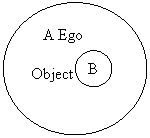
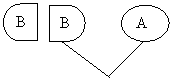
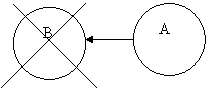
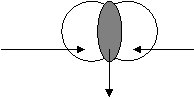

The k Factor
(k =
Katatonia in German; Catatonia in English)
(Achtnich:
Understanding, Reason, Logic, Need for intellectual clarity, Restriction,
Limitation, Objectivity, Reality)
[See
Susan Deri’s book, Szondi, Moser, and Webb’s book, and web sites for more
information.]
The k+ Factor
(k =
Catatonia)
The k plus is the introjective
function of the ego. Szondi calls this
the ego that has as its aim to have the valuable objects and knowledge of this
world. It is the material ego. This is the part of the self that
paradoxically wants to be emotionally detached from the objects of the world
but at the same time it wants to focus on the real world of valuable objects in
its concrete form. The k plus ego has an
ideal image of itself as Narcissus did of his mirror image in the pool. This image he loves, not the objects in the
world beyond the isolated glade. This
is the basis for one calling the k plus person egotistical, independent, and
emotionally detached [objective, ruled by reason and the intellect]. As the diagram on the circulation path of the
ego shows, the object of interest is included in the k plus ego. Therefore, whatever is of value in the
external material world—whether persons, possessions, or knowledge as perceived
by the k plus person—becomes a focus of interest and must be had. The k plus person has suffered the painful
separation from the mother, and thus the environment, and now must maintain
this separation in all relationships.
The artist in the stage of giving form
to his ideas generated by the p function is ruled by the k plus factor. The artist must be separated from the
material form—whether music, a painting, a sculpture, a poem, a novel—in order
to give it physical form. Form implies
order that is a primary concern to k plus.
Susan Deri states that the k plus person loves Mozart and Bach because
this kind of music is highly structured.
Logic guides the underlying emotions in the music.
Occupations
Satisfying the k Need
In the following, Achtnich tends to give
strong weight to the k minus in his list of functions, even though he presents
this as a positive version of the k factor:
Functions
of Factor V: Reason, Understanding, Thirst for Knowledge, and Sense of Reality
(k in
pure Szondi):
[1] to have exact perception and observation,
to be attentive, to be concentrated (taken for granted to be in all occupations
everywhere)
[2] to learn, to acquire knowledge (learners in
schools and places of instruction [This is mainly by introjection: k+.])
[3] to name [to make up nomenclatures], to
designate, to mark, to note down, to write (very many occupations everywhere,
predominately in offices and workshops and in graphic trades)
[4] to put in order, to divide, to register, to
classify (store supervisor, government worker, archivist, librarian, office
worker in offices, archives, government, record offices, stores, and libraries)
[5] to count, to calculate, to compute
(designer, bookkeeper, proofreader, auditor, cashier, salespersons and those in
technical occupations of management and administration, computer work, and
statistician)
[6] to measure, to survey, to estimate
(technical occupations and many handicraft occupations everywhere and in
particular in factories, building sites, and laboratories)
[7] to copy, to counterfeit, to translate
(occupations in offices, technical draughtsman, blueprint men everywhere)
[8] to follow instructions, to follow the letter
of the law, to observe the regulations, to follow the instructions, to be
reliable and trustworthy, to be accurate, to be diligent, to persevere, to have
endurance, to have regular work habits (most occupations everywhere [Also see
d-.]).
[9] to adapt accurately, to regulate, to
adjust, to make something fit in (precision technical occupations, for example,
precision engineer, clock and watch industries, optical work in factories)
[10] to put together, to erect (mechanic,
engineer, fitter, technical occupations in industries, administrators working
with apparatus and machines)
[11] to test, to examine, to control, to secure, to
compare (examiner, inspector, diagnostician, book expert, data-processing
expert, computer expert in places where inspections are carried out)
[12] to
correct, to improve (proofreader, teacher)
[13] to automate, to mechanize (technical
professions in industries, management working wit apparatus, machinery, and
robotic machines)
[14] to construct (technical design occupations,
designer, blueprint person, drawing person in design places working with
technical materials)
[15] to organize, to plan, to arrange, to manage,
to administer, to systemize (planer, dispatcher, manager, organizer, program
planner, government and civil service administrator or manager, religion
institution manager, leader in industry, government, and trade)
[16] to understand logical connections, to prove,
to abstract (theoretical, logical occupation activity, computer and data
processing work everywhere, using logic, theories, principles, systems,
evidence, and proof)
[17] to criticize, to judge, to examine critically
(critical observer, assessor, examiner, advisor, expert, diagnostician
everywhere)
[18] to explain, to inform, to instruct, to teach,
to bring always something forward to others (teacher, instructor everywhere and
in school with people and learners)
[19] to decide, to set oneself a goal (very many
occupations everywhere, using decision-making capability)
[20] to require order, to discipline, to give
orders, to give directions, to give assignments, to order based on facts, to
exercise competence, to exercise authority (occupation positions in which
instructions will be given and in which they will be followed as in countries,
industries, government, military, and trade for people, order, rules, laws for
countries to establish authority, compliance, and discipline)
The k- Factor
(k = Catatonia)
Whereas the k plus person is independent emotionally of the objects,
persons, and interests in his or her environment, the k minus person is ruled
by the environment and its representatives.
The model is the student who first enters school for the first
time. Before his wishes were dominant
for him. Now, he must conform to the
wishes of society as represented by the school authorities, the rules, and the
knowledge approved by his particular society.
Now, the person must repress his own desires—some not approved by his or
her own internal censor—and not approved by the environment. The k minus person takes on the approved
values and postures of his environment.
Laws, rules, conventional roles—all these become his guides. Repression, denial, and opposition to his or
her own imagination rule. Adapting to
the environment rules. As with the k
plus, separation still prevails as the k minus person keeps emotional distance
from his or her own inner feelings and the environment. Whatever prevails in the popular culture
rules. The k plus person follows his or
her own desires that easily conflict with the popular culture. The k plus person can be the artist, whereas
the k minus person could only follow a fixed formula for a work of any kind. The k minus person and creativity are not
very compatible. Ultimately, Szondi has
k minus as one of the basic component of the common man who steps mechanically
through life, following the march music prescribed by society.
Achtnich:
Interpretations for Negative k
Note: Although Achtnich is giving the
negative of k in general, in reality, most of the list of activities, or
functions, are k minus. Therefore, the
negative of k given here is a negative of k minus, which is the factor for
adaptation and repressing one’s own desires for the good of the society.
|
The denied factor |
the native, original factor need |
the defense directed against |
the working out of the defense is a reaction formation (doing the reverse of the original need) |
|
-V [k-] Reason, Common Sense |
be rational |
Adaptation, limitation, Compulsion |
not adaptable behavior, learning disturbances |
In the next table are the complete defense and the
reversion for the V [k] need opposite one another:
|
Minus Factor |
Complete defense |
Reversion |
|
-V [k-] |
There can be a turning away
from all technical and economics matters, all accurate-pedantic, and similar
forms of uniform rules. That indicates
a certain “compulsiveness” that is attached to each vocational activity that
is declined. Thus viewed, the denial
of V [reason, common sense] cause an inhibition concerning achievement, work
disturbances, and learning disturbances.
Also the denial of authority can show itself, for example, as
opposition or disorders by adolescents. Between masculine and
feminine V testees there is an essential difference: for feminine V testees
the denial of V is so to speak somewhat “normal” and belongs at the same time
to their “femininity.” These, still so
much for the better, feel also widely today to belong to a whole succession
of very typical and masculine “V-occupations.” |
One supports control
functions and regulating. One is
therefore ready to work accurately and exactly when this must be the
case. Opposition is not too
pronounced and is somewhat held back.
Anyway there is still a readiness to adapt and to be incorporated into
the general system. |
The k0 Factor
(k =
Catatonia)
In many ways,
the k factor is what is normally considered the ego. Szondi uses the name ego for all the
functions of the ego, but, in reality, the k factors and p factors comprise the
self since the ego is called the bridge of opposites. The p factors are closely allied to the Id
and emotions; the k factors are representatives of controls over the outward
expression of the Id’s desires and emotions.
Szondi calls the k factors systole, or constrictive, and the p factors
diastole, or expansive.
In this
context, the open, or zero, k signifies as one of its meanings: the absence of
the controlling factors of k. The
controls of the ego are absent. Susan
Deri, as usual, has explained the full meaning of the open k. She states that the zero k signifies primary
narcissism: a state that harkens back to the state where the baby has no
frustrations and thus immediate satisfaction of all its desires. This is the Garden of Eden state before the
fall. In this condition, there is no
object such as the mother since the presence of the mother only becomes
apparent when there is some frustration of the baby’s desires. The k factors only come into being when there
are frustration of desires and an object; in this case the mother is recognized. The k plus functions by introjecting the
image of the object in order to have the object always available, even when the
object is absent or is frustrating the baby.
The k minus works by repression to overcome frustrations.
Primary
narcissism is self-love and concern only for himself or herself and occurs when
there is no awareness or recognition of an external object. Once an object has been recognized because
of frustration and introjected [k plus] as an object to be loved, then
secondary narcissism arises. This new
object is a substitute for the original object.
Jacques Lacan, the psychoanalyst, calls this stage the mirror stage of
development. This is the situation where
Narcissus is in love with the mirror image of himself in the pool.
Susan
Deri then points out that subjects beyond the baby stage who give the open k
are infantile in character. Particularly
when open k is with p minus, these individuals give full reign to their needs
and express them in their environment and toward their objects. They do not expect to encounter frustrations
in their self-expression. When they do
meet opposition, they react violently like a baby in rage. They are not to be reasoned with, Susan Deri
states, because they are not receptive rationally [no k plus] to any arguments
that oppose their wishes; rather they just want to express what is in them and
not take anything from the outside.
These
are difficult people to deal with.
After
the k factor appears as loaded, the open k also signifies that the functions of
the k factor are being lived out or satisfied in some positive or negative
way.
The p Factor
(p =
paranoia)
(Achtnich:
Spirit, Intuition, Creative)
[See
Susan Deri’s book, Szondi, Moser, and Webb’s book, and web sites for more
information.]
The p+ Factor
(p =
paranoia)
Susan Deri
places the p factor on the side of passion and the
As
Szondi has stated, the p person wants to be everything and to be complete. In fact, the p plus person strives for
completeness and perfection. Susan Deri
points out that the p plus person is idealistic. The p plus person is strong on words. The pathoanalysis view as ably expressed by
Jean Mélon in his book on Szondi puts the p plus factor at the highest stage of
development, for p plus is related to language itself and comes late in one’s
development. Mélon calls the p plus person “The Thinker.” He likewise calls the k plus person “The
Maker.” Creativity comes from the p plus
and p minus side and is brought into reality by the k plus factor and submitted
to criticism by the k minus factor.
There
can be a grandiose side to the p plus person because when separating from the
mother, this person extracted power from the mother and became at once both:
the self and the mother as one.
Ultimately, the p plus person can fuse with all of humanity and
God. The boundaries between opposites
are overcome and all becomes one.
Occupations
Satisfying the p Need
Achtnich
in his listing of functions is drawing from what are classically both the p+
and the p- factors.
Functions
of Factor G: Spirit, Intuition, Idea, Imagination (p in pure Szondi):
[1] to meditate, to philosophize, to imagine,
to muse (philosopher, humanities or arts scholar, mystic, founder of religion
in college or school, using intelligence, insight, ideas, intuition,
meditation, illumination about the unknown, the unresearched, and the
unconscious, the world of religion, philosophy, metaphysics, mysticism, and the
occult [p minus is here too.])
[2] to see and to grasp intuitively connections
and relationships, to combine, to solve problems, to unriddle, to have psychological
understanding (psychologist, psychiatrist, careers’ advisor, history
researcher, archeologist, who works independent of place)
[3] to investigate, to interrogate, to spy out,
to be a detective, to sound out, to ferret out, to track down, to sniff out
(jurist, criminologist, prosecuting attorney, judge, detective, spy, auditor
[These are mainly p minus: to spy out things])
[4] to inquire, to explore, to find out, to
discover, to test, to detect and to seek the new and the unknown (researcher,
inventor, chemist, physicist, astronomer, research physician, pharmacist,
futurologist, inventor of machines, discoverer in a research lab, expedition,
and research areas in natural science and technical research, using the
independence and freedom of the intellect and spirit as requirement for
improvement, finding completeness and even genius)
[5] to design, to be creative, to write poetry,
to write music, to compose (artist, painter, sculpturer, composer, writer, film
director, fashion designer, couturière, creative architect in art studio, using
creative fantasy, imagination, images, representations, and symbols)
[6] to immerse oneself into something, to
empathize (conductor, musician, psychiatrist, criminologist, simultaneous
translator; psychiatrists and psychologists use intuition and readiness for
passive identification [Intuition is also p minus.])
[7] to spread ideas, to win influence, to act
as a missionary, to convince, to successfully launch new products (manager of salespersons,
product manager, politician, journalist, professor, missioner in commerce,
trade, and university, using power of persuasion and inflative thinking)
[8] to persuade, to talk a person into something, to convert, to
suggest, to hypnotize, to make promises, to awaken hopes (politician,
advertising expert, genius about selling things, and religious and social
renovator in mass meetings and in bargaining and negotiation, using power of
persuasion, suggestion, fascination, emotion, and magic [Magic is the k plus
factor.])
[9] to believe, to have a presentment, to
foresee, to anticipate (priest, theologian, preacher, sectarian, but also a
business expert in the church and revival places, using belief, premonition,
and expectation [This is really p minus as well. Also see the e factor for the religious
connection.])
The p- Factor
(p =
paranoia)
The p
minus factor appears first in the ego’s development and the p plus last. The model for p minus is the baby’s being one
and the same with the mother. Szondi
calls this participation as well as projection.
All this union is on an unconscious level. Later, after the baby has realized that there
is a separation from the mother and the environment, he or she longs for this
state of being one with the other.
Unlike the p plus person who has become aware consciously—particularly
through words—of some unconscious needs, the p minus person always is
unconscious of how he or she is living out his or her needs in the outer world
of the environment and people. Whereas
the p plus person has a grandiose view of self, the p minus person feels
inferior to the other and the environment unless there is a positive fusion
with another person, idea, or situation.
Then the p minus feels the power of the other person or idea. The p minus is constantly acting out his or
her needs in the surrounding world. The
p minus person has great intuition since the insights and ideas are coming from
the outside or inside without any logical and conscious processing by this
person’s intellect. Szondi puts
participation [the p minus function] at the heart of his views of the ego,
really the self. Ultimately, the p minus
can fuse, that is participate, with a higher power. The negative side of the p minus and also of
the p plus is the idea of persecution by the other. This is a negative participation, for the p
minus person is still in a union with the other, only in a negative one.
Susan Deri points out at that painters
and sculptors function with p minus since they do not verbally give expression
to their emotions as do writers [p plus people] who are more conscious of what
they are expressing.
Szondi indicates that the p minus is
the most common of all the ego factors and is, along with k minus, a chief
component of the average man. Both p
minus and k minus are tuned to the culture and follow its lead.
Achtnich:
Interpretations for Negative p
|
The
denied factor |
the
native, original factor
need |
the
defense directed against |
the working out of the
defense is a reaction formation |
|
-G [p-] Spirit, Intuition |
fantasy, the spirit given free reign |
Intellectuality |
Inferiority feelings, envy, blasé attitude |
In the next table are the complete defense
and the reversion for the G [p] need opposite one another:
|
Minus Factor |
Complete defense |
Reversion |
|
-G [p-] |
Denial of intellect
[spirit]—perhaps because one dashes along and therefore no talent is present.
One will strive for no higher occupations and positions, perhaps out of
resignation because of frequent failures.
One has no creative fantasies and no intellectual [spiritual] or
scientific research interests. One
strives more after objective-practical occupations in which all is
prescribed. |
A problematic situation:
inferiority feelings—yet one will however nevertheless aspire to higher
positions…The impulse to gather with “famous people” in order to grab
something for oneself from this celebrity. |
The p0 Factor
(p =
paranoia)
The p factors are allied with the Id in
that the drives wish to be lived out in the external world. However, this cannot freely occur unless the
k is a zero too. In this case the self-expression
and fusing with the persons, ideas, and things of the external world can occur.
Susan Deri points out that, in all
other cases, the k factors can cause the p factor to be zero. For example, if k minus is functioning, then the
desires to fuse with external objects and express the self’s innermost desires
will be repressed. Then, the values and
wishes of society will be the master. If
the k plus is active, then the objects, knowledge, and valuable things of the
external world will be internalized or become a focus of interest and of
having. In Freudian terms, the libido
that was directed toward objects in the external world—that which is involved
with the p factors—becomes directed internally and becomes ego libido, or narcissistic
libido as indicated by the k plus factor.
Although we are not generally
discussing the pathological aspects of the different factors, one must observe
with Susan Deri that a k plus and a k minus ego with an open p signify
compulsive phenomena. Therefore, the
energy and desires normally directed toward the external world are absorbed by
internal thought, rituals, and compulsions.
An intellectualization of the p factors’ emotions takes place.
Sixteen
Combinations for the Schizophrenic [Ego] Vector
[See Szondi, Moser, and Webb book for
detailed analyses.]
[Extract from L. Szondi, Experimental
Diagnostics of Drives, English translation by Gertrude Aull]
Sch1
= - 0 The mythical mystical contemplative ego
Sch 2
= + - The autistic ego, the recalcitrant ego
Sch 3
= - 0 The compulsive ego
Sch 4
= - + The anti-inflative ego fighting obsessiveness
Sch 5
= - - The drill ego
Sch 6
= + + The flooded ego, endangered ego
Sch 7
= + 0 The professional ego
Sch 8
= +/- 0 The unfaithful masculine ego
Sch 9
= +/- + The talented anxious ego
Sch 10 = +/- - The ego in
fight for freedom, escapist’s ego
Sch 11 = 0 + The
obsessive prophetic ego
Sch 12 = 0 +/- The deserted,
passive, feminine ego
Sch 13 = + +/- The deserted
ego introjecting the deserting object
Sch 14 = - +/- The jealous self-aggressive ego
Sch 15 = +/- +/- The integrative
ego, anticipating catastrophe
Sch 16 = 0 0 The
disintegrating ego, ego-transformation
Szondi: Transformation of the Apparent
Forms of Drive Factors:
Personality Vicissitudes Related to the
|
Drive Vectors |
Sch Schizophrenia/Ego Drive |
|
|
Drive Factors |
k (Catatonia) (German spells this word with “k”) Ego constriction, ego systole, adjustive (k-),
materialistic ego (k+) The function (k) refers to
the auxiliary “to have,” tends to delimit the Ego, and aims at separating
itself. It is the tendency to create
norms, to capitalize, to transform. The
(k) moves in the direction of a contraction in order to make the Ego free of
any dependence. |
p (Paranoia) Ego expansion, ego diastole, spiritual ego The function (p) refers to
the auxiliary “being,” with the register of the representations, the setting
in scene of its relations to the others. The (p) has the need that works in
the direction of the unbounded expanding of the Ego. |
|
Drives Related to: [Some of these ideas come
from pathoanalysis.] |
The Relationship to the “Self” (which implies a certain relationship to totality) For Szondi, the construction, not of the
whole ego, but of its essential core, depends on the whole of possible
relationships between the self on the one hand and the different modalities
of being (p) and having (k) on the other hand. Schizophrenia is in a way a model for
psychosis. Only schizophrenia attacks
the basis of the ego, or the self; the other psychoses reach that ego or that
self only by repercussion. They do not
have a place in the self if we express it this way. The Ego vector (Sch) is the central
authority; its theoretical elaboration is the keystone of the Szondi
architecture. It structures the other
vectors: it has as a function to elaborate the other impulses, to subject
them to its own processes and to transform them. It is the place of the defense mechanisms
in regard to the instinctual dangers represented by the other vectors but
also in regard to those that are its own. The reactions of the subject in this
vector testify to a tendency to “self-realization” (implement one’s self,
express one’s self). But this the Ego
takes position in relation to itself, in such way that it constitutes,
develops, and cultivates itself by the interaction with the outside. It is about the dimension of the
subject. It is the relation with
oneself which is posed; the style of the person in her/his “being in the
world,” and even her/his essential expression. The Sch vector is the dialectical one
between the extension of the conscience of the desires (p) and the
restrictive function of the (k) tendency; between the need for increasing the
Ego (p) and that of its contracting (k). |
|
|
Other Descriptions |
k+: tendency to autism,
egotism, egocentricity, narcissism, and introjection. k-: tendency to adjustment to the collective,
repression |
p+: tendency to
ego-expansion, to seize power, blame others (projection [p-]) tendency to spread
humanitarian ideals, spiritual values |
|
Phylogenetic, animalistic |
none |
none |
|
Freudian: Early
childhood-pregenital Partial drives |
Original narcissism First phase of introjection Buildup of the perceptive
world |
Original projection Dual union with the mother |
|
Psychic Characteristics |
aristocratic exclusivity eclectic [choose the best]
choice of friends system-making,
scheme-making, rigid formalism hard-headedness, sobriety,
rationalism scrupulous pedantry,
exactness, exemplary without humor, taciturn,
abruptness, phlegmatic, feelings cold,
calm; supersensitive, mimosa-like
sensitivity, obstinacy; inflexible, uncompromising incapable of debating both
sides inhibited narrow-mindedness, bigoted,
compulsive, automaton, affected manner omnipotence feeling, autism,
incapable of going into another (auto-psychic resonance): reserved immovable To have all |
a. p+: striving after greatness,
boaster, swagger, braggart creative, a doer, a maker,
constructor, designer ability to go into another (allo-psychic resonance) to know all psychic inflation [to be two
opposites at once: male and female, for example], obsessive irrationalism fanaticism, enthusiasm feelings of exultation ambitendency religious fanaticism To be all b. p-: prophetic-like behavior magic thinking occultism, spiritualism, sectarian |
|
I. Pathologic, extreme, and
negative manifestations: (a) Drive disorders |
1. Catatonia (katatonia
in German) 2. Schizoid neurosis 3. Compulsion neurosis 4. Conversion hysteria 5. Apathetic asthenic
neurasthenia |
1. Paranoia 2. Paranoid schizophrenia 3. Demential senilis
paranoides 4. Querulousness (paranoid
lawsuits) 5. Irritative neurasthenia 6. Paranoid megalomania 7. Paranoid homosexuality 8. Narcomania: morpheme,
opium, cocaine p-: Hebephrenia |
|
(b) Delinquency |
Vagrancy, being a hobo,
burglary, work shy, globe trotters, wanderers |
Political crimes expressive
of grandiose ideas p-: card player, defrauder,
swindler, social subversion, revolutionary in society |
|
(c) Suicide |
Self-starvation, being run
over by a train |
Poison, gun |
|
II. Physiologic, normal
socialized manifestations: (1) Drive symptoms |
1. Ego-constriction, self-sufficiency,
ego systole 2. Adjustive ego (k-) 3. Introjection,
materialistic ego (k+) 4. Object-ideal formation:
“I want to have this.” 5. The rational censor |
Ego expansion, Ego diastole 1. Ego promotion 2. Need to bring unconscious
impulses to awareness 3. Expansion of the
personality (power), spiritual self 4. Projection 5. Ego-ideal formation: “I
want to be this.” |
|
(2) Maturity, Adult |
Ego Systole Autism (a) Buildup of Possessed,
object-ideal Yes of will (k+) (b) Negation, renunciation, denial,
repression, No of will (k-) |
Ego diastole (a) Buildup of ego-ideal,
spiritual tendencies (p+) (b) Projection (p-) |
|
(3). (a) Socialization (b) Character |
(a) k+: Introversion egoism, egocentrism,
narcissism, autism, power-seeking, sobriety, temperance, dryness, dullness,
rule of understanding, love of form, love for logic, realism, rationalism,
monotony, order compulsion, pedantry, stubbornness, detachment, seclusion,
ritualism, compulsive, knowledge seeking, rationalism, pedantry (b) k-: denial impulse,
separation (or isolation) impulse, inclination to inhibition and repression;
destruction impulse, negativism |
(a) p+: Extroversion passion, ardor, vehemence,
worship impulse, adoration impulse, enthusiasm, reveling, obsession, partiality,
pathos feelings, rank feelings, position and status feelings, greed for
power, self-overestimation, greatness delusion, pride, conceit, arrogance,
rivalry impulse, superiority complex, arrogance, bigheadness, bumptiousness,
bossiness (b) p-: self under
evaluation, delusions of inferiority, self-tormenting, foresight, mistrust,
scape goat seeking, unforgetful, quarrel seeking, oversensitive, resentment,
accusation impulse, quarrelling impulse |
|
(4) Occupation, Professional
field: Paroxysmal occupation field |
Sch professions Schizoform
professional circle: k professions: catatonoid |
Sch professions Schizoform
professions circle: p profession: paranoid |
|
(a)Chief Drive Need |
Shut up oneself, ego contraction,
narcissism, egocentrism, autism, Have power |
Ego expansion, boasting,
psychic Inflation, creative, Being power |
|
(b) Chief sense, reality
perception |
Closing off of the sense
organs |
Smell, hearing |
|
(c) Professional object |
Reproductive and abstract
knowledges: logic, mathematics, physics, aesthetics, geography, grammar, etc. |
(a) pragmatic, analytic
knowledge: psychology, psychiatry, medicine, chemistry (b) music (c) mystism, mythology,
occultism |
|
(d) (1) Professional means
(2) professional activity |
(a) book (b) writing, reading |
Invasion of ideas, creative,
inspiration |
|
(e) Professional place or
location |
Enclosed spaces, classroom,
lecture hall, library, “ivory” tower, cloister, nature |
Research institute,
laboratory, chemical factory, exotic regions or places. The depth of the soul and
the earth, insane asylums, jails |
|
(f) occupation solutions:
Occupation, Professional field Socialization in a profession, occupation |
Soldier, bookkeeper,
telegrapher, surveyor, cartographer, watchman, accountant, post office clerk,
farmer, night watchman, light house watchman, book seller, printer, security guard, administrator, writer,
designer, pattern-drawer, machine draftsman, printer, forester, |
Builder, organizer,
druggist, pharmacist, chemist, detective, lawyer, counterspy, constructor |
|
III. Socially Positive
manifestations: Drive Symptoms Sublimation |
1. Adaptation to the
collective 2. Repression of autism,
egotism, egocentricity, narcissism Thinking skill, philosophy
metaphysics, aesthetics, logic, mathematics, socialized humanist, reasoning
processes in general, social humanist, philosophy based on intellectual
analysis |
1. Need to engender
humanitarian trends, as collective kindness, generosity, justice, restraint,
self-denial 2. To create and promote
humanitarian ideas 3. Collective spiritualistic
preoccupations Sublimation: poetry,
fiction, research, creative and spiritual humanist |
|
Occupations |
Teacher, professor for mathematics,
philosophy, national economics Art critic Engineer Professor, chiefly linguist,
or professor of logic, mathematics, physics, philosophy, social sciences Aesthetics, art historian |
(a.) inventor (b) poet, writer, author (c) psychologist, psychiatrist:
depth psychology, psychoanalysis (d) mythologist, mystic,
geology, paleontology (e) expeditions-leader,
missionary (f) musician, (g) druggist, chemist [k o p
-: paranoid belief that one is being poisoned] Hebephrenia: graphologer,
astrologer, chirologer. (hebephrenia involves repression of exhibition (hy-),
projection (p-) in the form of hypochondria [exhibiting symptoms of the
body], strong aggression (s+) among other symptoms) p-: (h) judge, examining judge, public
prosecutor, lawyer (i) detective, spy,
counterspy (j) nature-cure physician [follower of homeopathy] (k) specialist in
metaphysics, theosophy, Hinduism |
The Contact
Drive
IV. The Circular Vector, or Contact Vector that
is more useful. This indicates the
general area of the subject’s object relationships or, in other words, his or
her contact with reality.
(Circular comes from the Circular name
for Depressives and Maniacs)
[See
Susan Deri’s book Introduction to the Szondi Test: Theory and Practice
for greater details.]
d factor (pictures of depressed
patients) reflecting the possessive “anal” type of object relationship
m factor (pictures of manic patients)
indicating the clinging “oral” type of object relationship
The d Factor
(d =
depression)
(Achtnich:
Matter, Materiality)
(Achtnich:
Factor d comprises the “matter,” the substance, the concrete, the
comprehensible, the practical, the earth and the ground, the natural, the
relationship to animals, but also the relationship to all having value, to
possessions, gold, and property)
[See
Susan Deri’s book, Szondi, Moser, and Webb’s book, and web sites for more
information.]
The d+ Factor
(d =
depression)
Although
the d in d+ or d- factor stands for depression, the d factor concerns anality
as described by Sigmund Freud and his followers. The child considers faces as an object that
is possessed and controlled. From a
psychological viewpoint, therefore, materiality is related to anality: the
retention and disposal of faces, a material substance. Persons as objects are also viewed
psychologically as mental and material things.
With objects of any kind, the issue of getting and retaining of them
comes into question. Does one possess an
object—whether material or living being—or not?
What happens if one loses a valued object? Then, psychologically, one can become
depressed, for depression is intimately involved with the loss of the treasured
object. Susan Deri and Sigmund Freud
have covered the details of anality and its connection to depression, or
melancholia.
The
pictures of depressives are shown in the Szondi test. Those who react positively and identify with
these depressives are d plus. Jean Mélon
in his Course on Szondi (1998) [an English translation by Arthur C.
Johnston] clearly distinguishes the differences between the reactions to a loss
and depression over it for the d plus and d minus person. The d plus person fully identifies with the
pictures of depressives in the Szondi test and fully feels the distress of
grief much more than the d minus person.
But d plus says to his or herself: O.K., I’ve lost my beloved. This is terrible. But one cannot just do nothing. One must try to overcome one’s grief. How to do that? Get a substitute for the lost person. Typical of this is the man who loses his wife
and within months or a year has remarried.
The d plus person wants a concrete substitute for his loss. He or she faces reality. The motto is “Do something.”
Susan
Deri gives three attributes of the d plus’ reaction to objects. One is that there is a strong need for
concrete objects and that they are highly valued. Two is that the d plus person’s focus is on
external reality as the source for all material things. And three is that the d
plus person wishes actively to manipulate and to pursue objects. This last aspect, Deri points out shows the
link between s plus and d plus.
Sculpturers
and painters typically give the d plus reaction since they deal with physical
materials. An interest in money, the
classic symbol for faces, is of great interest to the d plus person.
Like the
epileptics, the d plus persons have an “adhesive” quality in their attachments
to objects and persons. Susan Deri
states that this leads to “a general possessiveness, tendency for rivalry, and
a persistence in reaching a goal that might even lead to obstinacy.” Overall, d plus and open d are the most
frequent reactions of the general population.
With a
constant desire for the new and for change, the d plus person does not have
much loyalty to a material object or person.
Jean Mélon sees as a result of these desires that the d plus person has
difficulty in attaching oneself really or for a long time. This also applies to a task or a job. Jean Mélon sums up the d plus character: “The
subject has no real attachment to the old object. He is always in the search for new objects,
new feelings, open for random encounters.
The contact is infantile, inconsistent and incontinent.” [This quotation
is an English translation by Leo Berlips of Jean Mélon’s work available on the
Szondi Forum web site under “Contact Profiles.”]
The d
plus person is strongly influenced in his or her character by the expulsion
stage of anality as described by Sigmund Freud and his followers. This d plus person enjoys anality, loves some
disorder, irregularity, and differences.
Occupations
Satisfying the d Need
Following are the functions, or
activities, given by Achtnich:
Functions
of Factor M: Material, Substance, Possessions, the Concrete
(d in
pure Szondi):
[1] to hold fast, to hold back, to seize, to grip, to lay hold, to
take into possession, to collect, to hoard, to preserve, to save, to acquire, to
want to have and to possess, to act as an archivist, to distribute and to
receive, to have to do with money (archivist, librarian, employee in a museum,
numismatist [coin expert], stamp dealer, specialties salesperson occupations,
bank specialist in mortgages, cashier, teller in bank, collector, card dealer,
manages savings accounts in a bank, collection agency, museum, archive,
library, a second-hand bookshop [antiquarian], a remainder department for
books, lost-and-found department [d minus is here too.])
[2] to mine, to dig, to do any activity involving dirty or filthy
things (farmer, gardener, earthworks maker, miner, road and construction
workers, geologist, civil engineer, construction-of-building engineer, using
hands [If something does involve using one’s hands, it does not make sense.])
[3] to clean, to polish, to wash off, to wash
up, to rinse, to clean up dirt, to weed (sewage worker, one cleaning up
chemical spills and pollutions, sanitation facilities installer, worker in
removal of natural wastes, snow plow person, worker in cleaning institutions
and manufacturing of cleaning materials, remover of dirt, excrement, filth,
manure, rubbish, garbage)
[4] to smear, to oil, to grease, to put salve
on something (garage-helper worker, physical therapist, beautician, cosmetician
in fabrication of oil and fats that are used in machines, massage parlors, mud
bath spas [See h plus also.])
[5] to mix, to stir up, to mix up (sausage,
soap, starch, and paper makers, workers in dairy, beer brewing, workers in canning
food, chocolate, and pastry factories, work involving thick, slow-moving
material, mush, semi-solid material, and dough)
[6] to pave streets, to asphalt streets
(plasterer, bricklayer, asphalt-layer, and worker on concrete machines at
construction sites, particularly civil engineering and road construction sites)
[7] to print, to press, to form, to knead
(sculpturer of stone, wood, and plastic, printer, worker with print presses and
pressure presses, pottery worker, pottery factories)
[8] to paste, to glue, to use as an enema, to
size, to fuse, to melt, to dissolve, to break up (different industry and
commerce workers, bookbinding and cardboard box makers in workshops and factories and in fabrication
of glue)
[9] to house paint, to paint over, to plaster
(plasterer, painter, auto-lacquerer at building sites and workshops, using plaster, colors, lacquer,
salt solution, and acid)
[10] to smell, to occupy oneself with disgusting
or nauseous generating things (tanner, dissection helper, skinner, animal lab
technician, chemist in chemical factory, perfume makers, working with decaying
materials: It does not disturb when it stinks.)
[11] to occupy oneself with animals (farmer,
animal preserver, animal guardian, zoo employee, pet shop owner, veterinarian, animal
researcher, pig breeder, chicken breeder, dog breeder)
[12] to
tan skins, to work with leather (tanner, leatherware worker, and shoe maker)
[13] to
milk, to curdle milk (dairy person, cheese maker, and milker)
[14] to
fertilize, to use dung or manure (farmer, agriculture technologist)
[15] to ferment, to press grapes, to press out as
with a wine press (maker of unfermented fruit juice, wine producer, wine
grower, employee in wine shop)
[16] to plant, to stick in the ground (gardener,
farmer, and tree- nursery employee)
[17] to
harvest, to gather, to collect (farmer)
[18] to accumulate, to store up, to pile up, to
stack up (store worker, waste materials dealer)
[19] to conserve, to restore (restorer of old
artworks, preserving-food factory worker)
[20] to repair, to patch, to mend, to fix (people
who have to do with restoring a condition or an object)
[21] to search out, to seek, to hunt out, to
ferret, to desire to avoid losses (the searching man, recycling occupations,
“treasure hunter”)
[22] to retain one’s thoughts and ideas, to remember things, to hang on
to the same ideas, to ponder, to muse (psychotherapist in quiet places, focused
on mental conflict and depression, using remembrance [This is mostly d-.])
[23] to not separate oneself from the past, the
situation, the work place; to seek the origin or source of things, to want to
return, to preserve tradition, to occupy oneself with the past, history, the
old, the valuable or precious things (classical philogist [linguist],
genealogist, ancestor research, archeology, earth research, geology, history
research, paleontologist [This is all d minus: looking to the past.])
[24] to concern oneself with the dead, the past,
decay, decomposition, putrefaction, to bury (undertaker, mortician, employee in
funeral parlor, anatomy, medical examiner medicine, employee in life insurance
agency)
[25] to do monotonous, uniform, patience demanding
unspiritual activities (worker in an assembly plant that uses a conveyor belt
and automation that produces lots of similar products and other monotonous kind
of work)
The d- Factor
(d = depression)
With the
Szondi test, one can reject the pictures of those severely depressed, and they
are the d minus persons. Jean Mélon has equally
described the reaction of the d minus person to a loss that results in
depression. When this person loses a
loved one or object, the immediate reaction is to hold on to the memory of the
person and to ruminate on this beloved person or object. One constantly looks to the past. The model for the loss is that of losing
one’s mother. The d minus person never
forgets the paradise of childhood. The d
minus person does not look for new objects. Jean Mélon states that the efforts
of another person to get close to the d minus person causes the d minus person
to perceive this new person as an intruder or even an enemy [“Contact
Profiles”]. As a result of a loss, the d
minus person creeps into bed—a symbol of the womb—and, metaphorically, stays
there is his or her sorrow. He or she
feels the grief, but at the same time denies the loss to avoid the pain of
loss. The d minus person cannot bear the
loss of his or beloved and remains loyal to the memory of this person and
cannot bear to make a change to something new.
In summary, the d minus person sticks to the old, whereas the d plus
person looks for the new.
Susan
Deri points out that a chief characteristic of the d minus person is that he or
she has strong attachment to one particular person or one particular idea,
whereas the d plus person wishes to possess many objects.
Retention
is the key word to describe the d minus person.
These persons wish to retain the old; thus, they are conservative. Unlike the d plus person who can easily
replace a valuable old object or person with something new, the d minus person
has such strong attachment to an object or person that has come into his or her
circle that this loss is experienced as extremely depressing. When this reaction is applied to a broader
area, the d minus persons become the guardians of the traditions and
conventions of the established order.
Although the d minus person likes to retain money once it is in his or
her possession, this person does not aggressively pursue money as does the d
plus person. When in love with a person,
an idea, or a project, the d minus person does not take into account reality:
they may love the person when there is no chance of this love being returned or
continue with a project even when it is impractical to pursue it. Retaining the love and feelings in a passive
way without aggressive pursuit of the person in a real way is sufficient for
the d minus person. This is the very
opposite of the d plus person who aggressively pursues his or her objects and
goals only when there is a promise of concrete results in a material
world. Another area where retention
applies is the d minus person’s desire to remain in the same place and to stay
in the same job if at all possible. The
d plus loves to change places, to be on the go, and to change jobs. The d minus person likes to retain energy in
a state of rest, whereas the d plus person likes movement.
The d minus person is the
one that ordinary people think about when they say “anal.” Sigmund Freud’s description of the anal
character is that of the retention stage of anality.
Achtnich:
Interpretations for Negative d
|
The denied factor |
the native, original factor need |
the defense directed against |
the working out of the defense is a reaction formation |
|
-M [d-] Material, Substance, Possessions, the Concrete |
need for the primitive material |
Anality |
orderliness, willful, obstinate, perfectionism |
In
the next table are the complete defense and the reversion for the p need
opposite one another:
|
Minus Factor |
Complete defense |
Reversion |
|
-M
[d-] |
One
turns away from all dirty or stinking work. Without
relationship to origin, ground, possessions, etc. Problematic
in capability for bonding relationships.
|
One
seeks work (so long as coupled with V [k+]) in hygiene, cleaning; one likes
being neat and being pedantic. Inquisitive
investigative behavior when coupled with factor G (p+). Eventually
also an indication of a depressive mood. |
The following chart summarizes the
main differences between the d- and d+ factors.
The d- and the d+ Factors
|
Contrasts between d- factor and d+ factor |
|
|
d- factor |
d+ factor |
|
Oriented
to the past |
Oriented
to the future |
|
The
real and imaginary mother |
The
substitute mother: the environment |
|
Imagination,
introversion |
Reality,
extraversion |
|
At
rest |
Active |
|
Conservatism |
Love
for the new |
|
Nostalgia
for the past |
Hunt
for the new |
|
No
change |
Desiring
change |
|
Stay
put |
Get
up and go |
|
Mull
over the past |
Look
to the future |
|
Focus
on the self, narcissism |
Focus
on possessing the other, a different kind of narcissism |
|
Loyalty
to objects |
Disloyalty
to objects |
|
Strong
attachment to one particular object |
Desire
to possess many objects |
|
Sentimental
love for objects; thus keeps them |
Realistic
evaluation of objects; thus, easily gets rid of them |
|
Preserves
collectibles |
Always
on the hunt for some new object for collection |
|
Remains
in the same place and job if possible |
Likes
to change jobs and places frequently |
|
Likes
rest |
Likes
movement |
|
Anal
#2: retention [Freud] |
Anal
#1: expulsion [Freud] |
|
Freud’s
description of the Anal Character: love for order, regularity, and sameness |
Freud:
the character enjoys anality, love for some disorder, irregularity, and
differences |
The d0 Factor
(d =
depression)
Again, Susan
Deri is an excellent source for analysis of the different factors and their
combinations. As always, the open, or
zero, reaction for a factor indicates that the need of the person is finding
some satisfaction whether in character, jobs, interests, relations, symptoms,
or other outlets of the need in its original form. In rare cases, the open reaction indicates
lack of power behind the need.
In the
case of open d, this person does not feel any insecurity about his attachments,
so there is no anxious holding onto them or pursuit of them. There is an indifference or even apathy
toward attachments. Whatever is
available is O.K. or whatever one’s attachment wants to do is also
acceptable. “C’est la vie” or whatever
happens, happens is the prevailing attitude.
If there are no great hindrances, this person’s casualness to material
and concrete objects and persons can allow intellectual or artistic pursuits as
Susan Deri states.
With the
dropping out of tension in the anal-type relationships, either of d minus or d
plus, then relationships based on the oral component of the contact drive
(factor m) comes to the fore. For
example, when open d combines with m plus factor—the constellation for a normal
and stable adult and very common—then the person lives in a stable and trustful
relationship with the object supporting him.
With this stable situation, this type of person can does not have the
worries of the anal types. Jean Mélon in
his works gives excellent overviews of all these matters.
The m Factor
(m =
mania)
(Achtnich:
Orality)
(Achtnich:
All that that stands in connection with the mouth: (1) sucking, drinking, eating, blowing [as
with a musical instrument], kissing and (2) speaking and communication needs)
[See
Susan Deri’s book, Szondi, Moser, and Webb’s book, and web sites for more
information.]
The m+ Factor
(m = mania)
At the
very beginning, Szondi connected the m factor to the Freudian concepts of
orality. Later, Szondi stressed the contact
aspects of both the d and m factors based on the writings of Imre Hermann, a
Hungarian psychoanalyst, who wrote about to cling and to let go [m factors] and
to hold onto or to go on the search for new objects [d factors].
The m
factor, as Susan Deri has pointed out, refers back to the very first period of
orality that is connected to the baby’s use of the mouth for sucking, contact,
and pleasure. If the baby is frustrated
during this period either because of some neglect by the mother and the situation
or because of the baby’s strong oral needs, then when an adult the person will
try to make up for this early frustration by trying to gain pleasure through
very direct oral means such as drinking, eating, and being involved with food
in some way. Martin Achtnich calls this
the Oral Nourishment [OR] factor. The
adult also attaches himself or herself to persons for pleasure in some oral
manner like talking or conversing and thus communicating with others in a social
manner. In this situation, the m plus
person clings to the other person or persons in a passive and dependent
way. Martin Achtnich calls this aspect
of the m plus factor the OR speaking and communication needs [In German the
word Rede means speaking; therefore OR].
The m
plus person is optimistic about having his or her need for pleasure and support
from persons and the environment itself.
The pictures of maniacs in the Szondi test are all excited and smiling
or laughing. This is a mild form of
mania, called hypomania. Susan Deri states
that this mild form of mania truly represents the state of the person who is
expecting to gain pleasure and support from everyone and the environment
itself. Ultimately, m plus is the glue
that holds society together. Most adults
have m plus; that means that there is some tension and desire for satisfaction
of this social need that motivates in a positive way people to be
together. That is why this m area is
also called the contact drive.
Reality
eventually sets in for the m plus person and the other person or environment
does not satisfy fully the oral needs. The ultimate fear for m plus is to lose
the emotional pleasure and support given by the other person or
environment. (The d plus fears the
actual physical loss of the other person.)
The m plus person does not have great tolerance for frustration. Despite
this, the m plus person is always hopeful that pleasure and support from those
to which he or she is clinging will be forthcoming. The m plus person in his or her mild version
of mania is restless and desires many objects as sources of pleasure and
support. What ordinarily we think of
mania is the exaggerated state of hyper- not hypo- mania that has entered into
the pathological.
Orality,
the m plus need, is, in many ways, the foundation of artistic endeavors and,
again, shows how beneficial this factor can be when used constructively.
Occupations
Satisfying the m Need
Achtnich organizes the orality factor
into two groups: (1) OR for speaking and communications [speech and language]
and ON for nourishment needs.
Factor
OR: Speaking and Communication Needs, Speech, Language
[1] to
joke, to chatter, to tell, to narrate (master of ceremonies, cabaret master of
ceremonies, fantastic or exaggerated story telling, using wit, humor, and
narration)
[2] to talk, to speak, to telephone, to report,
to lecture, to recite (reporter, politician, radio or TV speaker, telephone
speaker, concierge, speech teacher)
[3] to greet, to welcome, to make contact
(being in a partnership type of occupation, trade, salesperson, catering trade)
[4] to discuss, to negotiate, to sell
(salesperson, trader or negotiator, stockbroker, principal in a school,
headmaster or headmistress, senior consultant, using salesperson’s talk)
[5] to interpret, to translate (interpreter of
foreign language, translator at congresses and conferences, focused on
establishing understanding between partners)
[6] to sing, to play a wind instrument [one that
one must blow into], to sound (singer, wind instrumentalist)
[7] to communicate, to give information, to transmit, to make known,
to orient, to inform (giver of information, advisor, consultant, teacher,
journalist, and a communicator for the questioner, the student, the customer)
[8] to speak artistically, to recite, to disclaim (actor, reciter,
dramatist, and writer, using speech and language and articulation)
[1] to eat, to drink, to eat sweets
(nourishment materials and occupations concerned with drinks such as kitchens
and hotels)
[2] to test with taste buds, to sample food
(wine tester, coffee tester, fruit tea or infusion salesperson)
[3] to nourish, to feed, to give food and drink
(restaurant worker, service employee, barkeeper, bar server [Also see h+: to
server.])
[4] to
prepare food, to cook (cook, landlord, hotel owner and workers)
[5] to produce food or foot stuffs (baker,
pastry cook, maker of food and worker in food factory)
[6] to sell food or food stuffs (food
salespersons, railroad steward or stewardess [Also see h+: to server.])
The m- Factor
(m =
mania)
We enter a different world from the m
plus when we encounter m minus. Whereas,
the m plus tries to make up for his unhappy experiences and lack of pleasure
and support, in his or her mind at least, by optimistically looking for
happiness in his or her relations to persons and the environment, the m minus,
who had the same frustrations in the early oral period as the m plus, denies
that this occurred and refuses to be dependent on others. This is the peak of independence but also a
source of feelings of unhappiness no matter how well things appear to go. Susan Deri discuses this thoroughly.
The m minus can go in a positive or
destructive direction. On the positive
side, the m minus person can be socially positive by being a supporter of
someone in a bad situation as a mother would be for a child in bad
circumstances. However, the minus person
expects that the one helped will return love in return. This does not always happen. And the m minus person has a high tolerance
for frustration and basically a pessimistic outlook toward obtaining pleasure
and love from others and the environment.
On the negative side, m minus can appear in those—such as juvenile
delinquents and other criminals and anti-social people—who experienced
frustration in the early oral period and now take out their revenge through
destructive ways on people and the environment.
These m minus persons have given up on any hope of getting oral
pleasures and support from people around them.
Achtnich: Interpretations
for Negative m
|
The denied factor |
the native, original factor need |
the defense directed against |
the working out of the defense is a reaction formation |
|
-O [m-]Orality -OR [m-] Speaking, communication |
language, speaking, contact needs |
contact readiness, pleasure in speaking |
inhibition in speaking, contact inhibition |
|
-ON [m-] Nourishment |
nourishment impulse |
nourishment needs |
hater-of-life attitude, emaciation [anorexia], disturbances in digestive track |
In the next table are the complete defense and the
reversion for the m need opposite one another:
|
Minus Factor |
Complete defense |
Reversion |
|
-O [m-] |
Absent in the testee are friendliness
and the wish for social contact. One will not work under people and seeks
occupations in which one works all alone.
When ON [m+] is denied strongly, there exists eventually the danger in
the direction of alcoholism similar to the one who avoids such occupations in
which these dangers are hidden. |
The picture with o as a
secondary factor always shows the needs for speaking and contact with
others. Thus these directions are sought
and affirmed. Here the difference between a picture with O [primary factor]
and o [secondary factor] can be clarified. [Note: Every picture in the
Achtnich’s Occupation test has a primary and a secondary factor.] |
The m0 Factor
(m =
mania)
Whenever
there is a zero or no more than one plus or one minus—an open reaction—for a
factor that means that the need of the factor is being satisfied in some manner
whether in its original native form—in this case orality—or in an occupation, a
choice of some kind, a symptom, an interest, and other ways both positive and
negative.
Susan
Deri emphasizes that there is an exaggeration here. Unlike m plus that wishes to cling and to
derive pleasure from one person or activity, the open m goes to the extreme of
having as many persons and activities as possible. There’s a frenetic quality of rushing from
one person to another. On the outside,
this open m person is charming, a bon vivant, a party-type person, a seeker
after pleasures to fill up every moment. Relationships are shallow. Gamblers would be the ones who challenge fate
and can’t stop from playing.
Susan Deri notes that the open m can be found
in writers, public speakers, and actors.
But one cannot determine by the open m exactly how the oral behavior
will manifest itself.
The
aggressiveness of this open m person in pursuit of pleasure and support derives
from the second oral stage called the sadistic-oral or cannibalistic
stage.
Susan
Deri has an excellent summary chart on the differences between the d factor and
the m factor relationships and attribute [Introduction to the Szondi Test:
Theory and Practice, 1949, p. 135]:
|
(m) factor ORALITY |
(d) factor ANALITY |
|
Objects
wanted for the pleasure to be derived from them; for the support they can
give, for clinging to them. |
Objects wanted for the sake of owning them; to accumulate
them and to control them. |
|
Essentially
passive relation to the object. Related to the h factorial object
relationship. |
Active manipulative relation
to the object. Related to the s factorial object relationship. |
|
Impatience
and restlessness in regard to reaching a goal object. |
Perseverance and
persistence in regard to reaching a goal. |
|
Ability to give love and emotional support to the love
object (through identification with the giving mother and through
identification with the person who needs love and support). |
Tendency to overwhelm love object with material gifts. |
|
More possibility
for sublimation without resorting to the defense mechanism of reaction formation
(no exaggerated. anticathexis needed in sublimating oral impulses). |
More need for resorting to
reaction‑formation in order to overcome the originally aggressive
attitude toward objects; hence, the compulsive quality of "anal"
type of love. |
Sixteen
Combinations for the Contact Vector
[See Szondi, Moser, and Webb book for
detailed analyses.]
[Extract from L. Szondi, Experimental
Diagnostics of Drives, English translation by Gertrude Aull]
C1
= 0 0 Childish, pleasure-seeking
relationship to the world; curiosity
C2
= 0 + Mature relationship to the world;
fear of loss of the object
C3
= 0 - Unhappy ties to the world;
hypomanic reaction
C4
= 0 +/- Unhappy state of living in a
dual-union relationship
C5
= - 0 Conservatism, loyalty, anal
character
C6
= - + Incestuous love and hatred,
extreme adherence to an idea
C7
= - - Unrealistic adherence to a lost
object
C8
= - +/- Incestuous adherence to the lost
object
C 9
= + 0 Unfaithful relationship
C10 = +
+ Simultaneous ties to two
objects; bi-objectivity
C11 = +
+/- Search for a new object after
loss of the old; depression
C12 = +
- Search for a new object
after separation from the old
C13 = +/-
0 Problematic, phobic tie
C14 = +/- + Bi-objectivity,
search for a new object in spite of adherence
to the old
C15 = +/- - Unrealistic
adherence to the old object, simultaneous search
for
a new object
C16 = +/-
+/- Contact dilemmas, simultaneous
loyalty and disloyalty
Szondi: Transformation of the Apparent
Forms of Drive Factors:
Personality Vicissitudes Related to the
|
Drive Vectors |
C Contact (or Circular) Drive |
|
|
Drive Factors |
d (Depression) Need to appropriate, to search (Anal) The factor (d) poses the
question of preserving what one possesses (d-) or to move towards another
object (d). |
m (Mania) Need to cling dependently (Oral) The factor (m) shows how the
subject reacts to the need to cling to the objects, to withdraw pleasure and
support from it. |
|
Drives Related to: [Lots of these ideas are
from pathoanalysis.] |
The Relationship to the “Other” in so far as it
passes through the mediation of the lost object Szondi thinks that all psyche, all
human subjectivity, is formed starting from a more or less mythical or
imaginary phase where the subject because of his initial imbecility and total
ignorance finds himself at one with the person who feeds him; at this stage
this person can only be another being for us only. This is a Dual-Union. [k0 p-] When one has separated from the ancient
dual partner, one will meet this partner as an object. But there is always the longing for the
mythical union. Separation from the dual union is always
felt as a loss and a rejection. Object
love will always be marked by uncertainty and precariousness because he has
to recognize the limits to this love, whereas there were no limits in the
dual union love. The contact (or Circular) vector
reflects the way in which a subject stands in the world, how he maintains
himself, without being carried away by the sensations that he
experiences. It is the insertion of
the individual into his surroundings.
It is the relation with the others that is at stake. It indicates the relation of the individual
to the world. It concerns the quality
of the relation: oral (m) or anal (d). It is the vector of environment,
sensations (mood) in connection with the world around. |
|
|
Other Descriptions |
d+: tendency to acquisition
to the disadvantage of others, search for new objects, disloyalty d-: tendency to self-denial for the sake of all
people, loyalty, anality (anal erotic, retention). |
m+: tendency to cling to the
old object (thing, person); orality, hedonism. m-: tendency to separate, to
loneliness |
|
Phylogenetic, animalistic |
To go on a search after
nourishing love objects |
Clinging to the mother, onto
the tree, etc. |
|
Freudian: Early
childhood-pregenital Partial drives |
Anality Anal erotic |
Orality Oral erotic |
|
Psychic Characteristics |
anxious, resentment, ill
feeling, constant pessimism anxious clinging to anyone complaining with varied
defenses of situation disdain for life thinking of death unfit or incapable in
action, decision, resolutions and work inhibited, holding back scrupulousness, formal,
fussy, complicatedness, self-disparagement,
readiness to weep, sentimentality holding onto old objects constant deploring about
objects and valuables, which have been lost in reality or in pathological fantasy endless complaining unproductive, incapable to
discuss things, renouncing oneself and the world almost stiff, nearly anxious
lamentations narrow-mindedness rising conscientious, self-critic,
self-accusation, self-torment Anality: constipation, not
eating, not speaking, saving, economical, greed, constant readiness to
criticize |
carefree cheerfulness,
constant optimism, good-heartedness, warm humanity fraternization, small town
worldliness, enjoyment many activities, varied
events close to life, enjoyment of
life hedonism constantly seeking after new
sources of enjoyment energy, great work and life
capability desire for undertakings good reality sense, realism,
materialism ease in acquiring money frivolity, carelessness,
squandering money, making debts, bearing of life’s problems with lightness
and good humor exaggerated freeness and not
being bound in object relationships: ease, facility, weakness inconsistency, inconsiderate,
instinctuality, irrationalism, unsteadiness good nature, sense of humor,
facetiousness, readiness to laugh talkativeness, gift for
speaking ability to convince,
readiness to debate, hastiness, quick anger with quick fading versatility unrest broad-mindedness constantly making plans,
riches to fall into, freedom from remorse lack of self-criticism irresponsibility being religious without
holding to form or rituals Orality: eating, drinking,
sucking on candies, smoking, readiness to use tongue, kissing, eventually
oral sexuality |
|
I. Pathologic, extreme, and
negative manifestations: (a) Drive disorders |
1. Depression 2. Melancholia 3. Agitated depressive
neurasthenia 4. unsteadiness 5. Fetishism 6. simple out-of-humor neuroses,
depressive cycloid 7. Disposition to diabetes A simple mixed form:
catatonia form of melancholia Manic-depressive psychoses:
changing manic and depressive conditions Mixed form of paranoid
quarrelling depressions, mostly with senile ill-feeling (resentment),
suspicion, anxiety about going to ruin |
1. Mania, 2. Hypomania, simply being
happy, euphoria 3. Agitated hypomanic
neurasthenia 4. Alcoholism, addiction 5. Nymphomania, satyriasis 6. Predisposition to
diabetes, bladder illnesses, formation
of stones (gall or hard stones, etc) A frequent form of illness
is inflative paranoid mania |
|
(b) Delinquency |
Violations against property,
theft (mostly within the family as compensation for the lost love),
instability |
Swindling, fraud, bigamy,
dipsomania, imposter |
|
(c) Suicide |
Sedatives (drugs) |
Alcohol poisoning |
|
II. Physiologic, normal
socialized manifestations: (1) Drive symptoms |
1. Searching for objects
(d+) 2. Acquisitiveness 3. Appropriateness 4. Rivalry 5. Anal tendencies |
1. Clinging to a specific
person, family, religion, social group, race, nation 2. Oral tendencies 3. Close adherence to
acquired objects |
|
(2) Maturity, Adult |
(a) Acquisition impulse,
changing impulse (d+) (b) impulse to cling, perservence
tendency, collecting need (d-) |
a) making safe impulse for
the acquired object: orality; impulse, thus, to accept and to be confirmed as
one is (m+) (b) separation impulse (m-) |
|
(3). (a) Socialization (b) Character |
(a) d+: acquisition sense,
eternal seeking, inquisitive, curious, innovation seeking, untrue, disloyal,
pleasure in squandering, wasting, liberality, generosity, immoderate,
extravagant, unsteadiness (b) d-: true, loyal, faithfulness,
pleasure in saving and collecting, covetousness, avarice, stinginess,
remuneration joy, conservatism, pleasure in criticizing, melancholy,
perseverance impulse |
(a) m+: clinging impulse, security impulse,
enjoyment pleasure, pleasure impulse, serenity, cheerfulness, good nature,
capriciousness, anxiety about losing the object (b) m-: loneliness,
separation or isolated, deserted, neglected, hasty, snatching, unreal binding
to the world, inclination to addiction, unsteadiness, grab everything and
pleasure since one sees no value in anything (mania) |
|
(4) Occupation, Professional
field: Paroxysmal occupation field |
Contact professions,
Depression professions (Anal) |
Contact professions, Mania
professions (Oral) |
|
(a)Chief Drive Need |
Object and value or worth
seeking Hanging on to the collected
objects |
Object need. Clinging and
seeking objects and respectively throwing them away. |
|
(b) Chief sense, reality
perception |
Smell |
taste |
|
(c) Professional object |
(a) real worth: gold, money,
art treasures (b) literature and art works (c) entrails, bowels |
Everything that can be the
source of oral pleasure |
|
(d) (1) Professional means
(2) professional activity |
To collect, to gather one
after the other, to dress, to attire, to ornament, to preserve |
(a) speech organ: movement
of the mouth and tongue (b) color mixing , costs
(expenses, charges) |
|
(e) Professional place or
location |
(a) bank, theatre office,
antique dealing, antique shop, museum (b) water closet, bathroom,
sewer |
Public house , inn,
restaurant, bar |
|
(f) occupation solutions:
Occupation, Professional field Socialization in a profession, occupation |
painter, house-painter banker, pawn-broker, lender
employee refuge collector, garbage
collector, street sweeper, toilet cleaner, bowels and leather worker chemist purifier journalist collectors: stamp collector,
antique collector, magazines, market, pawnshop dealer auctioneer,
dry-cleaner, painter, exterminator, furrier |
Cook, innkeeper, coffee house
employee, bar tender mixer, wine taster Music: horn instruments,
jazz Film, music school, concert
office supervisor Waiter, bartender, cook, jazz band, musician, buyer, linguist, speech teacher,
linguist, salesman landlord Broker, salesman, purchaser |
|
III. Socially Positive
manifestations: Drive Symptoms Sublimation |
1. Self-denial for the sake
of the common good 2. Loyalty National economy, economic
humanist |
Separation from a specific person,
family, religion, social group, race, or nation for the sake of the common
good Sublimation: Speech arts and
Art in general |
|
Occupations |
as physician: bowels
specialist, Art dealer, critic antique dealer, museum
employee, art collector painter of pictures |
Politician, orator, artist,
speech teacher, dentist, dental surgeon Money-making: banker,
stockbroker, director of firms and businesses, entrepreneur Representative in
parliament, union representative, delegate Artistic activities: singer,
organizer of art exhibits, art dealer, leader of a concert bureau, director
of a music school, lyric poet, etc. |
Resources
English
Works:
Deri, Susan, Introduction to the
Szondi Test: Theory and Practice, 1949 [Deri was a Szondi worker and has
excellent interpretations of his test.]
Hughes, Albert E., Your Fate in Your
Handwriting: How to analyze yourself, 1978 [This books gives graphological
and descriptions of the eight factors of Szondi.]
Hughes, Richard A., Cain’s Lament: A
Christian Moral Psychology, 2001 [Has some good material on Szondi’s
thinking but not as good as the Ancestor book.]
—, Return of the Ancestor, 1992
[This gives a good survey of Szondi’s thinking without being too
technical. A scholarly approach.]
—, The Radiant Shock of Death,
1995 [This explores the connection between the paroxysmal experience and
paranoia to death, using the ideas of Szondi. Excellent exploration and very
readable.]
Johnston, Arthur C., Szondi Test:
Its Interpretation and Graphological Indicators, [self-published], 2006
—, Talk on Shame and Shamelessness,
[This is a talk I gave several years ago.
It is an exposition of the Szondi hy+ (shamelessness) and hy- (shame)
factors. Léon Wurmser, whom I used a lot, was a follower of Szondi and wrote
about criminals and their traits shown by the Szondi test.]
Kenmo, Rolf, Let the personality
bloom: A blue thread towards life balance in your living space…, 2005
[Kenmo presents Szondi’s and Achtnich’s ideas in an easy to understand form,
using names like Power for Sadism and Relations for Homosexuality. He has applied Szondi’s ideas to one’s
personal development and occupations.
The book is for sale by him for $50 and his tests start at $150 and drop
to $50 for additional tests, all available on his internet sites: www.humanguide.se and info@humankonsult.se. His book is
translated into several languages]
Mélon, Jean, Course on Szondi,
1998 (translated from French to English by Arthur C. Johnston, 2005) [This is
an excellent book on Szondi’s ideas in depth. Mélon represents pathoanalysis, a
combination of psychoanalysis and Szondi’s ideas without any use of his gene
theory. Available on The Szondi Forum: http://www.szondiforum.org.]
Schneider, Carl D., Shame, Exposure,
and Privacy, 1977 [Another book on hy+ and hy-.]
Sonnemann, Ulrich , Handwriting
Analysis As a Psychodiagnostic Tool, 1964 [The best interpretations of
Ludwig Klages’ work in English. This is
an excellent book in every way except its readability.]
Szondi, Leopold, Experimental
Diagnostics of Drives, translated by Gertrude Aull, 1952 [Some charts used
in the talk came from this translated work.]
Szondi, Lipot; Moser, Ulrich; Webb,
Marvin W., The Szondi Test in Diagnosis, Prognosis and Treatment, 1959
[A technical discussion of the Szondi test.]
Tulloch, Alex, Szondi’s Theory of
Personality in Handwriting, 1994 [ISBN 0913700 1] [This book literally
translated sections from the two French books Graphologie et Test de Szondi.
Well-done overall.]
Wurmser, Léon, The Mask of Shame,
1981 [This explores the hy+ and hy- factors without mentioning them.]
Foreign
Works:
Achtnich, Martin, Der
Berufsbilder-Test [Occupations Pictures-Test], 1979, Hans Huber
[Excellent for real insights into Szondi’s ideas as applied to occupations.
Translations into English by Arthur C. Johnston are included in this present
work.]
Beeli, Armin, Psychotherapie-Prognose
mit Hilfe der “Experimentellen Triebdiagnostik”, 1965, Verlag Hans Huber
Grämiger, Ines, Lehrbuch der
Schicksalspskychologischen: Graphologie, 2001 [self-published] [This book
applies Szondi’s ideas to the whole (Gestalt) and the particulars of
handwriting.]
Lefebure, Fanchette, Gille-Maisani,
Jean-Charles, Graphologie et Test de Szondi: Tomb 1: le Moi, 3rd ed.,
1990; Tomb 2: dynamique des pulsions, 2nd ed., 1990]; [The authors gave
the Szondi test to hundreds of people and obtained writing samples at the same
time to find the graphological indicators of the Szondi factors.]
Schneider, E., Der Szondi-Versuch,
1952, Verlag Hans Huber
Szondi, Leopold, Die
Triebentmischten, 1980, Verlag Hans Huber
—, Freiheit und Zwang im Schicksal
des Einzelnen, 2nd ed., 1977, Verlag Hans Huber
—, Kain Gestalten des Bosen,
1969, Verlag Hans Huber
—, Lehrbuch der Experimentellen
Triebdiagnostik, Band I, 1972, Verlag Hans Huber [Up-to-date information
from this book was translated and given in the charts on the four vectors.]
—, Moses Antwort auf Kain, 1973,
Verlag Hans Huber
—, Schicksalsanalyse: Wahl in Lieb,
Freudschaft, Beruf, Krankheit und Tod, 3rd ed., 1965, Schwabe & Co.
[Lots of information given in the charts on the four vectors were translated by
Arthur C. Johnston from this book.]
—, Schicksalsanalytische Therapie,
1963, Verlag Hans Huber
—, Szondi-Test: Experimentelle
Triebdiagnostik, Test Band, Verlag Hans Huber, 1981
—, Triebpathologie: Elemente der
Exakten Triebpsychologie und Triebpsychiatrie, 1952, Verlag Hans Huber
World
Wide Web Addresses:
Szondi Institute: http://www.szondi.ch/
[This is the official site for the Szondi Institute.]
Web site
for all kinds of articles and information on Szondi and his test: http://www.szondiforum.org. This site is edited by Leo Berlips, a
long-time supporter of Szondi’s and his followers’ ideas and works. [Click on Articles (Foreign Languages and
English) for abundant information on Szondi and his test. Particularly get Ego Vector 2, 3, 4. This
site is now putting up Susan Deri’s work and English translations of important
French and German authors in English.
This is the place to go on the Web.
http:// home.tiscali.be/vuc-roma is the web
site of pathoanalysis and has many valuable articles and information on Szondi
and psychoanalysis. This site is opening
new possibilities for Szondi’s ideas with the exclusion of those on the gene
theory.